Pascal, Fermat and the unfinished game: how probability began
In 1654, how to split the stakes of an interrupted game set two French mathematicians writing letters all summer, and taught us to calculate with the future.
Mục lục
The interrupted game
Two players play a simple game: toss a coin, and whoever first wins three rounds takes all the stakes. Each has put in 32 pistoles, 64 in total. The first player has won two rounds, the second one. Just then, something urgent comes up and the game must stop.
How should the 64 pistoles be split fairly?
Splitting in half feels unfair to the leader: he is only one round from victory. Giving everything to the leader, the other player objects: he might have come back. Splitting by the score, 2 : 1, so the leader gets about 43 pistoles, sounds reasonable, but turns out to be wrong too.
This puzzle is called the problem of points. It troubled European mathematicians for nearly two centuries. Then, in the summer of 1654, two Frenchmen solved it in a series of handwritten letters: Blaise Pascal in Paris and Pierre de Fermat in Toulouse. In solving it, they laid the foundation of a whole new branch of mathematics: probability theory.
This is the first article in a series on mathematicians. Each one tells the story of one person and one moment: a specific problem, how they thought about it, and where that idea lives in everyday life today. By the end you will see the right way to split the 64 pistoles, and why that answer is still used whenever a sports competition is stopped halfway.
A two-hundred-year-old puzzle
The problem of points was not Pascal’s invention. It had appeared in arithmetic books since the Renaissance.
In 1494, the Italian friar Luca Pacioli printed a large mathematics textbook, Summa de arithmetica. It contained an example: two teams play a ball game, the first to 60 points wins, but the game stops halfway. Pacioli proposed a rule that sounds very natural: split the money in proportion to the points each side has[3].
More than half a century later, the mathematician Niccolò Tartaglia pointed out an absurdity in this rule. Suppose the game stops after exactly one point has been scored. By Pacioli’s rule, the team with that point takes all the money, even though the game still had a long way to go and a one-point lead says very little. Tartaglia tried another approach, based on the size of the lead relative to the length of the game. But he himself did not believe the problem had a solution both sides would find fair. He wrote that however you split it, someone would go to court[3].
Every solution before 1654 shared the same flaw: it looked only at the past, the rounds each side had already won. Pascal and Fermat’s secret was to look the other way.
Two men who never met
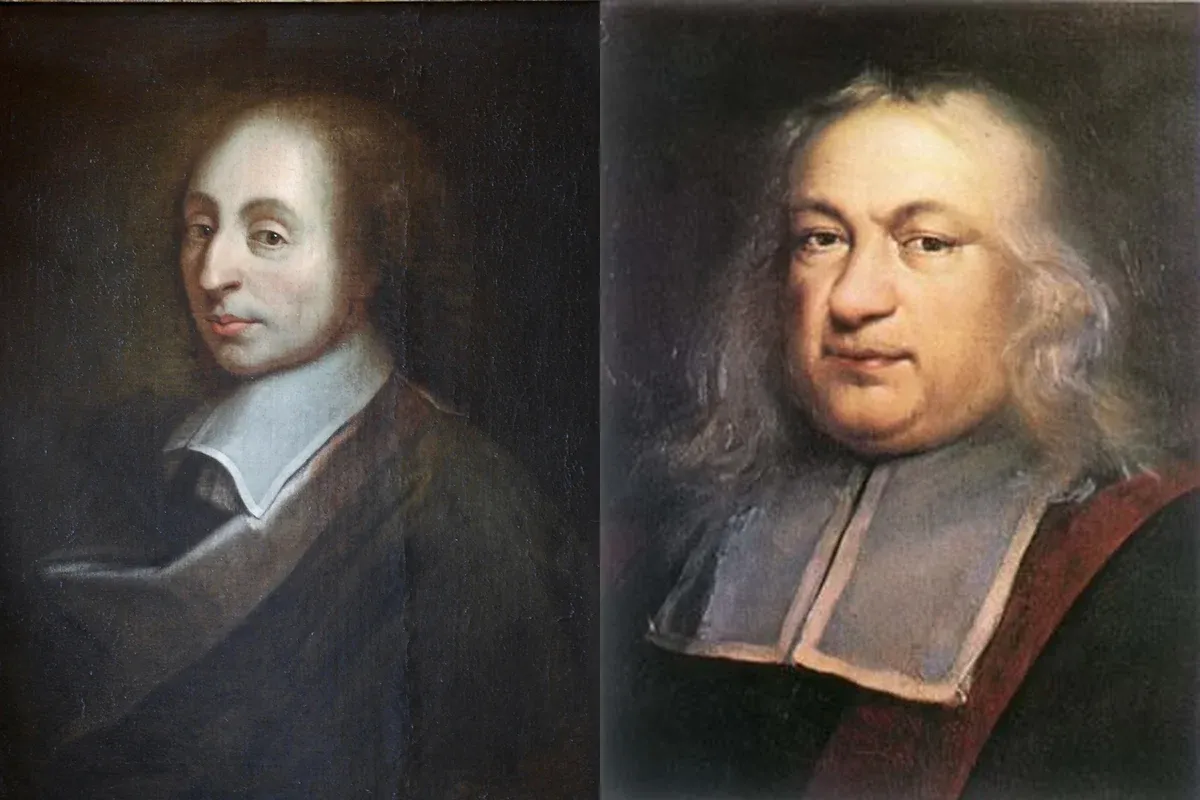
In 1654 Blaise Pascal was 31 and long famous. At 16 he wrote a treatise on geometry that caught the attention of the great mathematicians of Paris. At 19 he built a geared adding machine to help his father with tax calculations, later called the Pascaline, one of the first mechanical calculators.
Pierre de Fermat was entirely different. He was a lawyer, a magistrate at the high court of Toulouse, who did mathematics as a pastime. He published almost nothing. Most of what posterity knows of Fermat’s mathematics comes from letters and notes in the margins of books, including the famous one about a “marvelous proof” that the margin was too narrow to contain.
The two never met. Their story lies entirely in the letters passed between Paris and Toulouse that summer. Some are lost, but those that remain are enough to see how they thought[1].
The spark was Antoine Gombaud, a writer and gambler in Parisian high society, usually known as the Chevalier de Méré. He brought Pascal two gambling puzzles. The first was the problem of points. The second was a dice paradox that kept making him lose.
De Méré’s dice paradox
De Méré knew from experience that betting “in four rolls of one die, at least one six will come up” was a winning bet. He reasoned further: with two dice, a “double six” is 6 times less likely, so rolling 6 times as often, that is 24 times, should make the bet just as profitable.
Yet he kept losing.
Let’s count. The chance of not rolling a six in one roll is . Four rolls in a row with no six has chance . So the chance of at least one six is about 51.8%, a little more than half. A winning bet indeed.
With two dice, the chance of not rolling a double six in one roll is . Twenty-four rolls with none has chance . So the chance of at least one double six is only about 49.1%, below half. A losing bet.
The intuition “6 times less likely, so roll 6 times as often” is wrong, because chances do not add up that way. For the double-six bet to win, you need 25 rolls. That a gambler could sense a difference of less than 3 percentage points over many games is impressive in itself.
But it was the first puzzle that made history.
Fermat: count every possible future
Back to the game stopped at 2–1, playing to 3.
Fermat reasoned like this. The game is certain to end within at most two more rounds. So imagine both rounds being played, even if the first one already decides the winner. Two coin tosses have four outcomes, all equally likely:
| Round 4 | Round 5 | Overall winner |
|---|---|---|
| A | A | A |
| A | B | A |
| B | A | A |
| B | B | B |
The leader (A) wins in three out of four possible futures. So A should get three quarters of the money: 48 pistoles. The other player gets 16 pistoles.
This reasoning contains a bold leap: counting rounds that “don’t need to be played”. In the A–A future, the game is actually over after round 4; round 5 is superfluous. Adding that superfluous round doesn’t change who wins, but it turns every future into equally likely outcomes, so all you have to do is count. At first Pascal himself doubted this step, especially with three players. Fermat convinced him.
Pascal: work backwards from the finish
Pascal found a different route, and in the long run it mattered even more. In a letter dated 29 July 1654, he solved exactly this example by working backwards from the end of the game[1].
Suppose the next round is played:
- If A wins, the score becomes 3–1, A wins the game and takes all 64 pistoles.
- If B wins, the score becomes 2–2, the two are completely even, so each deserves 32 pistoles.
A is sure to get at least 32 pistoles whatever happens in the next round. For the remaining 32, the two have equal chances, so split it: 16 each. So A gets pistoles and B gets 16. The same answer as Fermat.
Put briefly: A’s share in each situation is the average of A’s shares in the two situations that can come next. Let be the share A should get when A still needs rounds and B still needs rounds. Then:
with (A has won) and (B has won). From those two “finish lines”, you can work backwards to any score.
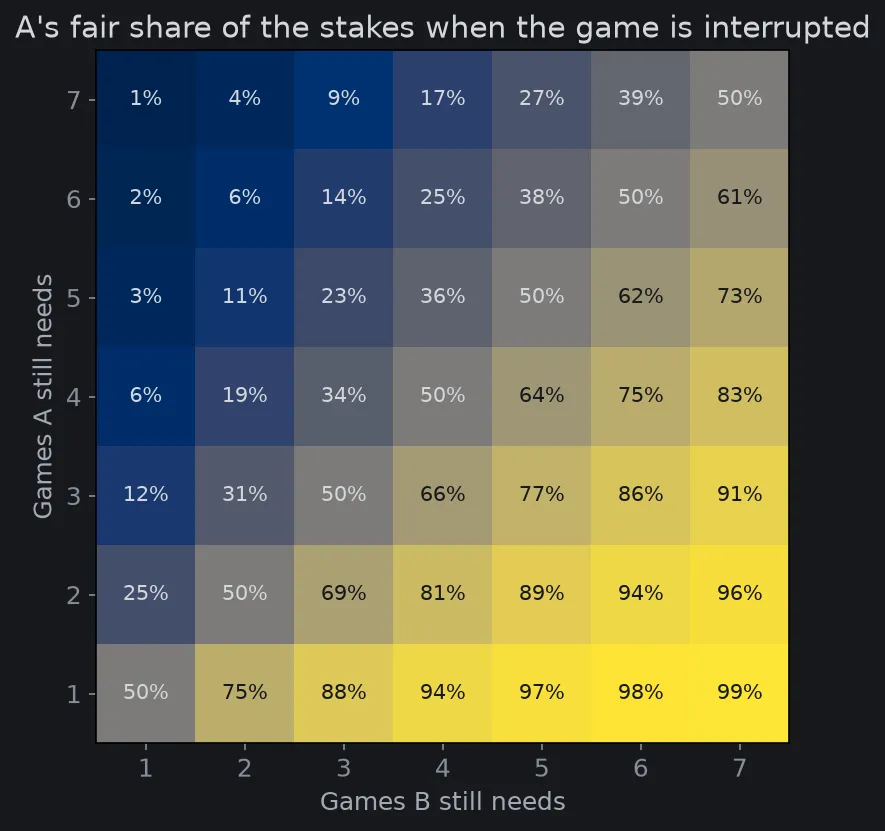
The table shows why Pacioli’s rule is wrong. The fair split depends not on rounds already won, but on rounds still needed. A score of 2–1 in a game to 3 (A needs 1, B needs 2) gives A 75%. But the same 2–1 in a game to 10 (A needs 8, B needs 9) gives A only about 60%. Same past, different future.
Pascal’s triangle
Computing that table by hand, Pascal noticed the numbers followed a structure he had studied: a triangle of numbers, each the sum of the two just above it.
1 1 1 1 2 1 1 3 3 1 1 4 6 4 1 1 5 10 10 5 1Row of the triangle counts the ways to get exactly heads when tossing coins. For example row 4 (1, 4, 6, 4, 1) says that tossing 4 coins there is 1 way to get 0 heads, 4 ways to get 1 head, 6 ways to get 2 heads, and so on. To know in how many futures A wins, just add up part of the corresponding row: exactly Fermat’s counting, without listing every future.
Pascal wrote a treatise on this triangle in that same year, 1654. It was only printed in 1665, after he had passed away. The triangle had been known to Chinese, Persian and Indian mathematicians for centuries. In China it bears the name of Yang Hui, a 13th-century mathematician. But in the West it is tied to Pascal’s name, because he used it to calculate with uncertainty.
A new idea: the value of the future
What was truly new in the letters of 1654 was not the number 48. It was a way of thinking:
What a player “owns” in the middle of a game is not the rounds already won, but the average value of every possible future, each future weighted by how likely it is.
Today that concept is called expected value. Three years later, in 1657, the Dutch scientist Christiaan Huygens wrote the first printed book on probability, De ratiociniis in ludo aleae (“On reasoning in games of chance”). He wrote it after visiting Paris and hearing about these letters. In it, Huygens presented expected value as a systematic tool. From then on, probability began to leave the gambling table.
1654 was also the year Pascal’s life took a different turn. On the night of 23 November, he had an intense religious experience and wrote it down on a scrap of paper, later found sewn into the lining of his coat. From then on, Pascal devoted most of his remaining life to philosophy and theology. The letters about the unfinished game were among his last major works in mathematics.
Where is the idea today?
Splitting gambling stakes sounds like a problem only for 17th-century gamblers. But the question “how do you split it when the game stops halfway?” still comes up, with far more money at stake.
When a season is cancelled
In March 2020, the COVID-19 pandemic forced France’s top football league, Ligue 1, to stop when each team had played only about 27–28 of 38 rounds. On 30 April the organizers decided not to resume. They chose the champion and relegated teams by points per game played[4]. Paris Saint-Germain, leading the second-placed team by 12 points, was awarded the title.
That is almost exactly Pacioli’s rule of 1494: split by what each side already has. The decision was highly controversial, especially at the bottom of the table, where the gaps were only a few points and each team still had ten matches to change its fate. The question Pascal would have asked is: with the matches remaining, what is each team’s chance of staying up? That question is much harder to answer, because football teams are not 50/50 coins. But it is the right question.
When rain interrupts a cricket match
Cricket has a problem of points that really must be solved almost every week. A one-day match lasts for hours, and when rain wipes out part of the time, the organizers must recompute a fair target score for the team batting second.
In the late 1990s, two English statisticians, Frank Duckworth and Tony Lewis, proposed a method based on exactly Pascal’s idea. What counts is not the runs a team has scored, but the “resources” it has left: the overs remaining and the batsmen not yet out, that is, its potential to score in the future. The method, later updated as Duckworth–Lewis–Stern, is now the official rule in international cricket[5].
The “win probability” bar on screen
Many sports broadcasts now show a percentage bar that updates with every play: “team A has a 73% chance of winning”. Behind that number is a model computing exactly what Pascal called the value of the game at the present moment: the average of every possible way the rest of the game could go, weighted by how likely each one is.
Whenever someone asks “what is this position worth, before the outcome is known?”, they are using the idea born in the letters of the summer of 1654.
Split the stakes yourself
The Python below computes the share of the stakes exactly Pascal’s way: working backwards from the two “finish lines”. The results are exact fractions, not rounded. It also draws Figure 1 above. All you need is matplotlib.
from fractions import Fractionfrom functools import lru_cache
import matplotlib.pyplot as plt
plt.rcParams.update({"figure.facecolor": "#16181c", "text.color": "#d4d7dc", "axes.labelcolor": "#a4a9b2",                     "xtick.color": "#878d97", "ytick.color": "#878d97", "font.size": 12})

@lru_cache(maxsize=None)def share(a: int, b: int) -> Fraction:    """Player A's share of the stakes when A needs a more games and B needs b more (each game 50/50)."""    if a == 0:        return Fraction(1)    if b == 0:        return Fraction(0)    # Pascal's idea: the next game is won either by A or by B; average the two cases.    return (share(a - 1, b) + share(a, b - 1)) / 2

# The letter of 29 July 1654: first to 3, score 2–1, total stakes 64 pistoles.print("A needs 1, B needs 2:", share(1, 2), "→", share(1, 2) * 64, "pistoles")print("A needs 1, B needs 3:", share(1, 3), "→", share(1, 3) * 64, "pistoles")print("A needs 2, B needs 3:", share(2, 3), "→", float(share(2, 3) * 64), "pistoles")
N = 7grid = [[float(share(a, b)) for b in range(1, N + 1)] for a in range(1, N + 1)]fig, ax = plt.subplots(figsize=(7, 6))im = ax.imshow(grid, cmap="cividis", vmin=0, vmax=1, origin="lower",               extent=(0.5, N + 0.5, 0.5, N + 0.5))for a in range(1, N + 1):    for b in range(1, N + 1):        v = grid[a - 1][b - 1]        ax.text(b, a, f"{v:.0%}", ha="center", va="center", fontsize=10,                color="#16181c" if v > 0.55 else "#d4d7dc")ax.set_xlabel("Games B still needs")ax.set_ylabel("Games A still needs")ax.set_title("A's fair share of the stakes when the game is interrupted", color="#d4d7dc")fig.savefig("problem-of-points-en.png", dpi=150, bbox_inches="tight")
A needs 1, B needs 2: 3/4 → 48 pistolesA needs 1, B needs 3: 7/8 → 56 pistolesA needs 2, B needs 3: 11/16 → 44.0 pistolesThe first line is the solution in the 1654 letter: 48 of 64 pistoles. Try changing / 2 to a different probability, for example if A is the stronger player and wins each round with probability 60%, to see how the table changes.
Back to the 64 pistoles
The answer to the opening puzzle: the player leading 2–1 gets 48 pistoles, the other 16. Not half each, not split by the 2 : 1 score, and not everything to the leader.
The number matters less than the road that led to it. Before 1654, everyone tried to split the money by looking back at what had happened. Pascal and Fermat were the first to calculate rigorously with what had not yet happened: list the possible futures, give each one a probability, then take the average. That was the moment when chance, which until then had belonged only to fate, first became something that could be measured.
If you want to see that same way of thinking resolve modern paradoxes, read on with the articles on Monty Hall, the birthday paradox and the gambler’s fallacy (in Vietnamese). The next article in this series is about Euler and the seven bridges of Königsberg.
Tài liệu tham khảo
- [1]Blaise Pascal and Pierre de Fermat; translated by Vera Sanford. Fermat and Pascal on Probability (English translation of the 1654 letters). In D. E. Smith, A Source Book in Mathematics (1929); PDF from the University of York, 1654.
- [2]Keith Devlin. The Unfinished Game: Pascal, Fermat, and the Seventeenth-Century Letter that Made the World Modern. Basic Books, 2008.
- [3]Problem of points. Wikipedia.
- [4]2019–20 Ligue 1. Wikipedia.
- [5]Duckworth–Lewis–Stern method. Wikipedia.