Ngô Bảo Châu and Asian Mathematicians Awarded the Fields Medal
Explore the lives and Fields Medal work of Ngô Bảo Châu, Akshay Venkatesh, June Huh, Yu Deng and Hong Wang, in chronological order with clear examples.
Mục lục
From a problem with an answer to the Fields Medal
At school, you usually solve questions whose answers the examiner already knows. When nobody knows the solution, the task changes: researchers must find both the right formulation and the tools to address it. The Fields Medal recognizes research contributions of this kind, together with the promise of further achievement.[1]
Ngô Bảo Châu received the medal in 2010 for proving the Fundamental Lemma. This article begins there, then introduces four Asian and Asian-origin mathematicians from the most recent award cycles: Akshay Venkatesh in 2018, June Huh in 2022, and Yu Deng and Hong Wang in 2026.[1] We move chronologically, from an identity difficult to verify to coloring problems, gas in a room and rotating a needle.
The selection needs a qualification: this is neither a ranking nor an exhaustive list. Caucher Birkar was also born in Asia and received a Fields Medal in the same 2018 cycle as Venkatesh. Choosing Venkatesh for the fourth place beyond Ngô Bảo Châu does not mean Venkatesh received the award later than Birkar.[7] June Huh was born in the United States and grew up in South Korea, so the scope includes Asian origin rather than treating birthplace, citizenship and workplace as interchangeable.[12]
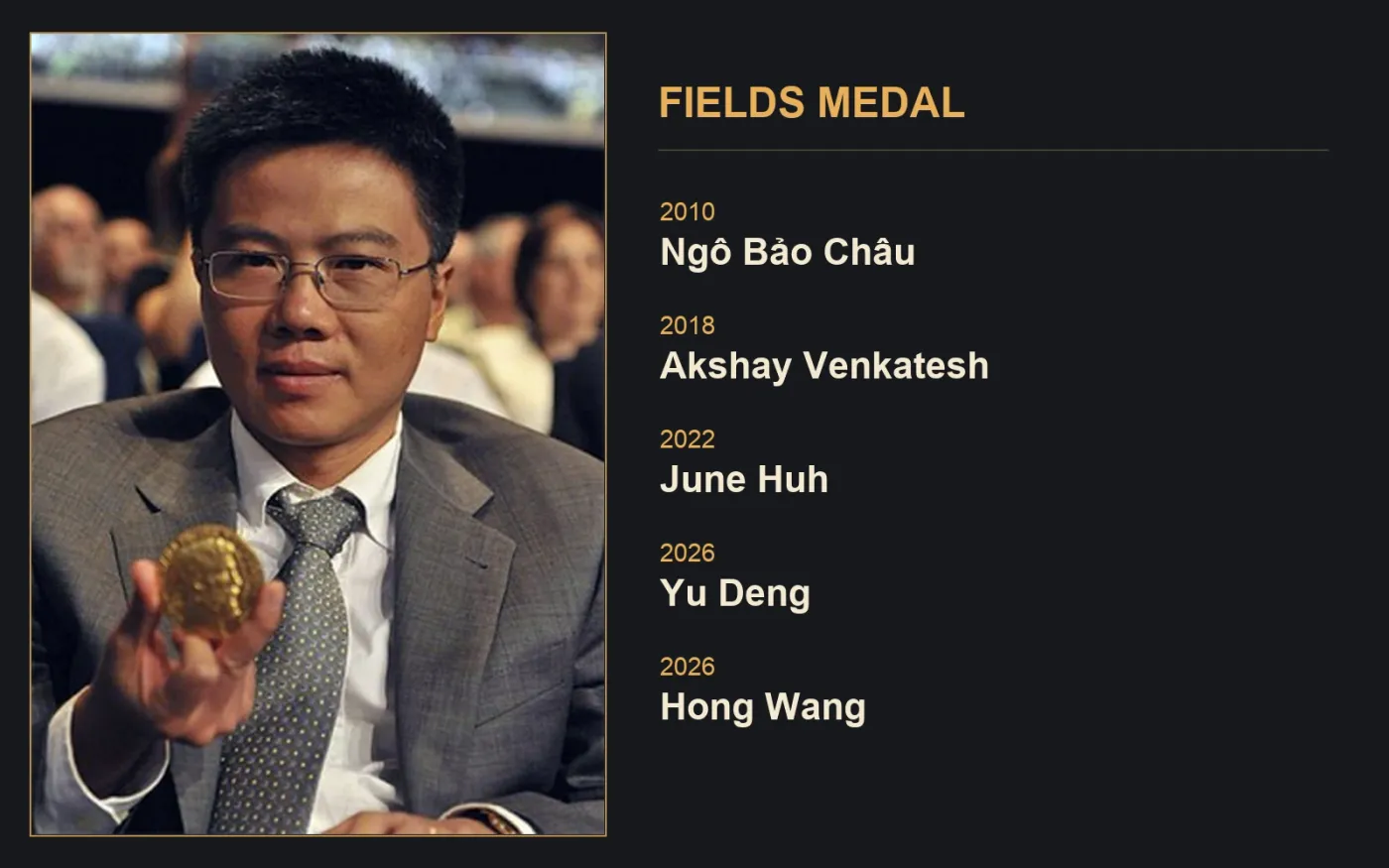
The cover shows Ngô Bảo Châu holding a Fields Medal. Its Wikimedia Commons file page identifies no photographer, labels the image CC0 1.0 and cites Bình Dương Newspaper.[20]
How does the Fields Medal differ from an Olympiad medal?
A mathematics Olympiad tests the ability to solve selected problems. Research also involves deciding what is worth asking and finding a way forward without a model solution. Think of the difference between solving a maze designed to have an exit and surveying territory with no map. Achievement at the first task does not automatically guarantee success at the second.
The Fields Medal is awarded by the International Mathematical Union, or IMU, every four years at the International Congress of Mathematicians. The award began in 1936. Current rules call for at least two recipients, with a strong preference for four, and consideration of diversity across mathematical fields.[1] Recipients in the same cycle are not ranked first, second and third.
The precise age condition is that a candidate’s fortieth birthday must not precede January 1 of the congress year. Someone may already be forty when receiving the medal and remain eligible.[1] “An award for mathematicians under forty” is therefore shorthand. It is not a lifetime-achievement award or the sole measure of a mathematician.
| Narrative order | Mathematician | Fields year | An accessible starting question |
|---|---|---|---|
| 1 | Ngô Bảo Châu | 2010 | Do calculations in two related worlds of symmetry agree? |
| 2 | Akshay Venkatesh | 2018 | Do scattered arithmetic objects follow distribution laws? |
| 3 | June Huh | 2022 | Do numbers arising in coloring problems satisfy inequalities? |
| 4 | Yu Deng | 2026 | How does an equation for gas emerge from colliding particles? |
| 5 | Hong Wang | 2026 | How large must a set containing a segment in every direction be? |
Award years come from IMU.[1] The questions are entry points, not full mathematical statements. The two 2026 recipients appear in a convenient narrative order, not an order of merit or presentation.
2010: Ngô Bảo Châu and the bridge called the Fundamental Lemma
From Hanoi to an unanswered question
Ngô Bảo Châu was born in Hanoi in 1972. After specialized mathematics classes and two International Mathematical Olympiad gold medals, they studied in France, entered the École normale supérieure in 1992 and completed a doctorate at Paris-Sud with Gérard Laumon in 1997.[5]
After timed contests came work with no answer to compare against. Ngô pursued a problem in the research network initiated by Robert Langlands. In 2004, Ngô and Laumon received the Clay Research Award for proving the Fundamental Lemma for unitary groups.[3] This was an important case, not the end of the task.
The Langlands program is a network of conjectures connecting number theory with structures of symmetry. Imagine a dictionary translating a difficult question into another mathematical language. But this dictionary must do more than rename objects: relationships and calculations must remain compatible. A total computed in one language must retain its meaning after translation.
An accessible entry point is the symmetry of roots in Galois’s story. On another side are automorphic forms, functions satisfying special symmetry rules. Think of a pattern that repeats under permitted transformations. The pattern illustrates symmetry; it does not define the functions completely.
A supporting result can hold up an entire construction
A lemma supports a larger argument. Its name describes its role, not its difficulty. A bridge into a construction site can be harder to build than many roads inside. The Fundamental Lemma is an identity between quantities called orbital integrals on related groups.[3]
A group is a collection of transformations with composition rules, such as rotations of a square. An orbit is the collection of states reachable from one state through permitted transformations. A chess piece and its movement rules suggest a set of reachable squares. An orbital integral aggregates values over analogous mathematical objects using precise structures and measures; it is not just counting chess squares.
An accounting comparison explains why the identity matters. A shop can total sales invoice by invoice or regroup them by product category. The totals should agree when the grouping and weights are compatible. The two sides of the Fundamental Lemma are much more abstract, but verifying compatibility remains the central idea.
Many theorems had been developed assuming the Fundamental Lemma. Its missing proof resembled an unapproved bridge support: the other plans were not meaningless, but the whole route was not yet secured. The problem resisted efforts for nearly three decades.[2]
Changing tools: using geometry to understand an identity
Ngô introduced algebraic-geometric methods. Algebraic geometry studies shapes defined by polynomial equations, such as a familiar circle. Descartes’s connection between drawings and equations offers a starting point for understanding why geometry can supply information rather than merely rewrite a calculation.
A central tool is the Hitchin fibration. Picture a map with a whole space of objects attached above each location. Instead of handling isolated calculations, one studies an entire family of spaces varying over the map. This comparison describes the organization of the tool, not the geometric structures of the proof itself.[4]
The manuscript on the Fundamental Lemma for Lie algebras first appeared on arXiv on January 3, 2008. Combined with earlier reductions by other mathematicians, it supplied the missing component.[4][5] In 2010 at Hyderabad, Ngô received a Fields Medal for the proof through algebraic-geometric methods.[2]
The distinction matters: this proved the Fundamental Lemma, not the entire Langlands program. Connections with other areas do not mean a phone directly runs the proof whenever it encrypts data. Ngô joined Chicago in 2010; an HKU announcement states that they joined the university from June 2026.[2][6]
2018: Akshay Venkatesh finds laws in distributions
From New Delhi through Perth to Princeton
Akshay Venkatesh was born in New Delhi, India, in 1981 and moved with their family to Perth, Australia, as a young child. Venkatesh participated in both international physics and mathematics Olympiads and completed undergraduate study at the University of Western Australia while still a teenager.[9] The later Fields Medal was not an award for those early milestones.
Venkatesh received a Princeton doctorate in 2002 under Peter Sarnak. The Clay profile describes interests in number theory, automorphic forms and equidistribution on symmetric spaces.[8] After working at Stanford, Venkatesh became a professor at the Institute for Advanced Study in 2018.[9]
Uniform distribution does not mean equal spacing
Suppose you mark where buses appear along a route. They need not stand at identical intervals. Yet over many observations, the proportion appearing within each section may follow a stable law. Equidistribution concerns proportions within regions; it does not require neighboring points to be equally spaced.
In number theory, the observed points may be integer solutions, meaning solutions whose coordinates are integers. For example, an equation setting x² + y² + z² equal to a specified number raises a question: which directions do its integer solutions point toward? As parameters vary under appropriate conditions, we can ask whether the distribution is biased or approaches a natural measure. This illustrates a type of question, not a claim that every sphere has integer solutions or every sequence is equidistributed.
Venkatesh combines tools often studied separately. Analytic number theory uses limits, sums and estimates to investigate integers, rather like studying the flow of traffic instead of following individual vehicles. Dynamics studies changes under repeated rules, such as successive laps along a prescribed route.
A homogeneous space has a symmetry system capable of moving any point to any other. An unmarked sphere suggests an example: rotations move one point to another without changing its geometry. Representation theory turns symmetries into linear transformations, like recording rotations in number tables so calculations become possible. These pictures do not cover every space appearing in the research.
Why can combining fields produce new results?
When a point set is difficult to count directly, one may recognize it as the trace of motion on a symmetric space. The arithmetic question then becomes a question about how trajectories pass through regions. Topology adds information about connections and holes, like distinguishing a road network with loops from a branching tree with none.
The 2018 Fields citation specifically recognizes Venkatesh’s synthesis of analytic number theory, homogeneous dynamics, topology and representation theory. These methods resolved longstanding problems, including equidistribution of arithmetic objects.[7] There is no single “Venkatesh formula” that stands for the entire award.
The connection to Ngô is the meeting of mathematical languages. But the achievements differ: one removes an obstacle in an identity underlying transfer, while the other develops methods for tracking distributions. Working in number theory does not mean working on the same question.
2022: June Huh and numbers arising from coloring
A route without a chain of school medals
June Huh was born in California in 1983 while their parents studied at Stanford, then grew up in South Korea. Huh once wanted to write poetry and initially followed no clear path into mathematical research. At Seoul National University, lectures by Heisuke Hironaka sparked an interest in research mathematics.[12]
After Seoul, Huh studied at Illinois and then Michigan, completing a doctorate under Mircea Mustață in 2014. Research positions followed, eventually including a professorship at Princeton.[11][12] This biography does not establish that leaving school is a route to mathematical success. It shows that school achievement is not a single template for every researcher’s story.
How many ways can four corners be colored?
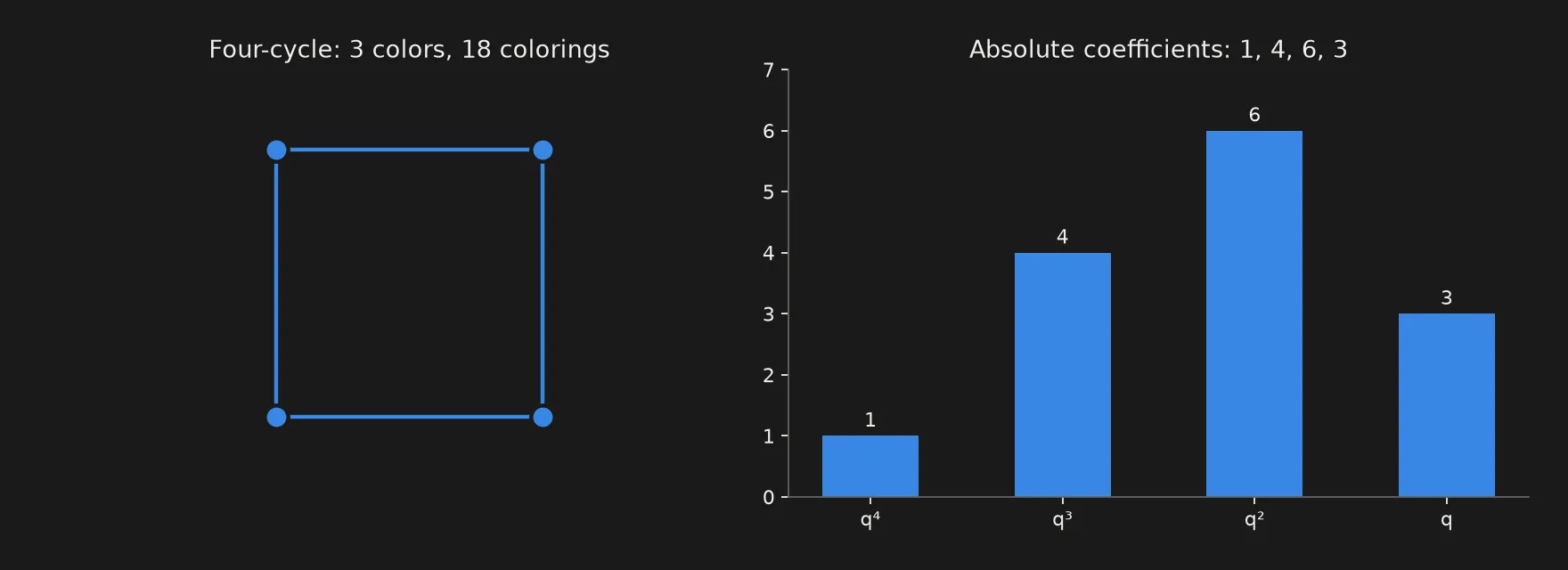
Take four points at the corners of a square and connect them in a cycle. Use q distinct colors, requiring adjacent points to have different colors. Opposite corners may share a color. This is vertex coloring, not coloring the square’s interior.
With two colors there are exactly two possibilities: choose the first corner’s color and the rest are forced. With three colors, the program below checks that there are 18 possibilities. The chromatic polynomial gives the number of valid colorings when the number of colors is substituted. It resembles a price formula: change the quantity entering the formula and obtain the corresponding total.
For the four-cycle, the expression is q⁴ − 4q³ + 6q² − 3q. This example is calculated again in the article, not taken from a survey. Read the nonzero coefficients in descending degree and discard the signs: 1, 4, 6, 3. Why do coefficients arising from other graphs also often rise and then fall?
A stronger property is log-concavity: the square of an interior term is at least the product of its neighbors. It is a quantitative way of preventing a term from dipping too far below those around it, not just a visual impression. Here, 4² ≥ 1 × 6 and 6² ≥ 4 × 3. These calculations check the square example; a theorem must address an entire class.
Bringing geometry to counting problems
Combinatorics studies ways of choosing, arranging and connecting discrete objects, like counting possible schedules or colorings. Huh brings algebraic geometry and Hodge theory to such problems. Instead of summing cases one by one, the aim is to find an underlying structure from which inequalities follow geometrically.[10]
Hodge theory studies algebraic structures associated with complex geometry. As a first picture, imagine compatibility relations between different measurements on one space. When those relations can be transferred to a counting problem, an inequality apparently about quantities receives an explanation from geometry. This does not mean drawing a square makes the proof visible.
A central object is a matroid, an abstract model of independence. In a road network, an edge set containing no cycle provides an example of independence: adding an edge may introduce a redundant loop. A matroid retains independence rules even when there is no particular graph drawing behind them. The results therefore go far beyond a school coloring exercise.
With Karim Adiprasito and Eric Katz, Huh developed Hodge theory for matroids and proved the Heron–Rota–Welsh conjecture on log-concavity of characteristic-polynomial coefficients. The paper appeared in Annals of Mathematics in 2018.[13] The 2022 Fields citation also includes Lorentzian polynomials and the strong Mason conjecture.[10]
The coloring example reveals a patterned sequence; the research constructs a theory for much broader structures. Exhaustively testing small graphs does not prove the general statement. The distinction between checking examples and proving a theorem is not erased by a computer.
2026: Yu Deng connects particle collisions with an equation for gas
A researcher of equations who also enjoys Go
Yu Deng grew up in Shenzhen, China. Their personal website lists poetry, stories, puzzles and Go among interests alongside mathematics. Deng completed a Princeton doctorate in 2015 under Alexandru Ionescu and is a mathematics professor at the University of Chicago.[15]
The 2026 Fields citation mentions the Boltzmann equation, wave kinetics and probabilistic approaches to nonlinear Schrödinger dynamics.[14] To see the common question, start with air in a room rather than notation. Each molecule moves individually, but we describe gas using collective quantities.
Two descriptions of the same container of gas
One description tracks every particle’s position and velocity. Particles move and collide. Given the initial state and interaction rules, the mechanical model determines subsequent motion. But the number of variables increases with the number of particles, making this detailed record unwieldy.
Another description uses a distribution function: within a small region, how many particles have velocities within a specified range? Think of counting cars by neighborhood and speed band rather than keeping a file on every vehicle. This describes the statistical shape of the population rather than a particular particle.
The Boltzmann equation describes how that distribution changes as particles travel and collide. It occupies an intermediate kinetic level: more detailed than equations retaining only quantities such as gas density and average velocity, but less detailed than tracking every particle.[16] It should not simply be called an equation for the room’s temperature.
The difficult question is whether the statistical description can be derived from the particle model, rather than accepting the two as separate assumptions. After repeated collisions, particles may carry correlations. Two vehicles that previously shared a traffic jam offer an analogy: their common history makes complete independence an assumption to justify, not take for granted.
The difficulty lies in controlling collision histories
Yu Deng, Zaher Hani and Xiao Ma studied systems of hard spheres. This is an idealization, not real molecules with every chemical interaction included. As particle numbers increase and sizes change in an appropriate dilute-gas limit, the task is to prove that the statistics approach the Boltzmann equation.[16]
Clay highlights the advance to long times, beyond the restrictions of earlier short-time control. Tracking branching collision histories requires combinatorics and algorithms designed for intricate structures. The controlled times may grow with particle number, provided the equation’s regular solution continues to exist.[16]
That final condition matters. The result does not simulate every real gas forever or solve all of Hilbert’s sixth problem. Clay describes a solution to part of the program of connecting microscopic laws to macroscopic descriptions.[16] Deng’s Fields Medal also recognizes work on waves, not only gas kinetics.
2026: Hong Wang and the question of rotating a needle
From Guangxi to Fourier analysis
Hong Wang comes from Guangxi, China. After mathematics at Peking University, Wang studied at École polytechnique and Paris-Sud, then completed a doctorate at MIT under Larry Guth in 2019. Following IAS and UCLA, Wang worked at NYU’s Courant Institute and also became a permanent professor at IHES.[17]
The research concerns harmonic analysis and geometric measure theory. Harmonic analysis studies decomposition and reconstruction through oscillating components, like splitting a sound into frequencies. Geometric measure theory asks how large sets are even when their geometry is too complicated for familiar area formulas.
A rotating needle and a set containing every direction are different
Place a unit-length segment on a table. Holding one endpoint fixed and rotating it sweeps a disk. But that is only one rotation method. Allowing translations as well leads to another question: how small a region can contain unit segments in every direction?
A Kakeya set contains a unit line segment in every direction. The segments may occupy different locations. The definition does not require one needle to move continuously through every orientation while staying within the set. Ignoring this distinction changes the question.
Ordinary volume is not the whole story. A set may have zero volume and still possess rich structure. An easier analogy is a segment in the plane: it has no area but does have length. A finer measurement is needed to ask how many dimensions a Kakeya set really occupies.
Full dimension does not mean positive volume
Hausdorff dimension and Minkowski dimension measure complexity at increasingly small scales. Imagine covering a shape with grid cells and shrinking the cells: the growth in the required number reveals more than a single measurement. The two dimensions have different definitions and need not always agree.
Hong Wang and Joshua Zahl proved the Kakeya conjecture in three-dimensional space. The work controls intersections of thin tubes and how their arrangements change across scales.[18][19] The conclusion is full dimension in the corresponding senses, not positive volume for every Kakeya set.
Multiscale analysis resembles examining a city at successive zoom levels: neighborhoods, streets, then alleys. Two configurations that look similar from far away can differ sharply up close. The new tools exploit spacing information at each scale rather than compressing an entire set into one summary number.[18]
Thin tubes also arise in studying how waves concentrate and intersect. The needle problem therefore connects to obstacles in Fourier analysis and wave equations, not just saving table space. The Fields citation also mentions Fourier restriction, Falconer distance sets and Furstenberg sets.[14] Kakeya is a concrete starting point, not a summary of the whole career.
Five achievements are not five formulas for success
The chronology spans different kinds of mathematics. Ngô verifies a transfer identity between structures. Venkatesh combines fields to study distributions. Huh uses geometric relations to solve counting problems. Deng controls limits of particle systems. Wang analyzes geometric arrangements across scales.
The common thread is not mental-arithmetic speed or a school medal count. It is finding structure that makes a difficult question manageable. Nor did any achievement emerge independently of teachers, collaborators and earlier results. Naming collaborators accurately explains the work; it does not diminish recognition.
Each result has conditions. The Fundamental Lemma is not all of Langlands. Huh’s inequalities do not make every arbitrary counting sequence log-concave. A dilute-gas limit is not every real gas. Full dimension is not positive volume. Keeping these distinctions makes the achievements intelligible rather than treating Fields as a label meaning “solved everything.”
Count the colorings of a four-cycle yourself
Huh’s example is small enough to check in Python. The program uses inclusion–exclusion to calculate the chromatic polynomial, then directly counts colorings with two and three colors. Inclusion–exclusion resembles counting people who belong to at least one group: add group sizes and correct repeated counts. Here, the groups are edges violating the different-color condition.
The program plots the four-cycle and the absolute coefficients. This is a finite check, not a proof of Hodge theory or the result for every matroid. It requires numpy and matplotlib; no random seed is needed because there is no randomness.
from itertools import combinations, productfrom pathlib import Pathimport numpy as npimport matplotlib.pyplot as plt
edges = [(0, 1), (1, 2), (2, 3), (3, 0)]coeff = [0] * 5  # Coefficients in ascending order: q^0 through q^4.for size in range(5):    for subset in combinations(edges, size):        parent = list(range(4))        def find(x):            while parent[x] != x:                x = parent[x]            return x        for u, v in subset:            parent[find(u)] = find(v)        components = len({find(v) for v in range(4)})        coeff[components] += (-1) ** size
for q in (2, 3):    count = sum(all(c[u] != c[v] for u, v in edges)                for c in product(range(q), repeat=4))    assert count == sum(a * q ** k for k, a in enumerate(coeff))    print(q, "colors:", count, "colorings")a = [abs(x) for x in coeff[::-1] if x != 0]print("Absolute nonzero coefficients:", a)assert all(a[i] ** 2 >= a[i - 1] * a[i + 1] for i in range(1, len(a) - 1))
bg, ink, blue = "#1a1a19", "#f0efec", "#3987e5"fig, axes = plt.subplots(1, 2, figsize=(11, 4), facecolor=bg)xy = np.array([[0, 0], [1, 0], [1, 1], [0, 1]])for ax in axes:    ax.set_facecolor(bg)for u, v in edges:    axes[0].plot(*xy[[u, v]].T, color=blue, lw=2)axes[0].scatter(*xy.T, s=140, color=blue, edgecolors=bg, linewidths=2, zorder=3)axes[0].set(xlim=(-0.3, 1.3), ylim=(-0.3, 1.3), aspect="equal")axes[0].axis("off")axes[0].set_title("Four-cycle: 3 colors, 18 colorings", color=ink)axes[1].bar(range(4), a, width=0.5, color=blue)for i, value in enumerate(a):    axes[1].text(i, value + 0.15, str(value), ha="center", color=ink)axes[1].set_xticks(range(4), ["q⁴", "q³", "q²", "q"])axes[1].set_ylim(0, 7)axes[1].tick_params(colors=ink)axes[1].spines[["top", "right"]].set_visible(False)for spine in axes[1].spines.values():    spine.set_color("#666660")axes[1].set_title("Absolute coefficients: 1, 4, 6, 3", color=ink)fig.tight_layout(pad=2)out = Path("images/giai-fields-5-nha-toan-hoc-chau-a")out.mkdir(parents=True, exist_ok=True)fig.savefig(out / "huh-to-mau-en.png", dpi=160)plt.close(fig)
The actual output is 2 colorings with two colors and 18 with three colors. Coefficients in ascending degree are 0, −3, 6, −4, 1, giving q⁴ − 4q³ + 6q² − 3q. The absolute nonzero coefficients are 1, 4, 6, 3; the tested inequalities hold. These numbers come from the example, not observations of a real-world dataset.
Back to the question with no model solution
Four points in a cycle are easy for a student to draw. Yet asking why coefficients obey a general relation leads to geometry that is no longer directly visible. Air in a room and a needle on a table do the same: familiar objects open questions far beyond familiar calculations.
From Ngô Bảo Châu in 2010 to Yu Deng and Hong Wang in 2026, the story is not just the award year. It is how researchers find questions, learn tools and work with collaborators to turn something unknown into a result with precise conditions. A medal recognizes a stage of that journey; methods and proofs are what later researchers continue using.
Free geometric illustrations for students and teachers: EyeViz.
Tài liệu tham khảo
- [1]Fields Medal: rules, history and laureates. International Mathematical Union.
- [2]Steve Koppes. Ngô Bao Châu receives Fields Medal, highest honor in mathematics. University of Chicago News, 2010.
- [3]Ngô Bao Châu: Clay Research Award 2004. Clay Mathematics Institute.
- [4]Ngô Bảo Châu. Le lemme fondamental pour les algèbres de Lie. arXiv:0801.0446, first submitted January 3, 2008, 2008.
- [5]Ngô Bảo Châu: biography and bibliography. Wikipedia; educational milestones cross-checked.
- [6]Fields Medalist Professor Ngô Bảo Châu Joins HKU as Chair Professor. The University of Hong Kong, 2026.
- [7]Fields Medals 2018: Akshay Venkatesh and Caucher Birkar. International Mathematical Union, 2018.
- [8]Akshay Venkatesh: Clay Research Fellow profile. Clay Mathematics Institute.
- [9]Akshay Venkatesh: biography. Wikipedia; birthplace and education cross-checked.
- [10]Fields Medals 2022: June Huh. International Mathematical Union, 2022.
- [11]June Huh: Clay Research Fellow profile. Clay Mathematics Institute.
- [12]June Huh: biography. Wikipedia; education and the role of Hironaka cross-checked.
- [13]Karim Adiprasito, June Huh, Eric Katz. Hodge theory for combinatorial geometries. Annals of Mathematics, 188, 381–452, 2018.
- [14]Fields Medals 2026: Yu Deng and Hong Wang. International Mathematical Union, 2026.
- [15]Yu Deng: About me and Research. Academic personal website, University of Chicago.
- [16]Yu Deng: Clay Research Award, work with Zaher Hani and Xiao Ma. Clay Mathematics Institute, 2026.
- [17]Hong Wang: academic biography and research. Institut des Hautes Études Scientifiques.
- [18]Hong Wang: work on Furstenberg and Kakeya problems. Clay Mathematics Institute, 2026.
- [19]Hong Wang: personal website and publications. Academic personal website.
- [20]Unidentified photographer. NgoBaoChauFields.jpg: Ngô Bảo Châu holding a Fields Medal. Wikimedia Commons; file page labels it CC0 1.0, citing Bình Dương Newspaper.