Why can something be true but unprovable? Gödel and incomplete mathematics
What do Gödel’s incompleteness theorems say? A rulebook and proof checker explain why truth differs from provability, without making mathematics unreliable.
Mục lục
A prisoner stands before a king and is allowed one statement to determine their fate. The king sets a rule: a true statement leads to beheading; a false one leads to hanging. The king must keep the promise, without changing the rule or choosing another punishment.
What could the prisoner say to have a chance of surviving? Pleading does not change the rules. An ordinary true or false statement leads to one of the two punishments.
Pause and think before reading on. Is there a statement that prevents either punishment from being carried out while the king keeps the promise?
One statement that blocks both choices
The prisoner says: “I will be hanged.” Rather than asking the king to change the rule, the statement makes its own truth depend on the action taken.
Hanging makes the prediction true. But a true statement requires the other punishment. Beheading makes the prediction false, which requires hanging. Either choice breaks the king’s own rule.
This is a hypothetical riddle, not a historical event or an anecdote about Gödel. The prisoner has not found a statement simultaneously true and false under one fixed outcome. Each action gives the prediction a truth value incompatible with the condition authorizing that action. Keeping the promise prevents either punishment. That is the chance of surviving intended by the puzzle, not a guaranteed pardon: the king could still abandon the rule, but would then break the promise.
The puzzle raises a question: can a set of rules answer everything without getting stuck? Gödel’s incompleteness theorem establishes a different, more precise limit: a mathematical theory can be free of contradiction yet unable to settle every sentence. The king’s story introduces the question; it does not prove the theorem.[1]
At school, a proof problem usually has a solution in the textbook. When we cannot solve it, we assume we are missing a transformation. Gödel showed that, under suitable conditions, some sentence can neither be proved nor disproved using the selected rules. To understand why this does not undermine mathematics, first distinguish contradicting yourself from being unable to answer.
What if every proof must follow one rulebook?
In geometry, you do not prove everything from scratch. You accept certain starting points and use them to derive new results. These starting points are axioms, like the initial rules of a game. The article on Euclid’s axiomatic method explores that choice further.
One familiar inference says: if A holds, and A implies B, then B holds. Everyday reasoning works that way too. If valid tickets admit their holders, and your ticket is valid, you may enter. A rule lets you proceed only when its conditions are satisfied.
Imagine all the axioms and inference rules collected in a book. A valid proof is a sequence of lines, each justified by that book. An examiner need not guess what the writer meant: each step is checked against explicit rules.
This pictures a formal system. “Formal” means specified precisely, like a form with exact requirements, not a superficial exercise. Permitted symbols, well-formed sentences, and valid inference steps must all be defined.
The book can be extremely long, even contain infinitely many axioms. What matters is that a mechanical procedure can enumerate them, like a printer generating pages from a program. Having infinitely many axioms does not itself escape incompleteness.[1]
Avoiding contradictions is different from answering everything
A consistent rulebook cannot prove both a sentence and its negation. It does not stamp the same ticket both valid and invalid under the same interpretation and conditions.
A complete theory, in the sense used here, settles every sentence in its language. It proves either that sentence or its negation. No sentence remains outside both categories.
These requirements differ. Never contradicting yourself does not mean answering everything. An official might never approve opposing decisions while still encountering an application that current regulations cannot settle.
Incomplete does not mean contradictory. A perfectly non-conflicting rulebook can leave questions undecided. Conversely, in classical logic a contradiction permits every sentence to be derived. A machine stamping everything has not understood all mathematics.[1]
Another word is true. Truth concerns the objects being discussed, such as the natural numbers 0, 1, 2, 3, and onward. Provability concerns what follows from the rulebook. The two are related, not identical.
The ambition of one rulebook for all mathematics
David Hilbert pursued a program of formalizing mathematics and justifying its consistency using methods considered secure. An important hope was to organize reasoning precisely enough that it no longer depended on vague intuition.[1][2]
The image of a proof-checking machine captures part of that ambition. If every step can be checked, checking can be assigned to a procedure. A bigger question then appears: could a rulebook be both free of contradiction and capable of settling every arithmetical question?
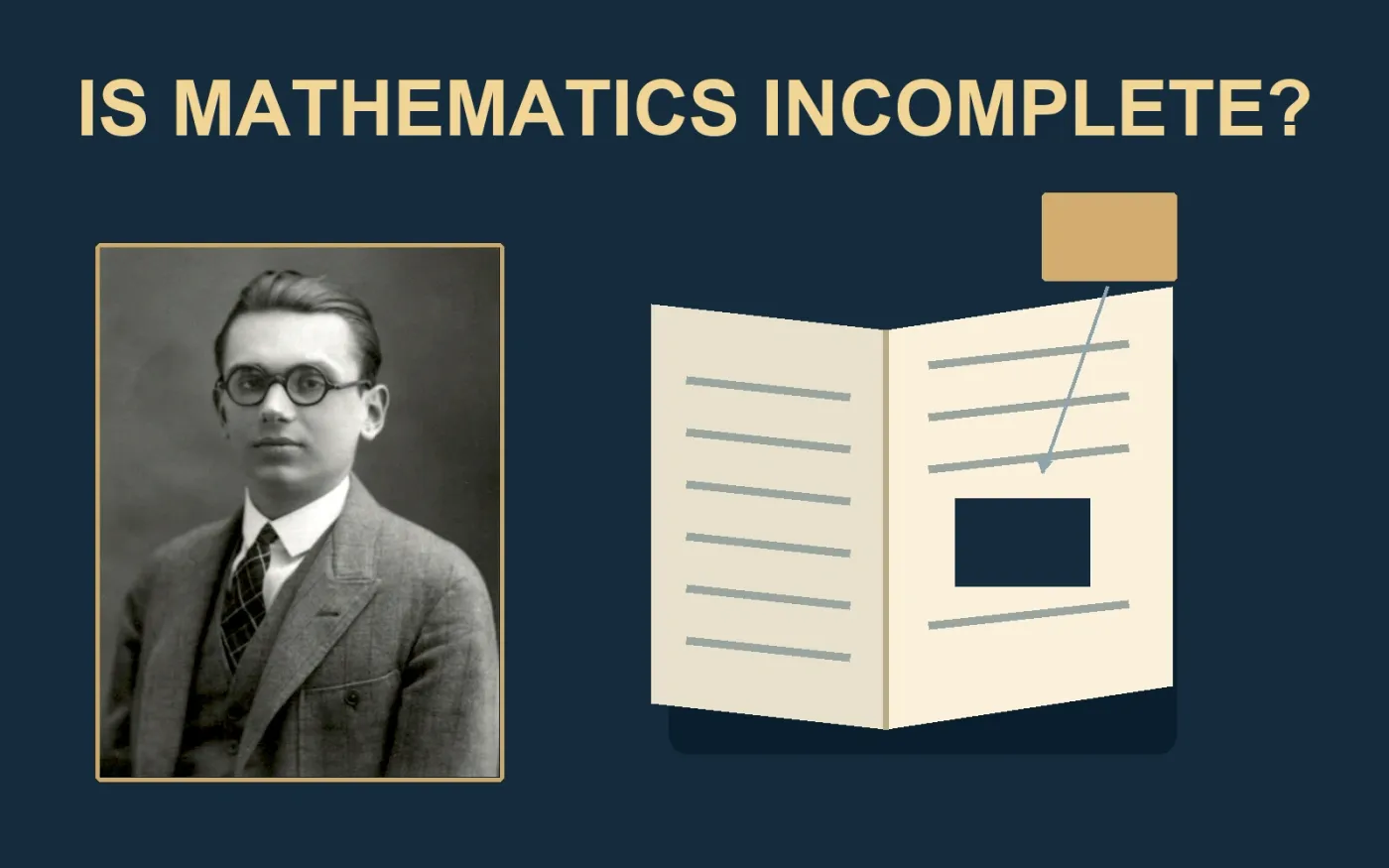
On September 7, 1930, Kurt Gödel announced his first incompleteness result during a discussion at the Königsberg conference. He was 24. John von Neumann was present and recognized its significance.[1][5]
The result was not a calculation that made a machine run longer than expected. It showed that, under specified conditions, such an all-powerful rulebook cannot exist. The difficulty was not that nobody had finished writing it. The requirements could not all be met together.
On November 20, von Neumann wrote to Gödel about a consequence: such a system cannot prove its own consistency. Gödel had independently reached that conclusion and submitted a manuscript containing the second result. The paper appeared in 1931.[1][3]
There is no need to invent a stunned room or dramatic dialogue. The documented detail is enough: a discussion contribution led to a limit on an entire foundational program. The question became not merely how well the rulebook could be written, but what it could do.
Which rulebooks encounter Gödel’s limit?
Having rules does not automatically imply incompleteness. The theorem requires consistency, an effective procedure enumerating the axioms, and enough strength to express a certain amount of arithmetic. Then some sentence can neither be proved nor disproved in the system. “In that system” is indispensable.[1]
Effective means following definite mechanical operations, not relying on someone who already knows every truth to whisper the answers. A book saying “take every true statement about natural numbers as an axiom” seems to solve the problem. But no algorithm can enumerate exactly all true first-order arithmetical sentences about the natural numbers. This is a proved impossibility, not software we have yet to write.
Strong enough means more than recording a few specific additions. The system can describe natural numbers, addition and multiplication relations, and enough structure to express finite checking procedures. Merely writing plus and multiplication symbols is not sufficient.
A useful counterexample is the appropriate first-order theory of natural numbers with addition alone. It can be complete and decidable. The claim that “every mathematical system is incomplete” is therefore too broad.[1]
Historical details also matter. Gödel’s original proof required a condition stronger than consistency to establish both unprovability and unrefutability. In 1936, J. Barkley Rosser improved the result so that consistency sufficed in the appropriate setting. The three-condition statement above uses the modern form incorporating that improvement.[1]
How can arithmetic talk about itself?
You could write, “This sentence cannot be proved using rulebook F.” If the rulebook proves it, trouble seems to follow. But a word game in English is not yet a theorem about arithmetic.
Gödel needed something harder: converting statements about symbols and proofs into statements about numbers. Think of student identification numbers. A name uses letters, but a school assigns a number to each student for processing. The number does not turn a student into arithmetic; it identifies them.
Gödel numbering assigns numbers to symbols, formulas, and entire proof sequences. Crucially, encoding and decoding follow definite procedures. Relationships among sentences can then be expressed as relationships among their numerical codes.[4]
For a small example, let the symbol 0 have code 1 and the equals sign code 5. The expression “0 = 0” becomes the sequence 1, 5, 1. Consecutive primes provide separate slots for the positions:
Factoring 2430 into primes recovers the exponents 1, 5, 1. Looking up the symbols reconstructs “0 = 0.” This example follows the coding table in Stanford’s reference. The number has no mystical significance.[4]
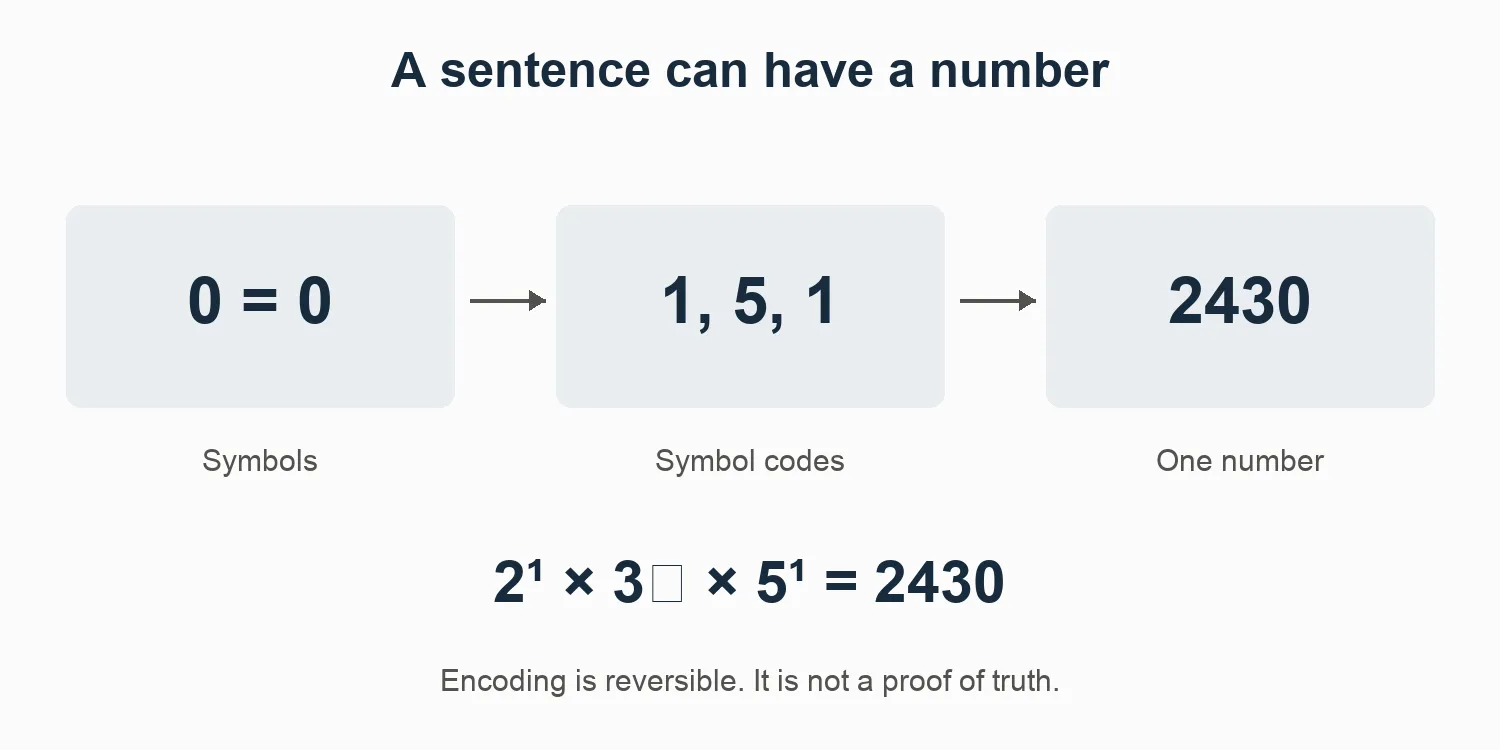
A proof is also a finite sequence, so it too can receive a number. “Does this sequence constitute a valid proof?” becomes an arithmetical relationship. Like a machine checking applications by their codes, arithmetic can now describe checking its own proofs.
The next step uses diagonalization to construct a sentence connected with its own code. Think of entering an application’s identification number into the slot on a form that discusses an application. This technique is related to Cantor’s construction of an object outside a list, though the details differ.
“I have no proof in this rulebook”
Call the rulebook F and the constructed sentence G. Informally, G says: “No number encodes a proof of G in F.” It does not refer to every argument a person could ever devise. It targets one definite system.
For intuition, temporarily assume F proves no false statement about natural numbers. If F proves G, there is a finite proof, hence a corresponding code number. But G says that no such number exists. F would have proved a falsehood, contrary to our assumption.
Therefore G has no proof in F. Looking from outside and relying on our assumption about F, the assertion that G has no proof in F is true. We have a gap between truth about numbers and provability in rulebook F.
What about G’s negation? Under the strong assumption we are using, F cannot prove that either. It asserts the existence of a proof that does not actually exist. This provides an accessible way to see why both directions are blocked.[1]
Calling G true uses reasoning outside F, together with an assumption about F. It is not a proof of G using F’s own axioms. Reasoning about the rulebook and receiving its internal stamp are different positions.
How does Gödel’s sentence differ from the prisoner’s?
Return to the opening puzzle. The prisoner’s statement makes the king’s action and the evaluation of the prediction loop back into one another. It helps illustrate self-reference, like an instruction sheet containing a line pointing back to that same sheet. But self-reference does not always produce a contradiction.
The prisoner’s statement leaves no action compatible with the stipulated rule. Gödel’s sentence says “I have no proof in F,” not “I am false.” If F does not prove it, its content can be true without a contradiction.
The king is stuck because both actions violate the conditions authorizing them. An incomplete theory can remain consistent: it proves neither G nor G’s negation. An undecided question is not a pair of contradictory certifications.
Encoding and self-reference turn the idea about provability into a precise arithmetical assertion. Without those steps, we have only a language puzzle. The king’s story helps us remember the question; Gödel’s work establishes the mathematical limit.[1]
Why not add the missing sentence to the rulebook?
If outside reasoning justifies accepting G, why not make it an axiom? You can. The result is a new system, F plus G. The old G is immediately provable there because it is an axiom.
This does not refute the previous result. “Unprovable in F” never meant “unprovable in every possible system.” Adding a starting assumption can unlock results the earlier system could not establish.
But if the new system remains consistent, mechanically axiomatizable, and strong enough, the theorem applies again. Another sentence is independent of the new system. The old G has not suddenly escaped. Changing the rulebook changes the statement about its limits.[1]
Adding an omitted item repairs that omission. It does not guarantee that every effectively generated list can contain everything required. There is no final rulebook meeting all the theorem’s requirements without gaps.
Mathematicians continue to investigate stronger axioms and reasons to accept them. Incompleteness does not forbid extending knowledge. It prevents declaring that an effective system has closed every arithmetical question.
Can the rulebook guarantee that it is consistent?
The second incompleteness theorem adds another limit. Under the standard conditions, a consistent and sufficiently strong F cannot prove the standard arithmetical statement expressing F’s own consistency.[1]
Imagine an organization using its own procedures to issue a guarantee that those procedures never produce contradictory results. The analogy helps remember the question. The actual theorem concerns how consistency is expressed inside a mathematical theory, not a prohibition on organizational self-audits.
A stronger theory may prove the consistency of a weaker one. Confidence then rests on stronger assumptions. Checking a scale against a reference weight is useful, but you should still state what warrants trusting the reference weight.
The theorem does not say there can never be reasons to trust mathematics’ consistency. Nor does it prove F inconsistent. An inability to internally prove a guarantee is not the discovery of an error.
This is where foundational ambitions needed adjustment. Not every aspect of Hilbert’s research program vanished. But a sufficiently strong formal foundation completing this type of guarantee faced a mathematically established obstacle.[1][2]
Is every unsolved problem an instance of incompleteness?
No. An unsolved conjecture may simply be too difficult for current methods. Calling it independent of a system requires establishing that neither it nor its negation follows from that system.
The Collatz conjecture has an easy-to-test rule but no known general proof. A missing solution does not establish that Collatz is a Gödel sentence. Testing many numbers by computer does not settle that distinction either.
There are established independence results without the form “this sentence is unprovable.” Goodstein’s theorem, about certain sequences of natural numbers, is unprovable in Peano arithmetic but provable in stronger frameworks. The phenomenon does not live only in self-referential sentences.[1]
Nor does incompleteness make computers or verification useless. Checking a finite proof and finding a solution to every question are different tasks. Every line can be checkable even when no machine always finds an answer to every problem.
A related result due to Turing limits general procedures: no algorithm always correctly decides whether an arbitrary program will halt. This is a separate computability theorem, not an interchangeable phrasing of Gödel’s result.[6]
A number game that makes a rule boundary visible
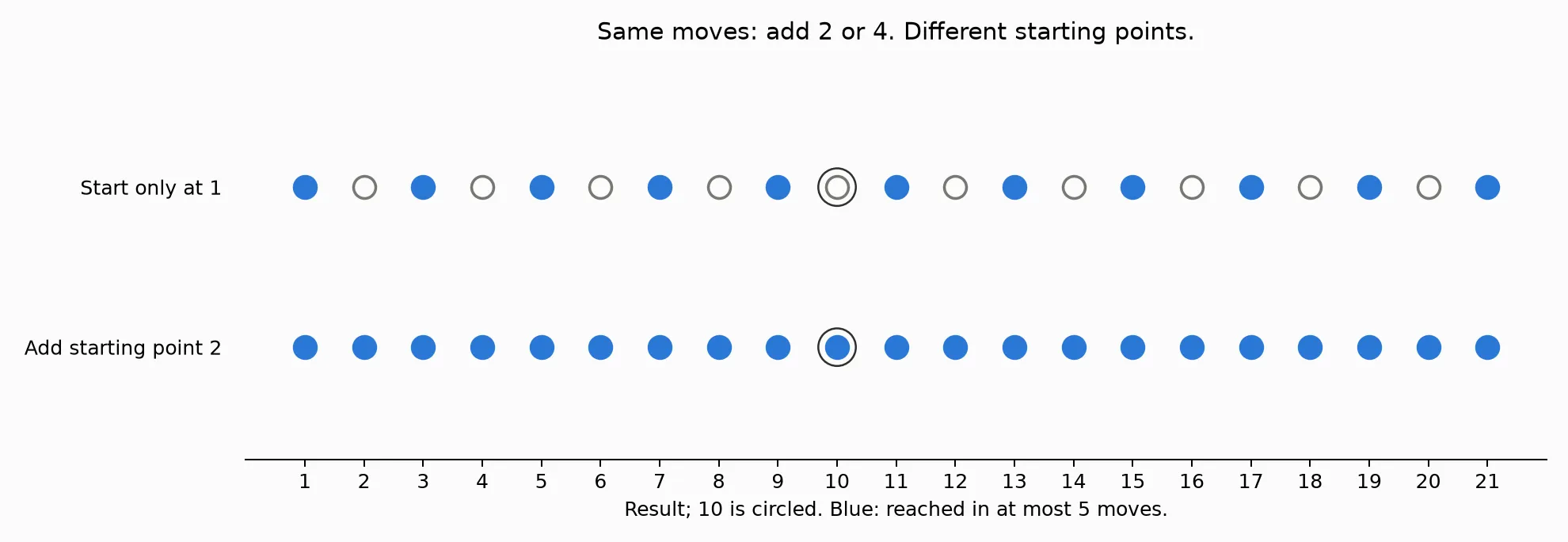
Before running code, try a tiny rulebook invented for this article. Start at 1. Each move may add 2 or 4. Can you reach 10?
You try 1, 3, 5, 7, 9, 11. Changing the order of additions still leaves an odd result. Parity is an invariant: a property unchanged by legal moves, like rearranging banknotes without changing the total in a wallet.
From outside the game, we can prove that 10 is unreachable. The initial value is odd; adding an even number preserves oddness. This is not a guess from a few attempts. It covers every finite number of moves.
If 2 is added as another permitted starting point, even values become reachable too. Now 10 is obtained from 2 plus 4 plus 4. Changing the rules changes the obtainable results.
Run a tiny rulebook yourself
This Python snippet enumerates values reachable in at most five moves and draws Figure 2. A blue dot means a route was found; an empty circle means none was found in this search. For the old rules, the parity argument additionally proves every even value unreachable.
The computation is deterministic, so it needs no random seed or external data. Run it from the EyeBlogs directory with matplotlib; it saves the figure in the article’s image folder.
from pathlib import Pathimport matplotlib.pyplot as plt
out = Path("images/godel-dinh-ly-bat-toan")out.mkdir(parents=True, exist_ok=True)
def reachable(starts, steps=5):    seen, layer = set(starts), set(starts)    for _ in range(steps):        layer = {x + d for x in layer for d in (2, 4)}        seen |= layer    return seen
old = reachable([1])new = reachable([1, 2])print("Old rules, within 1..21:", sorted(old & set(range(1, 22))))print("Number 10:", 10 in old, "→", 10 in new)
fig, ax = plt.subplots(figsize=(11, 3.8), facecolor="#fcfcfb")ax.set_facecolor("#fcfcfb")for y, values in [(1, old), (0, new)]:    for x in range(1, 22):        ax.scatter(x, y, s=125, facecolor="#2a78d6" if x in values else "#fcfcfb",                   edgecolor="#2a78d6" if x in values else "#777773", linewidth=1.4)ax.scatter([10, 10], [0, 1], s=360, facecolor="none", edgecolor="#30302e")ax.set_yticks([0, 1], ["Add starting point 2", "Start only at 1"])ax.set_xticks(range(1, 22))ax.set_ylim(-0.7, 1.7)ax.set_title("Same moves: add 2 or 4. Different starting points.", pad=18)ax.set_xlabel("Result; 10 is circled. Blue: reached in at most 5 moves.")ax.spines[["top", "right", "left"]].set_visible(False)ax.tick_params(axis="y", length=0, pad=12)fig.tight_layout()fig.savefig(out / "bo-luat-en.png", dpi=180)plt.close(fig)
Within 1 through 21, the old rules produce the 11 odd numbers. The test for 10 prints False → True. Increase the step limit to expand the reachable range, but the old rules still never produce an even number.
Do not reverse the reasoning: a program searching for a long time without finding a value does not prove unreachability. Here, parity supplies the proof. Gödel’s limit likewise requires a logical argument, not simply waiting for a machine to run long enough.
Back to the king’s promise
The king could find no action compatible with the rule he had set. Gödel established a different limit: even a mathematical rulebook without contradictions can leave a sentence undecided. Both begin with rules, but the two situations must not be equated.
For school problems, finding the right transformation remains worthwhile. Incompleteness does not erase existing proofs, invalidate addition, or license accepting falsehoods because we prefer them.
Gödel changed the belief that every arithmetical question could be captured by one effective, consistent, gap-free rulebook. We can expand the book, while identifying new starting assumptions and reasons to accept them. A limit established by mathematical reasoning is not a failure of reasoning. It is one of its results.
When you encounter “true but unprovable,” ask: in which system? That question turns a slogan about mathematics’ helplessness back into a precise claim.
Free geometry illustrations for students and teachers: EyeViz.
Tài liệu tham khảo
- [1]Panu Raatikainen. Gödel’s Incompleteness Theorems. Stanford Encyclopedia of Philosophy.
- [2]Juliette Kennedy. Kurt Gödel. Stanford Encyclopedia of Philosophy.
- [3]Kurt Gödel. Über formal unentscheidbare Sätze der Principia Mathematica und verwandter Systeme I. Monatshefte für Mathematik und Physik, 38, 173–198, 1931.
- [4]Gödel Numbering. Stanford Encyclopedia of Philosophy.
- [5]J. J. O’Connor and E. F. Robertson. Kurt Gödel: biography. MacTutor History of Mathematics, University of St Andrews.
- [6]The Church-Turing Thesis. Stanford Encyclopedia of Philosophy.
- [7]Young Kurt Gödel as a student in 1925. Wikimedia Commons; Kurt Gödel Papers, Institute for Advanced Study.