Georg Cantor: some infinities are bigger, and his tragedy
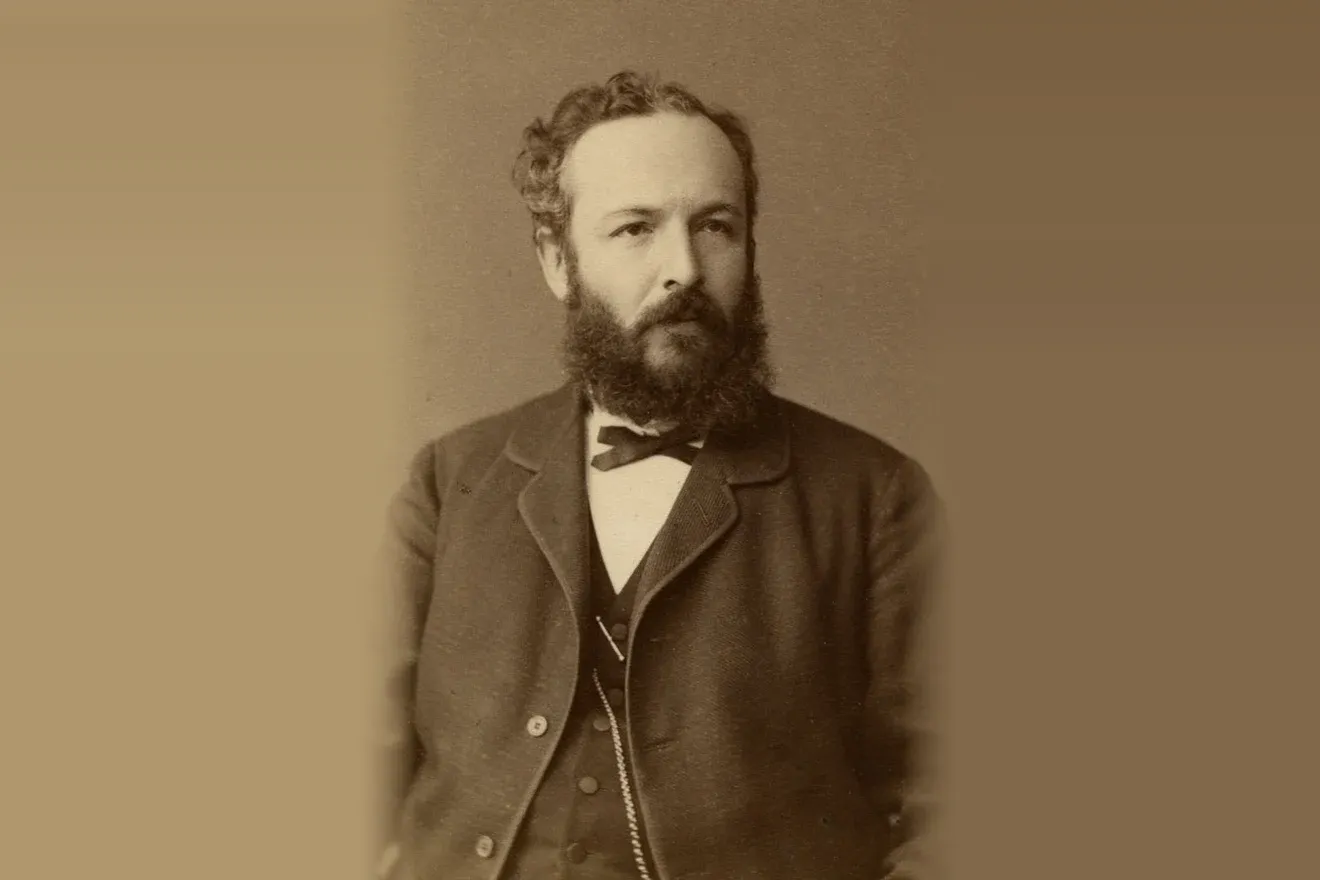
Georg Cantor proved some infinities are bigger than others, was called a charlatan and passed away in a psychiatric clinic. His idea now underpins mathematics.
Mục lục
Winter 1918 in Halle
On 6 January 1918, Germany was in the fourth year of the First World War. Food was rationed and scarce everywhere. In the neurological clinic of the university hospital in Halle, a 72-year-old man, wasted from hunger, passed away after a heart attack. A few months earlier he had written to his wife asking to be allowed to come home. He was not allowed[1].
The old man was Georg Cantor, who had proved something almost no one before him had dared to think: there is more than one kind of infinity. Some infinities are bigger than others. The set of natural numbers 1, 2, 3… is infinite. The set of all points on a line segment is infinite too. But the second is strictly bigger than the first, and Cantor proved it with an argument so short that a high-school student can follow it.
For that idea, one of the most powerful mathematicians in Germany called him a charlatan. He lived for more than thirty years with bouts of severe depression, was hospitalised many times, and passed away in a hospital room in the middle of a war. Only a few years later, David Hilbert, the greatest mathematician of the day, declared: “No one shall expel us from the paradise that Cantor has created for us”[5].
This is an episode in a series about mathematicians. It tells why infinities can come in different sizes, the price Cantor paid for discovering it, and why every computer today still carries his fingerprints.
Is there an infinity bigger than infinity?
Before meeting Cantor, try answering a question yourself: which are there more of, natural numbers or even numbers?
Intuition says natural numbers, since the even numbers are only half of them. But try this: pair 1 with 2, 2 with 4, 3 with 6, and so on, each n with 2n. No natural number is left out, no even number is left out, nobody is paired twice. The two sides match one to one.
Galileo noticed this paradox in 1638, with the square numbers 1, 4, 9, 16…, and concluded that “equal”, “greater” and “less” simply do not apply to the infinite. He stopped there. Nearly 250 years later, Cantor did the opposite: he took that very pairing as the definition.
To know whether a theatre has as many seats as spectators, you do not need to count: if every seat has exactly one person and nobody is standing, the numbers are equal. Cantor said: two sets have the same “size” if they can be paired off, with nothing left over on either side. For infinite sets, this is the only way to compare, and it leads to strange results.
Hilbert’s hotel
In 1924 Hilbert told a story to illustrate this, later known as Hilbert’s hotel. A hotel has infinitely many rooms, numbered 1, 2, 3…, and every room is occupied. A new guest arrives. No vacancy?
There is room: every guest moves to the next room, and room 1 is free. Then a bus with infinitely many new guests arrives. Still room: the guest in room n moves to room 2n, and all the odd-numbered rooms are free.
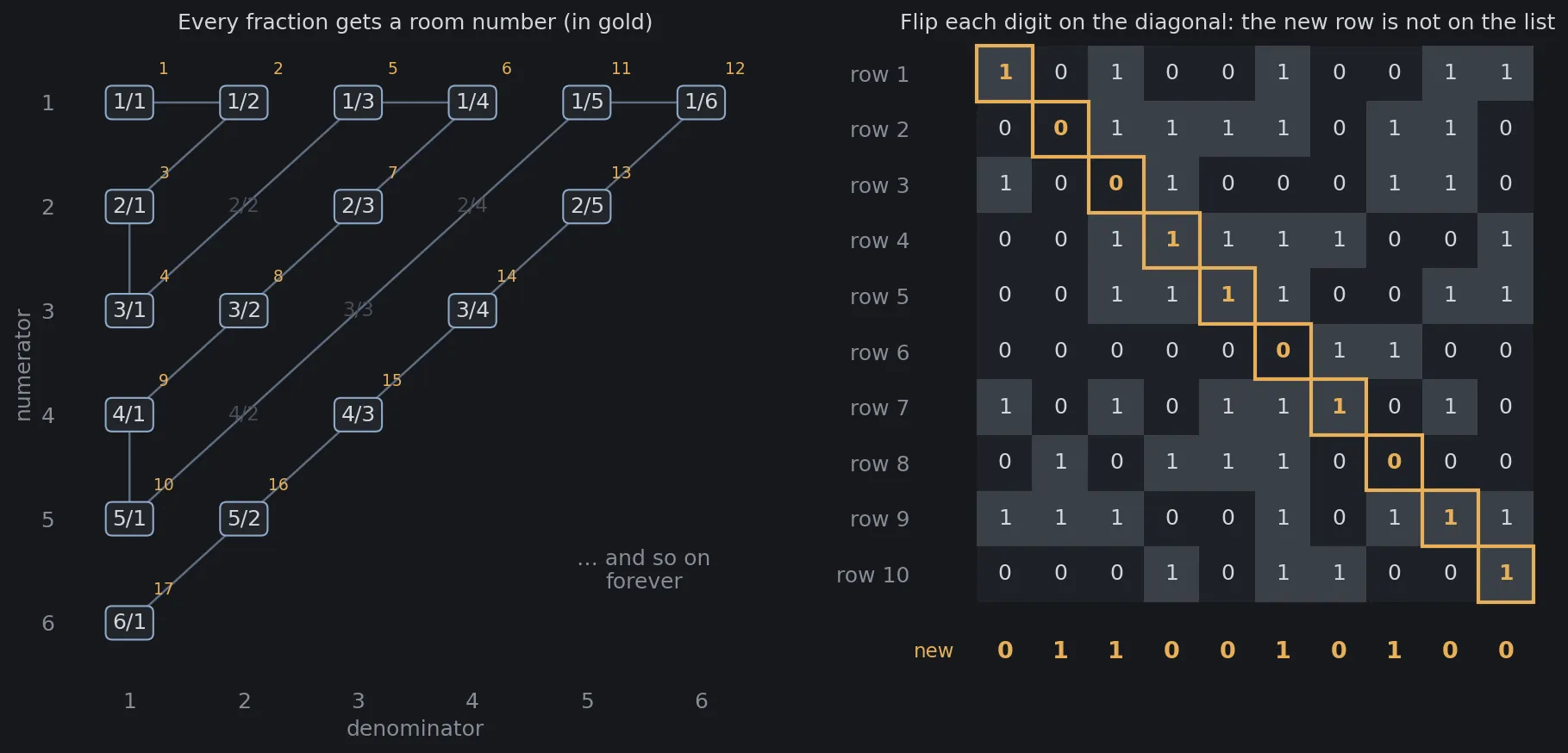
Even every positive fraction gets a room. Arrange them in a table: rows are numerators, columns are denominators. Then walk along the diagonals, like a snake crossing a chessboard: 1/1, 1/2, 2/1, 3/1, 1/3… Skip any fraction that repeats an earlier one (2/4 is just 1/2). Sooner or later the snake passes every cell, so every fraction gets a room number. The path is shown on the left of Figure 1, below.
Sets that fit into Hilbert’s hotel like this, that is, can be arranged in a list of first, second, third…, are called countable. Natural numbers, even numbers, integers, fractions: all countable, all the same size of infinity.
At this point it is tempting to think all infinities are alike. Cantor was the first to prove that this is false.
The boy from Saint Petersburg
Georg Cantor was born on 3 March 1845 in Saint Petersburg, Russia. His father was a merchant of Danish origin; his mother came from a family of violinists. Cantor himself played the violin well and loved music all his life. In 1856, because of his father’s health, the family moved to Germany[1].
His father wanted him to be an engineer, but in 1862 agreed to let him study mathematics. He studied in Zürich and then Berlin, home to three great mathematicians: Karl Weierstrass, Ernst Kummer and Leopold Kronecker. Remember the last name. In 1869 Cantor began teaching at the University of Halle, a small university. He always hoped to move to Berlin, but stayed in Halle for the rest of his life.
In 1872, on holiday in Switzerland, Cantor met Richard Dedekind. The letters the two exchanged over the following years are where the theory of infinity was born[2].
Winter 1873: the real numbers will not line up
On 29 November 1873, Cantor wrote Dedekind a seemingly innocent question: can the natural numbers be paired off with all the real numbers, every point on the number line, including numbers like and ? In other words: do the real numbers fit into Hilbert’s hotel?
Just a week later, on 7 December, Cantor sent the answer: no. However you arrange them, every list leaves out some real number[2].
His first proof was fairly technical. Eighteen years later, in 1891, Cantor found another, so neat that it now has its own name: the diagonal argument[4].
What is Cantor’s diagonal argument?
To keep things simple, consider infinite sequences of the digits 0 and 1, such as 0110100… Each such sequence corresponds to a real number (much as a computer writes numbers in binary), so if these sequences cannot be put in a list, neither can the real numbers.
Suppose someone claims to have put all the sequences in a list: first sequence, second sequence, third sequence… Cantor builds a new sequence like this:
- Look at the first digit of the first sequence. If it is 0, write 1; if it is 1, write 0.
- Look at the second digit of the second sequence, and flip it.
- Look at the third digit of the third sequence, and flip it. And so on forever.
Is the new sequence on the list? It cannot be the first sequence, because it differs from it in the first digit. It cannot be the second, because it differs in the second digit. It cannot be the millionth, because it differs in the millionth digit. It differs from every sequence on the list in at least one place. So the list is incomplete, however cleverly it was built.
Conclusion: the real numbers are uncountable. Hilbert’s hotel, for all its infinitely many rooms, cannot hold them. The infinity of the real numbers is bigger than the infinity of the natural numbers.
Cantor went further. Using the same diagonal idea, he proved that for any set, the set of all its subsets is always bigger than the set itself. So there is no largest infinity: above every infinity there is a bigger one, and a bigger one again, a ladder with no top rung. He called the numbers that measure these sizes of infinity transfinite numbers, and named them with the Hebrew letter (aleph).
A shocking consequence
As early as 1874, Cantor showed that the numbers which are roots of a polynomial equation with integer coefficients (such as , a root of ) are merely countable. So the overwhelming majority of real numbers are transcendental, like or e. Before that, it took great effort to prove that even one specific number was transcendental; Cantor showed that they fill almost the entire number line without naming a single one.
The result was published in 1874 in Crelle’s journal, the same journal that had printed the first papers of Abel half a century earlier. Cantor gave the paper a modest title about “algebraic numbers”. According to many historians, this was a detour to get the paper past opponents he knew would read it[2].
“I see it, but I don’t believe it”
Three years later, Cantor asked himself another question. Does a square have “more points” than one of its sides? Intuition, and most of the mathematicians he asked, said yes: a square has two dimensions, a segment only one.
Cantor proved that the answer is no. A line segment and a square, even a cube, have the same number of points. The rough idea is to “interleave” digits: the point with coordinates (0.123…, 0.456…) in the square corresponds to the point 0.142536… on the segment, taking the digits of the two coordinates in turn. (The full proof must handle numbers with two decimal expansions, like 0.0999… = 0.1, carefully, but that is the idea.)
On 29 June 1877 he wrote to Dedekind, in French in the middle of a German letter: “Je le vois, mais je ne le crois pas!”, “I see it, but I don’t believe it!”[2]. Every step was correct, but the result contradicted everything he had been taught about space.
The paper on this result was sent to Crelle’s journal and held up for an unusually long time. Cantor believed someone was deliberately blocking it. He had a name in mind. The paper was finally published in 1878, but Cantor never sent another paper to that journal[1].
Kronecker and the door to Berlin
The name was Leopold Kronecker, Cantor’s former teacher in Berlin.
Kronecker was a great mathematician, powerful in Berlin, and firmly convinced that mathematics must be built from the integers in finitely many steps that can be carried out on paper. A famous saying is attributed to him: “God made the integers; all else is the work of man.” For Kronecker, a “completed” infinite set, existing all at once, was not mathematics. Cantor’s stacked infinities even less so.
The opposition did not stay philosophical. According to accounts by Cantor and his contemporaries, Kronecker called Cantor a “scientific charlatan”, a “renegade” and a “corrupter of youth”[2]. Cantor believed it was Kronecker who kept him from ever being offered a post in Berlin. No document proves this for certain, but Cantor believed it, and the belief stayed with him for years.
To be fair, Kronecker was no fairy-tale villain. “Does a mathematical object exist if we cannot construct it?” is a serious question, and soon afterwards set theory did run into real paradoxes, such as Russell’s paradox of 1901. Kronecker was wrong to want an idea banned, but not wrong to demand that it be solid.
Cantor’s tragedy: thirty years in the dark
In May 1884, at 39, Cantor suffered his first recorded severe breakdown[1]. He was straining to prove a conjecture of his own (more on it below). Some days he believed he had proved it true, then found a mistake; other days he believed he had proved it false, then found another mistake.
A year later came another blow, this time from a friend. Gösta Mittag-Leffler, editor of the Swedish journal Acta Mathematica, who had published many of Cantor’s papers when German journals hesitated, advised him to withdraw a paper he had submitted. Mittag-Leffler’s explanation, as recorded, was that the paper was “about one hundred years too soon”[1]. He meant well, but to Cantor it was a sign that even his allies did not believe in him.
The depression returned again and again. He turned to subjects far from mathematics: trying to prove that Shakespeare’s plays were really written by Francis Bacon, and corresponding with theologians. A deeply religious man, he believed that the absolute infinite belonged to God, and that his theory had been revealed to him to write down[2].
There were bright years too: in 1890 he founded the German Mathematical Society and became its first president, then campaigned for the first International Congress of Mathematicians, held in Zürich in 1897. Kronecker passed away in 1891, after the two had partly reconciled.
Then, in December 1899, his youngest son Rudolf, not yet fourteen, passed away suddenly while Cantor was away lecturing on the Bacon–Shakespeare question[1]. Cantor almost collapsed. From then on, his stays in the Halle neurological clinic became more frequent.
In 1904, at the International Congress of Mathematicians in Heidelberg, the Hungarian mathematician Julius König presented a proof that Cantor’s great conjecture was false. By some accounts, Cantor sat in the audience and was deeply shaken. Less than a day later, Ernst Zermelo found the error in König’s proof[1].
He retired in 1913. The celebration of his 70th birthday in 1915 had to be scaled down because of the war. In June 1917 he entered the clinic for the last time.
Did his opponents drive him mad?
The story often told is that, opposed by the mathematical world, Cantor could not bear it and went mad. It spread through Eric Temple Bell’s Men of Mathematics (1937), a good book with a taste for drama.
Later historians, such as Joseph Dauben, see it differently. Cantor’s illness, according to many researchers, resembles bipolar disorder: severe depression alternating with periods of feverish work. It might have come even without Kronecker. Pressure from colleagues, the loss of his son and an unsolvable question probably made it worse, but were not necessarily the cause[2].
One example shows how the “whole world against Cantor” story has been exaggerated: the line “set theory is a disease from which mathematics will recover” is often attributed to Henri Poincaré. The historian Jeremy Gray went looking for it and found it in none of Poincaré’s writings[6].
The truth is perhaps sad in a quieter way: a sensitive man, with an illness no one at the time understood or could treat, produced one of the boldest works in the history of mathematics in between its episodes.
The continuum hypothesis: a question with no answer
The question that tormented Cantor from 1878 on was this. The infinity of the natural numbers is the smallest size, called . The infinity of the real numbers is bigger. But is there a size of infinity in between? Cantor believed there was not, and called this belief the continuum hypothesis (the continuum being his name for the real line). He tried to prove it for the rest of his life.
In 1900, when Hilbert presented his list of 23 great problems for the new century in Paris, Cantor’s hypothesis came first.
The answer came in two halves, and it was stranger than anything Cantor could have imagined. In 1940, Kurt Gödel proved that with the standard axioms of mathematics, one cannot prove the hypothesis false. In 1963, Paul Cohen proved that one also cannot prove it true[8]. Cohen received the Fields Medal for this.
In other words: the question Cantor spent half his life on has no answer in ordinary mathematics. One can accept the hypothesis, or accept its opposite, and neither choice leads to a contradiction. Cantor did not fail for lack of talent: the problem he posed lay beyond the reach of the very tools he had built.
Where is Cantor today?
The common language of mathematics
Today, nearly every university mathematics course begins with sets. Functions, probability, geometry, algebra: all are defined in the language of sets that Cantor started, after Zermelo and others repaired the foundations to avoid the paradoxes. The chapter on sets at the start of many high-school maths courses is a distant descendant of Cantor’s letters to Dedekind.
From the diagonal to the limits of computers
The diagonal argument turned out to be far more powerful than a trick about real numbers. In 1936, Alan Turing used exactly the same structure to prove that no program can check every other program to decide whether it runs forever, the problem now called the halting problem[7]. Suppose there is a list of all programs; build a program that “goes against the diagonal”, doing the opposite of what program n does on input n. It differs from every program on the list, and a contradiction appears. That is why no testing tool can catch every infinite loop.
In the same paper, Turing pointed out something just as surprising: all possible computer programs, however long, form only a countable list, because each program is a finite string of characters. The real numbers are uncountable. So almost every real number cannot be computed by any program at all. The numbers we can compute, like , or e, are tiny islands in an ocean that computers will never reach.
And the Cantor set (1883), obtained by repeatedly removing the middle third of a segment, has total length 0 yet as many points as the whole original segment. Nearly a century later, Benoît Mandelbrot counted it among the first fractals.
Line up the fractions and draw the diagonal yourself
The Python below produces Figure 1: it hands out room numbers to fractions along the diagonals, then runs the diagonal argument on 10 random 0/1 sequences (seed 1891, the year Cantor published the argument). All you need is numpy and matplotlib.
import matplotlib.pyplot as pltimport numpy as npfrom math import gcd
plt.rcParams.update({"figure.facecolor": "#16181c", "axes.facecolor": "#16181c", "text.color": "#d4d7dc",                     "axes.edgecolor": "#2a2e35", "xtick.color": "#878d97", "ytick.color": "#878d97", "font.size": 12})
# ── Part 1: line up every positive fraction along the diagonals (zigzag) ────N = 6                                  # draw a 6 × 6 table: row = numerator, column = denominatororder = []                             # order in which cells are visited (num, den)for s in range(2, N + 2):              # diagonal s: num + den = s    diag = [(p, s - p) for p in range(1, s)]    order += diag if s % 2 else diag[::-1]   # up, then down, like a snake
seat = {}                              # fraction → room number in Hilbert's hotelfor p, q in order:    if gcd(p, q) == 1:                 # 2/4 equals 1/2, so skip it: keep reduced fractions only        seat[(p, q)] = len(seat) + 1print("first 10 fractions:", [f"{p}/{q}" for (p, q), k in seat.items() if k <= 10])
# ── Part 2: the diagonal argument ───────────────────────────────────────────rng = np.random.default_rng(1891)      # seed = the year Cantor published the diagonal argumentK = 10                                 # a "list" of 10 sequences, each 10 digits of 0/1table = rng.integers(0, 2, size=(K, K))diagonal = table[np.arange(K), np.arange(K)]new_row = 1 - diagonal                 # flip 0 ↔ 1 at each position on the diagonalprint("new sequence:", "".join(map(str, new_row)))print("new sequence differs from row i at digit i:", all(new_row[i] != table[i, i] for i in range(K)))print("does it match any row?", any((table == new_row).all(axis=1)))
# ── Plot ────────────────────────────────────────────────────────────────────fig, (ax1, ax2) = plt.subplots(1, 2, figsize=(12.5, 6))
xs = [q for p, q in order]ys = [p for p, q in order]ax1.plot(xs, ys, color="#8fa9c9", lw=1.2, alpha=0.6)for p in range(1, N + 1):    for q in range(1, N + 1):        if (p, q) in seat:            ax1.text(q, p, f"{p}/{q}", ha="center", va="center", fontsize=12, color="#d4d7dc",                     bbox=dict(boxstyle="round,pad=0.3", fc="#22262c", ec="#8fa9c9", lw=1))            ax1.text(q + 0.3, p - 0.32, str(seat[(p, q)]), ha="center", va="center", fontsize=9, color="#e8b05a")        elif p + q <= N + 1:           # duplicates (2/2 = 1/1, 2/4 = 1/2…): skipped, greyed out            ax1.text(q, p, f"{p}/{q}", ha="center", va="center", fontsize=11, color="#4a4e57")ax1.text(N - 0.5, N - 0.5, "… and so on\nforever", ha="center", va="center", fontsize=12, color="#878d97")ax1.set_xlim(0.4, N + 0.6)ax1.set_ylim(N + 0.6, 0.4)ax1.set_xticks(range(1, N + 1))ax1.set_yticks(range(1, N + 1))ax1.set_xlabel("denominator", color="#878d97")ax1.set_ylabel("numerator", color="#878d97")ax1.set_title("Every fraction gets a room number (in gold)", color="#d4d7dc", fontsize=12)
ax2.imshow(np.where(table[..., None] == 1, [0.23, 0.25, 0.28], [0.12, 0.13, 0.15]), extent=(-0.5, K - 0.5, K - 0.5, -0.5))for i in range(K):    for j in range(K):        on_diag = i == j        ax2.text(j, i, str(table[i, j]), ha="center", va="center", fontsize=12,                 color="#e8b05a" if on_diag else "#d4d7dc", fontweight="bold" if on_diag else "normal")    ax2.add_patch(plt.Rectangle((i - 0.5, i - 0.5), 1, 1, fill=False, ec="#e8b05a", lw=2))for j in range(K):    ax2.text(j, K + 0.4, str(new_row[j]), ha="center", va="center", fontsize=13, color="#e8b05a", fontweight="bold")ax2.text(-0.9, K + 0.4, "new", ha="right", va="center", fontsize=11, color="#e8b05a")ax2.set_xlim(-1.6, K - 0.4)ax2.set_ylim(K + 1, -0.6)ax2.set_yticks(range(K))ax2.set_yticklabels([f"row {i + 1}" for i in range(K)])ax2.set_xticks([])ax2.set_title("Flip each digit on the diagonal: the new row is not on the list", color="#d4d7dc", fontsize=12)for ax in (ax1, ax2):    ax.tick_params(length=0)    for s in ax.spines.values():        s.set_visible(False)fig.tight_layout()fig.savefig("cantor-duong-cheo-en.png", dpi=150, bbox_inches="tight")
first 10 fractions: ['1/1', '1/2', '2/1', '3/1', '1/3', '1/4', '2/3', '3/2', '4/1', '5/1']new sequence: 0110010100new sequence differs from row i at digit i: Truedoes it match any row? FalseThe first line is the first guests of Hilbert’s hotel. The last two lines are Cantor’s whole argument in miniature: the new sequence differs from row i exactly at digit i, so it matches no row.
Try changing the seed or raising K to 50: the diagonal always finds a sequence that was left out.
Back to Halle, 1918
Cantor passed away in a cold hospital room, hungry, not allowed to go home. He did not live to see his hypothesis resolved in the strangest way possible, or his diagonal argument mark out the limits of machines no one had yet imagined.
But he saw something that Galileo saw and turned away from: infinity can be counted, compared, arranged into a ladder. He looked straight at it when the most powerful people in his field told him he was not allowed to, and when his own mind turned against him.
In 1925, in a lecture published the following year, Hilbert promised that no one would expel mathematicians from Cantor’s paradise. A hundred years later, we are still in it.
Other episodes of the series: Abel and the letter that came too late, Galois, the night before the duel, Gauss and the lost asteroid, and Euler and the seven bridges of Königsberg.
Tài liệu tham khảo
- [1]J. J. O'Connor and E. F. Robertson. Georg Ferdinand Ludwig Philipp Cantor (1845–1918), biography. MacTutor History of Mathematics, University of St Andrews.
- [2]Joseph W. Dauben. Georg Cantor: His Mathematics and Philosophy of the Infinite. Princeton University Press, 1990.
- [3]Georg Cantor. Über eine Eigenschaft des Inbegriffes aller reellen algebraischen Zahlen. Journal für die reine und angewandte Mathematik 77, 1874.
- [4]Georg Cantor. Über eine elementare Frage der Mannigfaltigkeitslehre. Jahresbericht der Deutschen Mathematiker-Vereinigung 1, 1891.
- [5]David Hilbert. Über das Unendliche. Mathematische Annalen 95, 1926.
- [6]Jeremy Gray. Did Poincaré say 'set theory is a disease'?. The Mathematical Intelligencer 13(1), 1991.
- [7]Alan Turing. On Computable Numbers, with an Application to the Entscheidungsproblem. Proceedings of the London Mathematical Society, 1936.
- [8]Paul J. Cohen. The Independence of the Continuum Hypothesis. Proceedings of the National Academy of Sciences 50(6), 1963.
- [9]Georg Cantor. Wikipedia.