Abel and the letter that came too late: no quintic formula
Niels Henrik Abel proved the quintic has no general formula, self-printed six pages, and passed away at 26. His ideas now secure HTTPS and Bitcoin.
Mục lục
A letter dated 8 April 1829
On 8 April 1829, in Berlin, the mathematician August Leopold Crelle wrote a letter with good news for his young friend in Norway: after months of lobbying, Crelle had secured him a teaching post at the University of Berlin. The young man would no longer have to live on private tutoring. He would have a salary, students, and time.
The addressee never read that letter. Niels Henrik Abel had passed away two days earlier, on 6 April, of tuberculosis, in a house at Froland in southern Norway. He was 26[1].
Five years before, Abel had settled the most famous question in the algebra of his day: the general equation of the fifth degree has no formula for its solutions. He printed that proof at his own expense, squeezed onto six pages to keep the cost down, and sent it to the greatest mathematicians in Europe. Almost nobody read it.
This is one episode of a series on mathematicians. By the end, you will see why Abel’s name is now written with a lower-case letter in mathematics books, and why one line of his research guards every website with a padlock in the address bar.
A three-hundred-year puzzle
The article on Galois, the night before the duel tells this story in detail, so here is only a short recap. The quadratic equation has a formula everyone learns at school, using only addition, subtraction, multiplication, division and roots. In the 16th century, Italian mathematicians found formulas for the cubic and the quartic, far longer and messier, but still using only those same operations.
Then, for almost three hundred years, nobody found a formula for the quintic. In 1799, the Italian mathematician Paolo Ruffini offered a proof that no such formula exists, but it had gaps, and the mathematical community did not accept it[4]. The question was still open when Abel arrived.
The pupil in Christiania
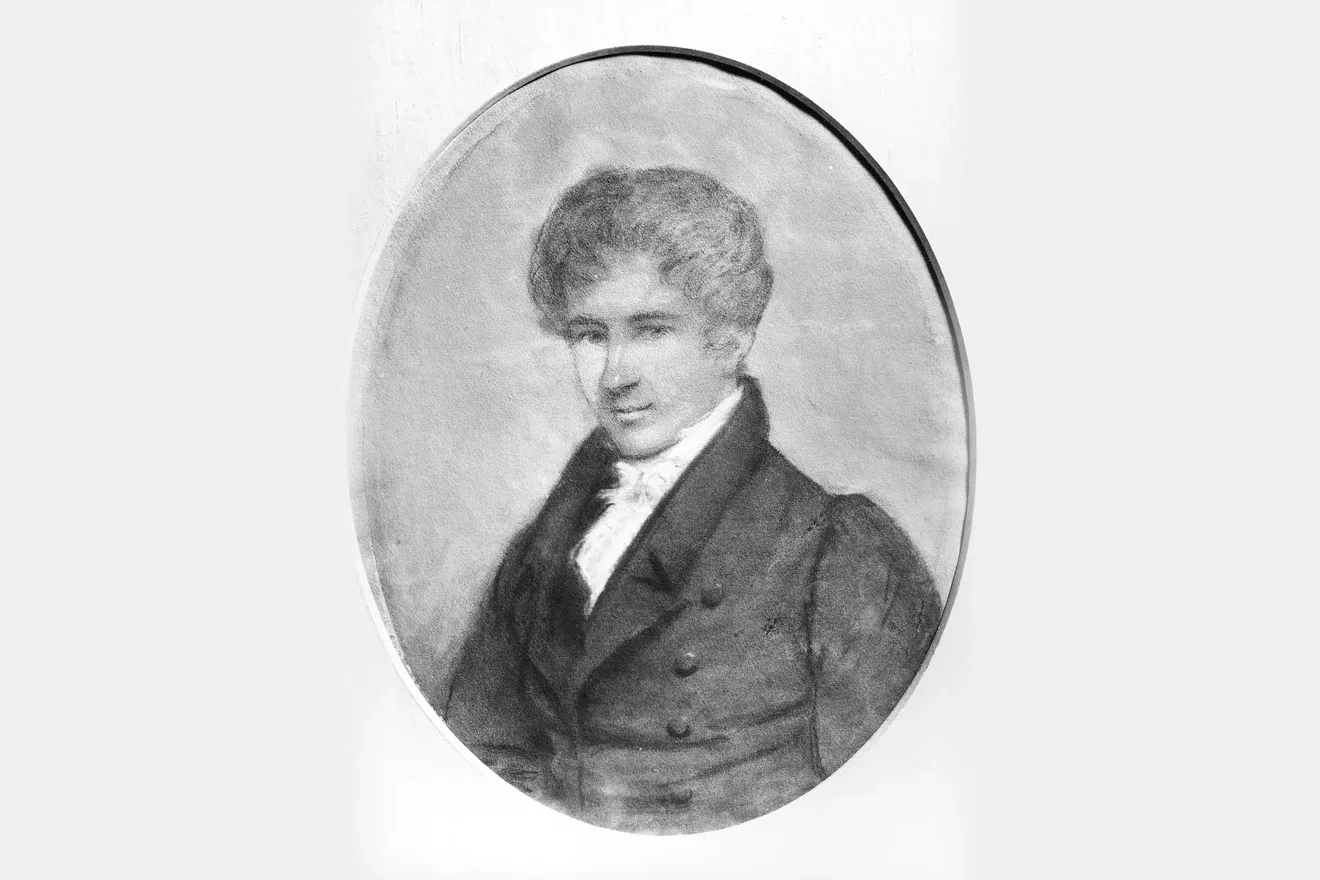
Abel was born on 5 August 1802 near Stavanger, Norway, the son of a pastor. His mother was the daughter of a merchant said to be the richest man in the town of Risør; she loved organising balls, but fell into drinking early and took little interest in her children[4]. The family was large and poor, and poorer still after the father passed away in 1820. Norway was then a small country that had just separated from Denmark, with no real tradition in mathematics.
The turning point came at the Cathedral School in Christiania, today’s Oslo. In 1817 the school got a new mathematics teacher, Bernt Michael Holmboe, only seven years older than Abel. Holmboe saw at once that his fifteen-year-old pupil was unlike anyone else. He had him read Euler, Lagrange and Gauss directly, and later raised money with his colleagues so that Abel could go to university[1].
In 1821, Abel believed he had found a formula for the quintic. His paper was sent to the Danish mathematician Ferdinand Degen. Degen could not find a mistake, but asked Abel for a concrete example. While working out the example, Abel found his own error[1].
It is a lesson worth remembering: an argument that looks airtight on paper can collapse the moment you try a specific case. And perhaps that failure is what changed Abel’s direction. Instead of hunting for a formula, he began to ask: what if the formula does not exist?
Six self-printed pages
In 1824, Abel had the answer. He proved that no general formula using only addition, subtraction, multiplication, division and roots can solve every equation of the fifth degree.
Abel had no money, and no Norwegian journal printed advanced mathematics. He paid to have the proof printed in French, the language of mathematics at the time. To save on printing costs, he compressed the whole argument into six pages, cutting every explanation he could[1]. The result was correct but extremely hard to read.
He sent the pamphlet to leading mathematicians, among them Gauss, the man Abel admired most. According to a story told many times, after Gauss passed away Abel’s pamphlet was found in his library with its pages still uncut, meaning it had never been opened[1]. Nobody knows for sure what Gauss thought, but at the time he did not consider solvability by radicals an important question.
How did Abel prove it?
The details are technical, but the shape of the idea can be told in words.
A solution formula, however long, is a tower of radicals: start from the coefficients, add, subtract, multiply, divide, take a root, then combine those results again, take roots on the next level, and so on. The quadratic formula has one level; the cubic and quartic formulas have a few.
Abel assumed such a tower exists for the quintic, then proved something surprising: every brick in the tower, every root on every level, must be expressible in terms of the five solutions themselves. Once that is true, you can ask: if the five solutions are shuffled, how many different values can each brick take? Counting carefully, Abel showed that those numbers cannot be stacked into a tower that reaches the five solutions. The assumption leads to a contradiction, so the tower does not exist.
Today the result is called the Abel–Ruffini theorem, crediting the man who opened the way. A few years later, Galois went further: he showed why there is no formula, and gave a way to test each specific equation for solvability by radicals. Abel answered “no”; Galois answered “why”.
A journey across Europe
In 1825, the Norwegian government gave Abel a grant to study abroad. In Berlin he met Crelle, a civil engineer with a passion for mathematics. The two got on at once. In 1826 Crelle founded a new mathematics journal, still known as Crelle’s Journal, and in its very first year printed seven papers by Abel, including a full rewrite of the quintic proof, far easier to read than the six pages of 1824[4].
Then Abel went to Paris, the centre of the mathematical world. In October 1826 he submitted to the French Academy of Sciences the work he considered the most important of his life, a general theorem about a class of integrals that now bears his name. The referees were Cauchy and Legendre.
Cauchy put the manuscript aside and forgot about it. It was found only in 1830, after Abel passed away. It was printed in 1841, then the original was lost again, and found once more in Florence, Italy, in 1952[1]. If you have read the article on Galois, the name Cauchy will sound familiar: he was also the one who did not publish Galois’s first manuscript.
Abel left Paris with empty pockets, unknown, and with a cough.
The race with Jacobi
Back in Norway in 1827, Abel was in debt, without a permanent position, living on tutoring and small advances. Yet these were also the years he did mathematics most intensely.
His big subject was elliptic integrals, the integrals that appear when you compute the perimeter of an ellipse or the motion of a pendulum swinging widely. Mathematicians already knew they could not be computed with the familiar functions. Abel had a reversing idea: don’t look at the integral, look at its inverse function, just as the sine is much easier to work with than the arcsine. These inverse functions, now called elliptic functions, turned out to have a beautiful structure: they are periodic in two directions at once.
At the same time, in Königsberg, the young German mathematician Carl Jacobi was reaching similar results. The two published almost in parallel, each paper answering the previous one. Legendre, then in his seventies and having devoted his life to elliptic integrals, wrote that through these works both would be placed among the foremost analysts[1].
Winter in Froland
At Christmas 1828, Abel travelled for days by sledge through the Norwegian winter to Froland, where his fiancée, Christine Kemp, worked as a governess. There he fell seriously ill. The tuberculosis advanced quickly. He passed away on 6 April 1829.
Two days later, Crelle wrote the letter about the post in Berlin.
In 1830, the French Academy awarded its Grand Prize in mathematics to Abel, posthumously, jointly with Jacobi[1]. The French mathematician Charles Hermite is said to have remarked that Abel left mathematicians enough to keep them busy for five hundred years[4].
Where is Abel today?
A name written in lower case
In mathematics books, people speak of abelian groups, and “abelian” is usually written with a small letter, as an ordinary word rather than a proper name[4]. It is a rare honour: a person’s name has become an adjective.
An abelian group is one where order does not matter: doing A then B is the same as doing B then A. Adding numbers is an example: 3 + 5 = 5 + 3. Turning a Rubik’s cube is not: turning the top face then the right face gives a different state from turning the right face then the top. The Rubik’s cube group is not abelian. The name honours Abel because, in his work on equations, he studied exactly the equations with this “order doesn’t matter” property and showed they are always solvable by radicals.
From elliptic functions to the padlock in your browser
Abel and Jacobi’s work on elliptic functions leads to an object that is now everywhere: the elliptic curve. The name is misleading, because it is not an ellipse. It is a curve of the form
and the name comes from the very elliptic integrals Abel studied: elliptic functions are a way to “parametrise” these curves.
What makes them special is that on an elliptic curve you can add two points to get a third: draw the line through the two points, find where the line meets the curve a third time, then flip that point across the horizontal axis. This addition has all the properties of ordinary addition, and it is the addition of an abelian group: P + Q always equals Q + P.
Cryptography relies on exactly this property. Take a point G on the curve, working over a finite set of numbers (much like the Galois field of the previous article). Adding G to itself a times is easy, but recovering a from the result is extremely hard. Two people who want a shared secret key over a channel anyone can eavesdrop on:
- Alice picks a secret number a and sends the point a·G.
- Bob picks a secret number b and sends the point b·G.
- Alice computes a·(b·G), Bob computes b·(a·G). Because order does not matter, both reach the same point: the shared key. The eavesdropper only sees a·G and b·G and cannot compute the key.
This is the key exchange behind most HTTPS connections today, usually on a curve called Curve25519[5]. Bitcoin signs transactions on another elliptic curve, called secp256k1[6]. Compared with RSA, explained in the article on prime numbers, RSA and JWT, elliptic-curve cryptography needs much shorter keys for the same security: about 256 bits instead of 3,072[7]. That is why it is in phones, chip cards and anywhere that needs to be fast and light.
To be fair, Abel never thought about cryptography, and the road from elliptic functions in 1827 to Curve25519 runs through the work of many people over almost two centuries. But the two ideas at its heart, elliptic functions and abelian groups, both start with the young man from Christiania.
The Abel Prize
In 2002, for the bicentenary of Abel’s birth, the Norwegian government created the Abel Prize, first awarded in 2003 and every year since for the most outstanding contributions to mathematics. It is often called “the Nobel Prize of mathematics”[8]. The young man who once paid to print six pages now has his name on one of the field’s greatest awards.
Add two points on an elliptic curve yourself
The Python below does three things. First, it adds two points on the curve by drawing a line and flipping. Second, it repeats that addition with numbers modulo 97 and checks that P + Q = Q + P for every pair of points, i.e. that this really is an abelian group. Third, it simulates the key exchange between Alice and Bob. It produces Figure 1. All you need is numpy and matplotlib.
import matplotlib.pyplot as pltimport numpy as np
plt.rcParams.update({"figure.facecolor": "#16181c", "axes.facecolor": "#16181c", "text.color": "#d4d7dc",                     "axes.edgecolor": "#2a2e35", "xtick.color": "#878d97", "ytick.color": "#878d97", "font.size": 12})
# ── Part 1: adding two points on the curve y² = x³ − x + 1 (real numbers) ────A, B = -1, 1

def add_real(P, Q):    """Draw the line through P and Q, find its third intersection, then reflect it across the x-axis."""    (x1, y1), (x2, y2) = P, Q    m = (y2 - y1) / (x2 - x1)    x3 = m * m - x1 - x2    y3 = m * (x3 - x1) + y1          # third intersection (before flipping)    return (x3, y3), (x3, -y3)

P = (-1.0, 1.0)Q = (0.0, 1.0)third, R = add_real(P, Q)print("P + Q =", tuple(round(v, 3) for v in R), "| Q + P =", tuple(round(v, 3) for v in add_real(Q, P)[1]))
# ── Part 2: the same addition over a finite field (mod p) ──────────────────p, a, b = 97, 2, 3                    # y² = x³ + 2x + 3 (mod 97)O = None                              # "point at infinity": the identity element

def add_mod(P, Q):    if P is O:        return Q    if Q is O:        return P    (x1, y1), (x2, y2) = P, Q    if x1 == x2 and (y1 + y2) % p == 0:        return O    if P == Q:        m = (3 * x1 * x1 + a) * pow(2 * y1, -1, p) % p    else:        m = (y2 - y1) * pow(x2 - x1, -1, p) % p    x3 = (m * m - x1 - x2) % p    return (x3, (m * (x1 - x3) - y1) % p)

def mul(k, P):    """k·P = P + P + … + P (k times), computed fast by doubling and adding."""    R = O    while k:        if k & 1:            R = add_mod(R, P)        P = add_mod(P, P)        k >>= 1    return R

points = [(x, y) for x in range(p) for y in range(p) if (y * y - (x ** 3 + a * x + b)) % p == 0]swaps_ok = all(add_mod(P1, P2) == add_mod(P2, P1) for P1 in points for P2 in points)print(f"points on the curve mod {p}: {len(points)} (plus the point at infinity)")print("P + Q == Q + P for every pair of points:", swaps_ok)
# Diffie–Hellman key exchange: the order of addition doesn't matter, so both sides reach the same point.G = points[3]alice, bob = 29, 41                   # two secret numbersshared_a = mul(alice, mul(bob, G))    # Alice receives bob·G and multiplies by her numbershared_b = mul(bob, mul(alice, G))    # Bob receives alice·G and multiplies by his numberprint("G =", G, "| Alice's shared key:", shared_a, "| Bob's:", shared_b)
# ── Plot ──────────────────────────────────────────────────────────────────fig, (ax1, ax2) = plt.subplots(1, 2, figsize=(12, 5.4))gx, gy = np.meshgrid(np.linspace(-2, 3, 800), np.linspace(-3.2, 3.2, 800))ax1.contour(gx, gy, gy ** 2 - (gx ** 3 + A * gx + B), levels=[0], colors="#878d97", linewidths=2)line_x = np.linspace(-1.6, max(third[0], 0) + 0.8, 10)m = (Q[1] - P[1]) / (Q[0] - P[0])ax1.plot(line_x, P[1] + m * (line_x - P[0]), color="#8fa9c9", lw=1.5, ls="--")ax1.plot([third[0], R[0]], [third[1], R[1]], color="#8fa9c9", lw=1.5, ls=":")for (pt, name, col) in [(P, "P", "#d4d7dc"), (Q, "Q", "#d4d7dc"), (third, "", "#878d97"), (R, "P + Q", "#e8b05a")]:    ax1.plot(*pt, "o", color=col, ms=10)    if name:        ax1.annotate(name, pt, xytext=(10, 8), textcoords="offset points", color=col, fontsize=13)ax1.axhline(0, color="#2a2e35", lw=1)ax1.set_xlim(-2, 3)ax1.set_ylim(-3.2, 3.2)ax1.set_title("Adding two points: draw a line, then flip", color="#d4d7dc", fontsize=12)
ax2.plot(*zip(*points), "o", color="#4a4e57", ms=4)path = [mul(k, G) for k in range(1, 9)]ax2.plot(*zip(*path), color="#8fa9c9", lw=1, alpha=0.7)ax2.plot(*zip(*path), "o", color="#8fa9c9", ms=6)for k, pt in enumerate(path, 1):    ax2.annotate("G" if k == 1 else f"{k}G", pt, xytext=(6, 5), textcoords="offset points", color="#a4a9b2", fontsize=10)ax2.plot(*shared_a, "*", color="#e8b05a", ms=18)ax2.annotate("shared key", shared_a, xytext=(10, -14), textcoords="offset points", color="#e8b05a", fontsize=11)ax2.set_xlim(-3, p + 2)ax2.set_ylim(-3, p + 2)ax2.set_title(f"Same addition, mod {p}: G, 2G, 3G… jump all over", color="#d4d7dc", fontsize=12)for ax in (ax1, ax2):    ax.grid(color="#22262c")fig.tight_layout()fig.savefig("abel-elliptic-en.png", dpi=150, bbox_inches="tight")
P + Q = (1.0, -1.0) | Q + P = (1.0, -1.0)points on the curve mod 97: 99 (plus the point at infinity)P + Q == Q + P for every pair of points: TrueG = (1, 54) | Alice's shared key: (87, 27) | Bob's: (87, 27)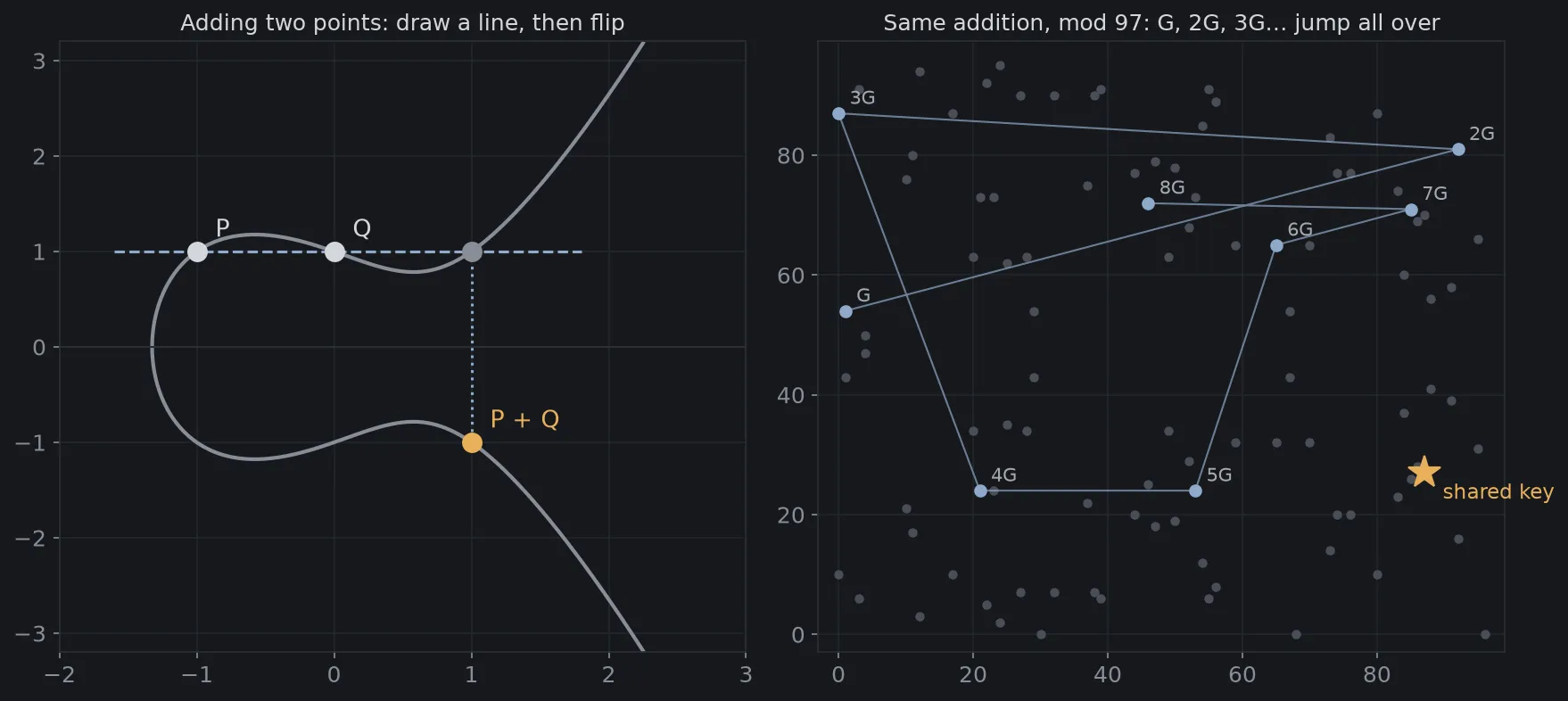
The third line of the output is Abel’s story in miniature: for all 99 points, adding in either order gives the same result. The last line is its consequence: Alice and Bob, each keeping a private number, still reach the same key (87, 27).
The right-hand chart shows why this is secure. Modulo 97 we can still count by hand. With a prime about 77 digits long, as in Curve25519, the multiples of G jump across a space of about points, and nobody knows how to walk back quickly: trying the possibilities one by one would take every computer on Earth billions of years.
You can change alice, bob, or pick a different point G to see that the two keys always match.
Back to April 1829
In his lifetime Abel never had a secure position, a living wage, or a reader who studied the most important manuscript of his life. He had Holmboe, the teacher who saw him. He had Crelle, the friend who printed his work. And he had a way of thinking rare at twenty: when nobody has found something for three hundred years, try proving it doesn’t exist.
Crelle’s letter came two days late. But the lower-case “abelian” in every algebra textbook, and the point addition on a curve inside your phone, arrived right on time.
Other episodes of the series: Euler and the seven bridges of Königsberg, Gauss and the lost asteroid, and Galois, the night before the duel, who picked up exactly the question Abel left behind.
Tài liệu tham khảo
- [1]J. J. O'Connor and E. F. Robertson. Niels Henrik Abel (1802–1829), biography. MacTutor History of Mathematics, University of St Andrews.
- [2]Arild Stubhaug. Niels Henrik Abel and his Times: Called Too Soon by Flames Afar. Springer, 2000.
- [3]Niels Henrik Abel. Mémoire sur les équations algébriques, où l’on démontre l’impossibilité de la résolution de l’équation générale du cinquième degré. Christiania (self-published), 1824.
- [4]Niels Henrik Abel. Wikipedia.
- [5]A. Langley, M. Hamburg and S. Turner. RFC 7748: Elliptic Curves for Security. IETF, 2016.
- [6]SEC 2: Recommended Elliptic Curve Domain Parameters (secp256k1). Standards for Efficient Cryptography Group, 2010.
- [7]NIST SP 800-57 Part 1 Rev. 5: Recommendation for Key Management. National Institute of Standards and Technology, 2020.
- [8]The Abel Prize. The Norwegian Academy of Science and Letters.