"And yet it moves": did Galileo really say it?
In 1633 Galileo knelt before the Inquisition and renounced the moving Earth. The true story behind "Eppur si muove", and why we never feel the Earth spin.
Mục lục
Rome, 22 June 1633
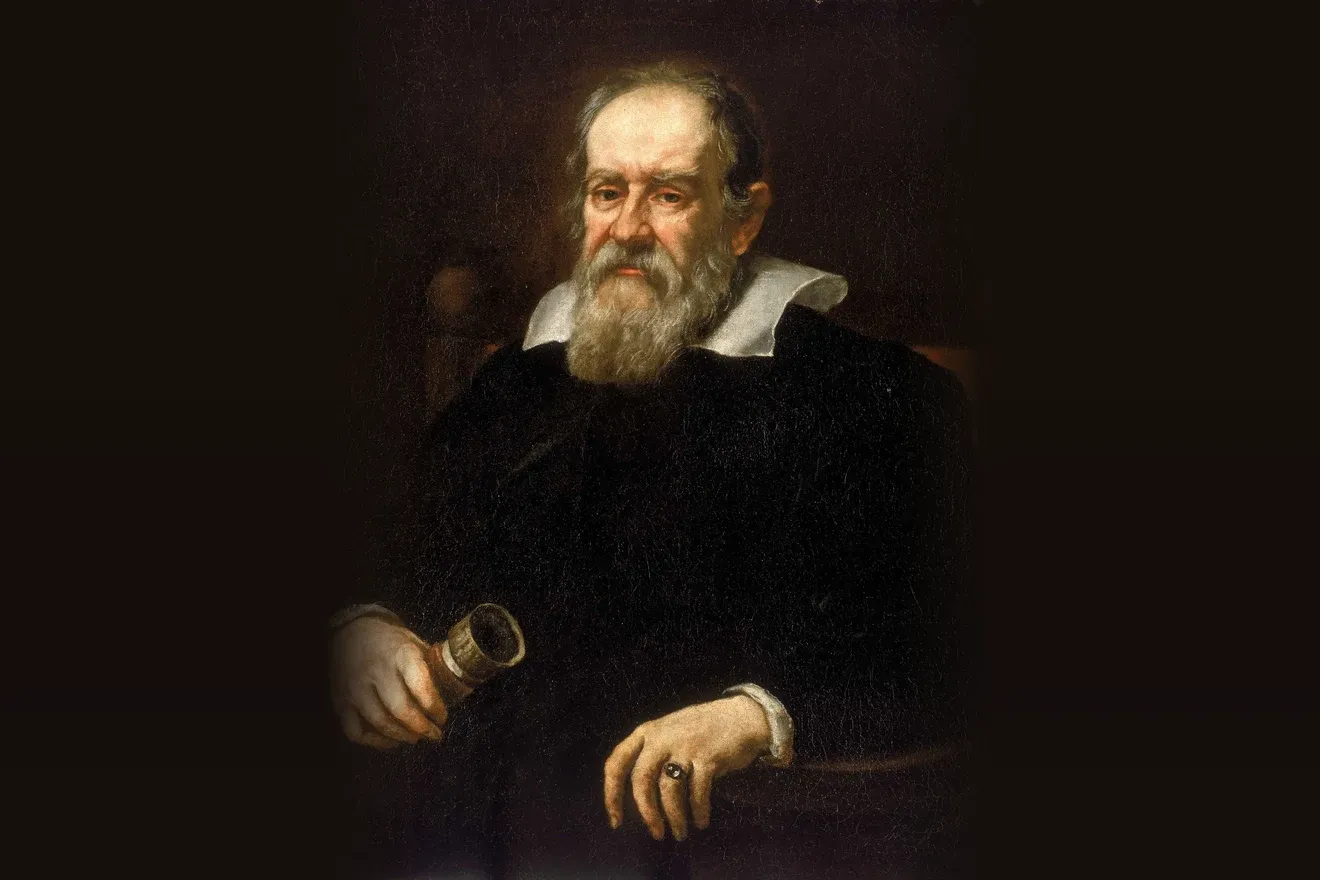
That morning, in a hall of the convent of Santa Maria sopra Minerva in Rome, a 69-year-old man in the white robe of a penitent knelt before the cardinals of the Inquisition. He read aloud a prepared text: he “abjured, cursed and detested” the idea that the Sun stands still at the centre of the universe while the Earth moves[2].
The old man was Galileo Galilei, the most famous scientist in Europe. According to a story retold for almost four centuries, as he rose to his feet he stamped on the floor and muttered: “Eppur si muove”, “And yet it moves.”
Did Galileo really say it? Almost certainly not, at least not in front of the court. The line first appeared in print more than a century later. But the true story is more dramatic than the legend: a friendship with a pope that fell apart, a banned book, and a physics question that the people who condemned him asked in all seriousness: if the Earth spins so fast, why don’t we notice anything?
This is the first episode of a series about physicists: one person, one moment per episode.
Why don’t we feel the Earth spinning?
The Earth turns once a day. At the equator, the ground races east at about 1,670 km/h. In Hanoi it is about 1,560 km/h, almost twice the speed of an airliner. On top of that, the Earth orbits the Sun at about 107,000 km/h.
Yet the glass of water on your desk does not ripple. People in Galileo’s time had good reason to doubt: if the ground moved that fast, a stone dropped from a tower should land far from its base, because the tower would have moved on while the stone fell; birds leaving a branch would be left behind; a fierce wind should blow from the east all the time. These arguments go back to Aristotle, nearly two thousand years earlier. They are not silly. They are wrong because of one thing nobody before Galileo had stated clearly:
You have tested this many times. On a plane cruising at 900 km/h, the flight attendant pours water into a cup as usual, and the stream falls straight down instead of flying toward the back of the cabin. You only notice the plane “moving” during take-off, landing or turbulence.
Galileo was the first to turn that familiar feeling into a principle of physics. To understand why that principle took him to court, we need to go back to Pisa.
The young man from Pisa
Galileo was born on 15 February 1564 in Pisa, Italy. His father, Vincenzo, was a lute player who liked to experiment with strings to check what the old books claimed. Galileo learned from his father the habit of measuring things himself instead of trusting books[1].
His father wanted him to be a doctor, but Galileo was swept away by mathematics and abandoned medicine. His last student, Vincenzo Viviani, said that the 19-year-old once sat in Pisa Cathedral watching a hanging lamp swing, timed it with his own pulse and noticed that whether the swing was wide or narrow, each one took the same time. The story may have been embellished, but Galileo really was the first to study the pendulum seriously. Remember the pendulum. It will come back at the end of this story.
The tale of dropping two balls from the Leaning Tower of Pisa, on the other hand, historians suspect never happened. What is certain is that Galileo rolled balls down inclined grooves, timed them by the amount of water flowing out of a vessel, and found the law: the distance fallen is proportional to the square of the time. Fall for twice as long and you go four times as far.
Winter 1609: a lens pointed at the sky
In 1609 Galileo, then a professor of mathematics in Padua, heard that someone in the Netherlands had made a spyglass that brought distant things close. He ground his own lenses and within a few months had one magnifying about 20 times, the best in Europe. Then he pointed it at the sky, and every night brought a shock[4]:
- The Moon has mountains and craters, rather than being the perfectly smooth sphere Aristotle taught.
- The Milky Way is countless stars the naked eye cannot separate.
- On 7 January 1610, there were three “little stars” next to Jupiter. The next night they had moved. A few nights later there were four. Galileo understood: they were four moons orbiting Jupiter.
The last discovery struck straight at the old picture of the universe. If everything goes around the Earth, how can bodies go around something else? And if Jupiter can move without losing its moons, so can the Earth.
In March 1610 he published it all in a slim book, Sidereus Nuncius (The Starry Messenger), and shrewdly named the four moons after the Medici family who ruled Florence. He was invited back to Florence as court mathematician. Later that year he saw that Venus has phases like the Moon, something impossible in Ptolemy’s model. Galileo was convinced: Copernicus was right. The Sun is at the centre; the Earth is just a planet.
The warning of 1616
The idea was not new: Copernicus had published it in 1543. But for more than half a century it was treated as a calculating tool for astronomers. Galileo wanted more: he wanted people to accept that the Earth really moves, and he wrote in Italian, for people who did not read Latin.
That touched a sensitive nerve. The Bible has lines such as “the Sun rises, and the Sun goes down”, and the Catholic Church, in the middle of its split with the Protestants, was wary of laymen interpreting Scripture. In 1615 Galileo wrote to the Grand Duchess Christina, borrowing a cardinal’s line: “The Bible teaches us how to go to heaven, not how the heavens go.”[8]
In 1616 the Church declared the Sun-centred theory “false and contrary to Scripture”. Cardinal Robert Bellarmine summoned Galileo and warned him not to hold or defend it. Galileo obeyed, and kept quiet for almost ten years.
The friend who became pope
In 1623 Cardinal Maffeo Barberini, a Florentine who had once written a poem praising Galileo, was elected Pope Urban VIII. The following year he received Galileo six times. Galileo understood that he could write about the two world systems as long as he presented them as two hypotheses. The Pope also wanted the book to include his favourite argument: an all-powerful God could produce everything we observe in ways humans cannot understand.
In February 1632 the Dialogue Concerning the Two Chief World Systems appeared[3]. It is a conversation between three characters: the clever Salviati, who argues for Copernicus; Sagredo, a sharp-minded layman; and Simplicio, defender of Aristotle, who loses one argument after another. The name sounds like “simpleton”.
On the final page, the Pope’s favourite argument is put into the mouth of… Simplicio.
Galileo may not have meant it as an insult. But his enemies in Rome told the Pope he was being mocked. Urban VIII, under heavy political pressure at the time, was furious. The book was withdrawn from sale. Galileo, aged 68, was summoned to Rome.
The trial
Many people imagine Galileo thrown into a dungeon. In fact, when he arrived in Rome in early 1633, he stayed at the Tuscan embassy’s villa and then in an apartment belonging to a court official, with his own servant[7].
The prosecution had a weapon: a record from 1616 stating that Galileo had been forbidden to discuss the theory “in any way whatsoever”. Galileo produced a letter from Bellarmine himself that said nothing of the kind. Bellarmine had passed away; there was no one left to testify. Historians still argue about that record[2].
Galileo chose the weakest possible defence: he claimed the book actually refuted Copernicus. Anyone who had read it knew otherwise. He was questioned one last time under the formal threat of torture, but he was not tortured.
On 22 June 1633 the sentence was read: Galileo was “vehemently suspected of heresy”. The Dialogue was banned. He was to be imprisoned at the court’s pleasure and to recite the seven penitential psalms once a week for three years. Of the ten cardinals on the tribunal, three did not sign[7].
Then he knelt and read his abjuration.
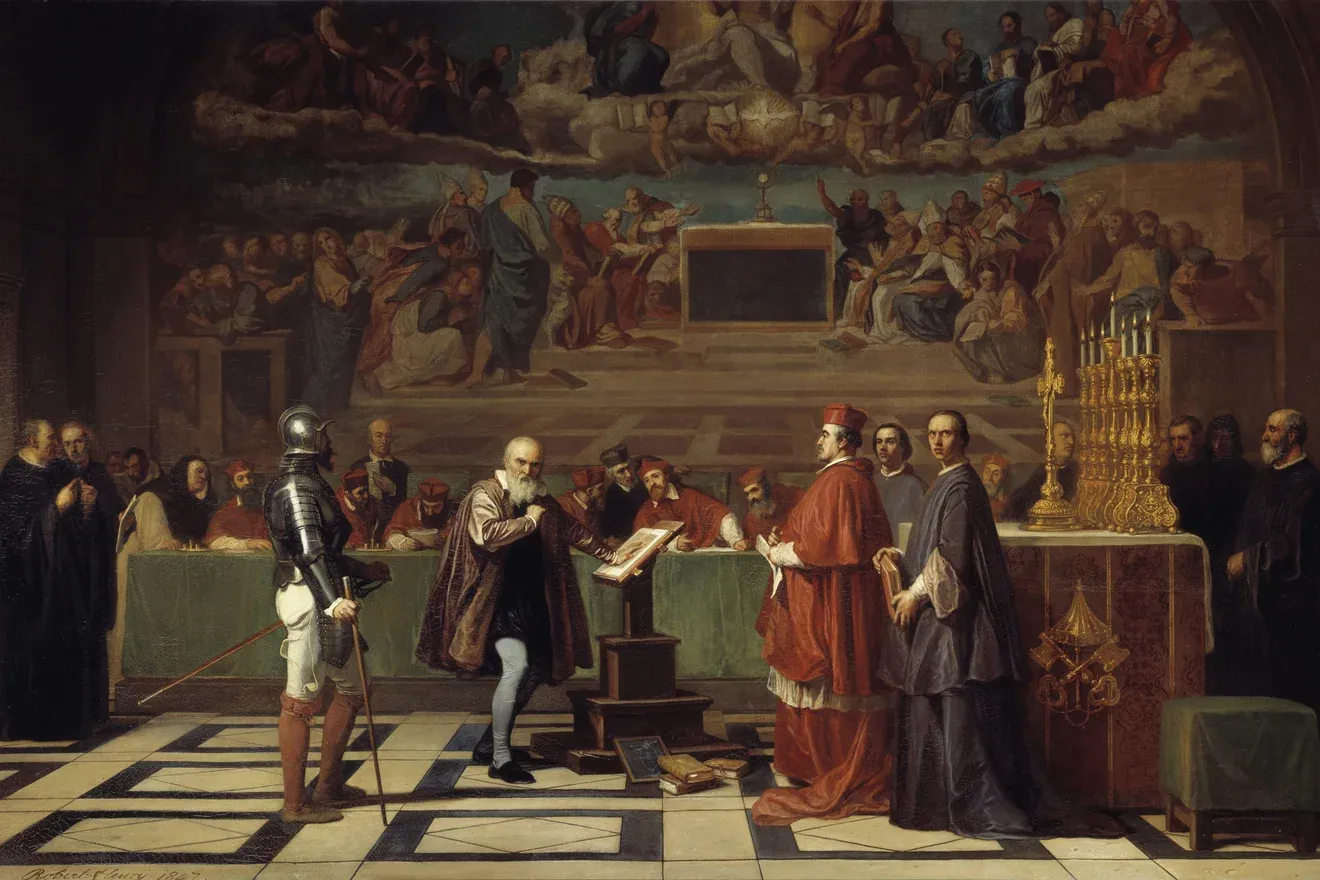
Did Galileo really say “And yet it moves”?
The words “Eppur si muove” first appeared in print in 1757, in The Italian Library by Giuseppe Baretti, an Italian writer living in London. According to Baretti, Galileo said them the moment he was set free, looking up at the sky, then down at the ground, and stamping his foot[6]. By then Galileo had passed away 115 years earlier.
Historians broadly agree that he did not say it before the court. A 69-year-old who had just escaped a harsher sentence would not defy his judges in the courtroom, since a relapse could have cost him his life.
But there is a twist. In 1911 a Spanish painting was found in Belgium, thought to date from the mid-1640s, only a few years after Galileo passed away. It shows him in a cell, pointing to a drawing on the wall of the Earth going around the Sun, with the words “E pur si muove” beneath[6]. If the date is right, the phrase was circulating very early; perhaps he did mutter it to friends, somewhere safe. The astrophysicist Mario Livio tried to trace the painting, but nobody now knows where it is, and its date is still disputed[5].
The honest conclusion: the line is almost certainly a legend, at least as far as the trial goes. But it sums up what actually happened: the abjuration did not stop the Earth from turning.
Where was Galileo right, and where was he wrong?
Galileo is often told as a hero fighting ignorance. The truth is more complicated.
In 1633 the evidence was not yet enough. The telescope ruled out Ptolemy’s model, but not that of the Danish astronomer Tycho Brahe, in which the planets go around the Sun while the Sun goes around a motionless Earth. Everything Galileo saw, including the phases of Venus, fit that model. Opponents also asked: if the Earth goes around the Sun, why don’t nearby stars shift slightly against distant ones, the way a finger held in front of your face jumps when you close each eye in turn? No one could see such a shift, because the stars are farther away than anyone at the time could imagine.
Galileo’s favourite proof was wrong. He believed the tides proved the Earth moves: sea water sloshing like water in a shaken basin. The entire fourth day of the Dialogue is devoted to this argument. In fact the tides are caused mainly by the Moon’s pull, an idea Galileo dismissed as “occult”. He also ignored Kepler’s discovery that planetary orbits are ellipses, the laws that almost 200 years later helped Gauss find the lost asteroid Ceres.
But on the most important point, Galileo was right. He answered the hardest question from Aristotle’s side: if the Earth moves, why don’t we notice?
Galileo’s ship
Imagine, says Salviati, that you shut yourself in the cabin below deck of a large ship, with some flies, some butterflies, a bowl of fish, and a bottle dripping into a basin beneath it. While the ship is still, the flies and butterflies fly equally in all directions, the fish swim equally every way, and the drops fall straight into the basin. Now let the ship move, as fast as you like, as long as the motion is uniform and not rocking. You will notice no change at all, and nothing in the cabin will tell you whether the ship is moving or standing still[3].
Aristotle’s followers said: drop a stone from the top of the mast of a moving ship and it will land behind, because the ship has moved on. Galileo replied: no, it lands at the foot of the mast. At the moment of release, the stone already has the ship’s velocity and keeps it while falling. Seen from the ship, the stone falls straight down. Seen from the shore, it follows a curve, travelling with the ship. The simulation in Figure 2, below, draws both predictions.
That answer contains two ideas that would change physics:
- Inertia: a moving body keeps moving unless something stops it. Aristotle thought something had to keep pushing it. Newton later turned Galileo’s idea into his first law.
- The principle of relativity: no experiment inside the ship can tell whether it is moving uniformly or standing still.
The Earth is the biggest ship of all. The stone, the bird, the air, and you yourself all travel with it.
The last years at Arcetri
After the trial, Galileo was kept under house arrest at his villa in Arcetri, near Florence, for the rest of his life. His eldest daughter, the nun Maria Celeste, asked to recite the penitential psalms in his place. In April 1634 she passed away from illness, aged 33.
Forbidden to write about astronomy, Galileo went back to falling bodies, inclined planes and the strength of materials. The manuscript was smuggled to the Netherlands, beyond the Inquisition’s reach, and printed in 1638 as Two New Sciences[10]. It contains the law of falling bodies, the proof that a projectile flies along a parabola, and a small paradox about infinity that two centuries later Cantor turned into a theory of infinity.
By 1638 Galileo was completely blind. He passed away on 8 January 1642, aged 77. At the end of that year, in England, Isaac Newton was born.
The Earth does move: proof arrived 200 years later
Galileo passed away before anyone could prove the Earth moves. The evidence came slowly:
- In 1729, James Bradley saw the positions of stars shift slightly over a yearly cycle, in a way that could only be explained if the Earth was moving around the Sun. It is like running in the rain: the rain falls straight down, but you have to tilt your umbrella forward.
- In 1838, Friedrich Bessel measured the shift of the star 61 Cygni as the Earth travelled from one side of its orbit to the other: less than one ten-thousandth of a degree. That is why no one in Galileo’s time could see anything.
- In 1851, in Paris, Léon Foucault made the Earth “confess” with a pendulum.
When he first tried it at the Paris Observatory, Foucault sent scientists an invitation: “You are invited to come and see the Earth turn.” A few weeks later he hung a 28 kg ball on a 67-metre wire under the dome of the Panthéon for the public to watch[9] [11].
The idea is simple. A pendulum keeps swinging in the same plane, because no force turns it. But the ground beneath it rotates. So anyone standing there sees the plane of the swing slowly turn clockwise, though no one touches it. At the North Pole it turns a full circle in one day. At the equator it does not turn at all. In Paris it turns about 11 degrees an hour. In Hanoi, about 5.4 degrees an hour: 130 degrees after one day, and almost three days for a full circle.
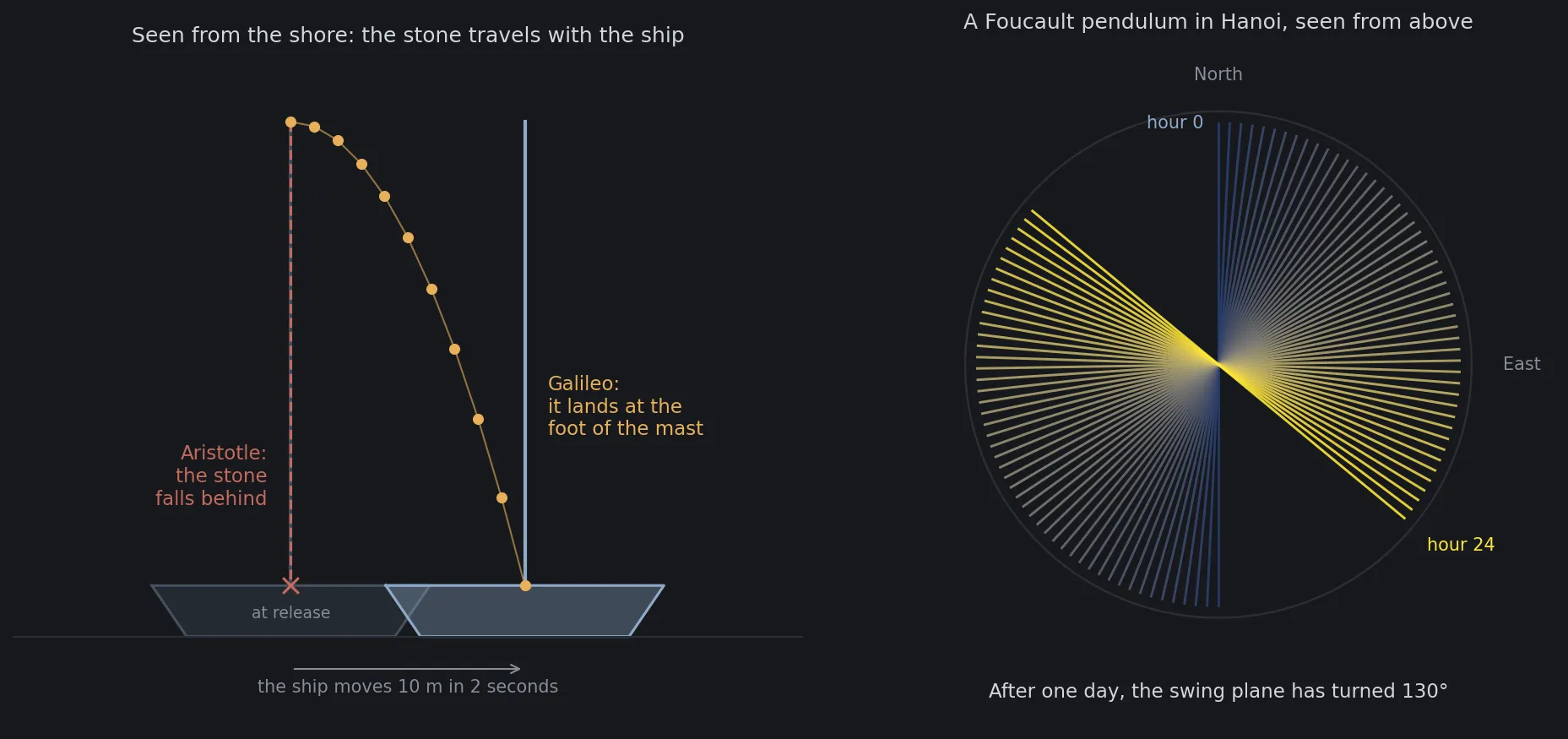
An experiment done on the ground, without looking at the sky, showed that the Earth turns. And the instrument that did it was the pendulum, the very thing the young Galileo had watched in Pisa Cathedral.
In 1835 the Church removed the Dialogue from its list of banned books. On 31 October 1992 Pope John Paul II formally acknowledged that the theologians who judged Galileo had been wrong[7], 359 years after the trial.
Where is Galileo today?
In your phone. Your phone has an accelerometer, which rotates the screen and lets apps count your steps. Just as Galileo said, it can only measure changes in motion, not velocity: on a desk at home or on a plane cruising at 900 km/h, it reads the same. Inside the “ship”, there is no way to tell that the ship is moving. So your phone has to “look out of the window” and listen to navigation satellites. One of those satellite systems, the European Union’s, is called Galileo. Airliners, meanwhile, carry gyroscopes sensitive enough to feel the Earth’s rotation of 15 degrees an hour and use it to find true north: a miniature Foucault pendulum.
In relativity. In 1905 Einstein began special relativity with exactly the principle of the ship, extended to light as well. From it he deduced that time passes differently for people moving differently. Today the clocks on navigation satellites must be corrected for relativity; otherwise your position on the map would drift by kilometres every day.
In the sky. The four moons of 1610, Io, Europa, Ganymede and Callisto, are now known as the Galilean moons. Under Europa’s ice there may be an ocean of liquid water, and NASA’s Europa Clipper, launched in 2024, is on its way there.
In the way science is done. Don’t trust what old books say just because they are old; do the experiment, measure, and write the result in mathematics. Galileo wrote that the great book of nature is written in the language of mathematics. Physics from Newton to Einstein has read that book the way he taught.
Drop the stone and build a Foucault pendulum yourself
The Python below draws Figure 2. The first part drops a stone from a 20-metre mast on a ship moving at 5 m/s (an illustrative number). The second part computes how fast a Foucault pendulum turns: the Earth’s rotation rate times the of the latitude. There is nothing random in the simulation, so no seed is needed. All you need is numpy and matplotlib.
import matplotlib.pyplot as pltimport numpy as np
plt.rcParams.update({"figure.facecolor": "#16181c", "axes.facecolor": "#16181c", "text.color": "#d4d7dc",                     "axes.edgecolor": "#2a2e35", "xtick.color": "#878d97", "ytick.color": "#878d97", "font.size": 12})
# ── Part 1: drop a stone from the top of a moving ship's mast ───────────────g = 9.81                     # gravitational acceleration (m/s²)h = 20.0                     # mast height (m)v = 5.0                      # ship speed (m/s), about 18 km/h — an illustrative numberT = np.sqrt(2 * h / g)       # fall timet = np.linspace(0, T, 11)x_stone = v * t              # the stone keeps the ship's horizontal velocity (inertia)y_stone = h - 0.5 * g * t**2print(f"the stone falls for {T:.2f} s; meanwhile the ship moves {v * T:.1f} m")print(f"the stone hits the deck this far from the foot of the mast: {x_stone[-1] - v * T:.1f} m (Galileo)")print(f"if the stone 'forgot' the ship's motion: it would land {v * T:.1f} m behind the mast (Aristotle)")
# ── Part 2: a Foucault pendulum in Hanoi ────────────────────────────────────sidereal_day = 23.934                   # the Earth turns once every 23.934 hourslatitude = {"Hanoi": 21.03, "Paris": 48.85, "North Pole": 90.0}for name, phi in latitude.items():    rate = 360 / sidereal_day * np.sin(np.radians(phi))      # degrees per hour    print(f"{name:10s}: swing plane turns {rate:5.2f}°/hour, full circle after {360 / rate:5.1f} hours")radius = 6371                           # kmfor name, phi in [("the equator", 0.0), ("Hanoi", 21.03)]:    print(f"ground speed at {name}: {2 * np.pi * radius * np.cos(np.radians(phi)) / sidereal_day:,.0f} km/h")
hours = np.arange(0, 24.01, 0.5)        # record the swing direction every half hourangle = 90 - 360 / sidereal_day * np.sin(np.radians(latitude["Hanoi"])) * hours   # northern hemisphere: clockwise
# ── Plot ────────────────────────────────────────────────────────────────────fig, (ax1, ax2) = plt.subplots(1, 2, figsize=(13, 6))
def draw_ship(ax, x0, alpha):    hull = np.array([[-6, 0], [6, 0], [4.5, -2.2], [-4.5, -2.2], [-6, 0]]) + [x0, 0]    ax.fill(hull[:, 0], hull[:, 1], color="#8fa9c9", alpha=alpha * 0.35, lw=0)    ax.plot(hull[:, 0], hull[:, 1], color="#8fa9c9", alpha=alpha, lw=1.5)    ax.plot([x0, x0], [0, h], color="#8fa9c9", alpha=alpha, lw=2)
draw_ship(ax1, 0, 0.35)draw_ship(ax1, v * T, 1.0)ax1.axhline(-2.2, color="#2a2e35", lw=1)ax1.text(0, -1.4, "at release", ha="center", color="#878d97", fontsize=9)ax1.plot([0, 0], [h, 0], ls="--", color="#c46a5e", lw=1.5)ax1.scatter([0], [0], marker="x", color="#c46a5e", s=80, zorder=5)ax1.text(-1, 3.5, "Aristotle:\nthe stone\nfalls behind", ha="right", color="#c46a5e", fontsize=11)ax1.plot(x_stone, y_stone, color="#e8b05a", lw=1, alpha=0.6)ax1.scatter(x_stone, y_stone, color="#e8b05a", s=28, zorder=5)ax1.text(v * T + 1, 6.5, "Galileo:\nit lands at the\nfoot of the mast", color="#e8b05a", fontsize=11)ax1.annotate("", xy=(v * T, -3.6), xytext=(0, -3.6), arrowprops=dict(arrowstyle="->", color="#878d97"))ax1.text(v * T / 2, -4.6, f"the ship moves {v * T:.0f} m in {T:.0f} seconds", ha="center", color="#878d97", fontsize=10)ax1.set_xlim(-12, v * T + 12)ax1.set_ylim(-5.5, h + 3)ax1.set_aspect("equal")ax1.set_xticks([])ax1.set_yticks([])ax1.set_title("Seen from the shore: the stone travels with the ship", color="#d4d7dc", fontsize=12)
colors = plt.cm.cividis(np.linspace(0.15, 1, len(hours)))for a, c in zip(np.radians(angle), colors):    ax2.plot([-np.cos(a), np.cos(a)], [-np.sin(a), np.sin(a)], color=c, lw=1.4, alpha=0.9)ax2.add_patch(plt.Circle((0, 0), 1.05, fill=False, ec="#2a2e35", lw=1.2))ax2.text(0, 1.18, "North", ha="center", color="#878d97", fontsize=10)ax2.text(1.18, 0, "East", va="center", color="#878d97", fontsize=10)ax2.text(-0.06, 0.98, "hour 0", ha="right", color="#8fa9c9", fontsize=10)a_end = np.radians(angle[-1])ax2.text(1.12 * np.cos(a_end), 1.12 * np.sin(a_end), "hour 24", ha="left", va="top", color=colors[-1], fontsize=10)ax2.text(0, -1.38, f"After one day, the swing plane has turned {angle[0] - angle[-1]:.0f}°", ha="center",         color="#d4d7dc", fontsize=11)ax2.set_xlim(-1.4, 1.4)ax2.set_ylim(-1.5, 1.35)ax2.set_aspect("equal")ax2.axis("off")ax2.set_title("A Foucault pendulum in Hanoi, seen from above", color="#d4d7dc", fontsize=12)for s in ax1.spines.values():    s.set_visible(False)fig.tight_layout()fig.savefig("galileo-tau-va-con-lac-en.png", dpi=150, bbox_inches="tight")
the stone falls for 2.02 s; meanwhile the ship moves 10.1 mthe stone hits the deck this far from the foot of the mast: 0.0 m (Galileo)if the stone 'forgot' the ship's motion: it would land 10.1 m behind the mast (Aristotle)Hanoi : swing plane turns 5.40°/hour, full circle after 66.7 hoursParis : swing plane turns 11.33°/hour, full circle after 31.8 hoursNorth Pole: swing plane turns 15.04°/hour, full circle after 23.9 hoursground speed at the equator: 1,673 km/hground speed at Hanoi: 1,561 km/hThe first three lines are the whole argument about the ship: the stone falls for two seconds, the ship moves 10 metres, yet the stone still lands at the foot of the mast. The next three lines are the Foucault pendulum in three places, and the last two are the ground speeds mentioned at the start of the article.
You can change the latitude to where you live, for example 51.5 for London. Try latitude 0 as well: the program prints inf, infinity. At the equator the pendulum does not turn, so it never completes a circle.
Back to Rome, 1633
Galileo probably never said “Eppur si muove” in front of his judges. He knelt, read his abjuration, and spent the rest of his life in a house on a hill, his eyes slowly failing.
But every time you pour water on a plane and it doesn’t fly off, every time your phone finds where you are, every time a Foucault pendulum in a museum quietly turns away from its starting line, the Earth says it for him.
And yet it moves.
More stories about the people who made science: Pascal, Fermat and the unfinished game, Gauss and the lost asteroid, and Cantor: some infinities are bigger.
Free geometry illustrations for students and teachers: EyeViz.
Tài liệu tham khảo
- [1]J. J. O'Connor and E. F. Robertson. Galileo Galilei (1564–1642), biography. MacTutor History of Mathematics, University of St Andrews.
- [2]Maurice A. Finocchiaro. The Galileo Affair: A Documentary History. University of California Press, 1989.
- [3]Galileo Galilei. Dialogo sopra i due massimi sistemi del mondo (Dialogue Concerning the Two Chief World Systems). Giovanni Battista Landini, Florence, 1632.
- [4]Galileo Galilei. Sidereus Nuncius (The Starry Messenger). Tommaso Baglioni, Venice, 1610.
- [5]Mario Livio. Galileo and the Science Deniers. Simon & Schuster, 2020.
- [6]And yet it moves. Wikipedia.
- [7]Galileo affair. Wikipedia.
- [8]Peter Machamer and David Marshall Miller. Galileo Galilei. Stanford Encyclopedia of Philosophy.
- [9]Léon Foucault. Démonstration physique du mouvement de rotation de la Terre au moyen du pendule. Comptes rendus de l'Académie des sciences 32, 1851.
- [10]Galileo Galilei. Discorsi e dimostrazioni matematiche intorno a due nuove scienze (Two New Sciences). Elzevir, Leiden, 1638.
- [11]Foucault pendulum. Wikipedia.