War of the Currents: Edison, Tesla and alternating current
The AC/DC war between Edison, Tesla and Westinghouse: why direct current lost, what transformers and rotating fields did, and who wins at your socket today.
Mục lục
At noon on 1 May 1893, in Chicago, US President Grover Cleveland finished his speech and pressed a gold-plated telegraph key. Two hundred thousand people packed into the Grand Court of the World’s Fair watched the engines in Machinery Hall start to turn and the fountains leap into the air [11]. When night fell, the whole “White City” blazed under tens of thousands of lamps.
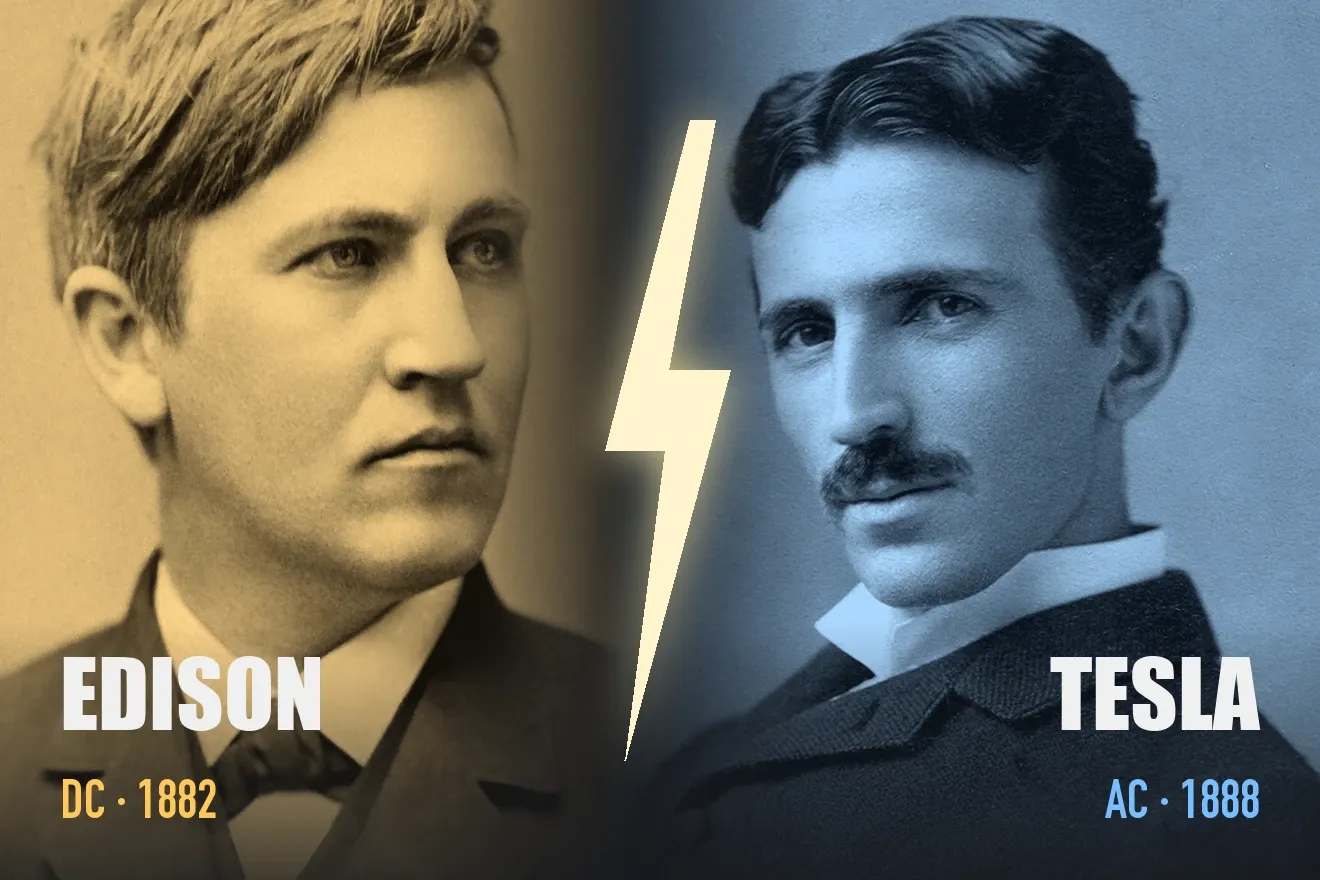
What is remarkable is that the man who lit the fair was not Thomas Edison, the most famous inventor in America at the time. The lighting contract went to George Westinghouse, with a kind of current that Edison had opposed in public for five years. Behind that system stood the patents of a Serbian engineer who had once worked for Edison himself: Nikola Tesla.
This was the climax of the war of the currents: the contest of the 1880s and 1890s between Edison’s direct current (DC) and the alternating current (AC) of Westinghouse and Tesla. The short answer to “why did AC win?” lies in a very simple device: the transformer. It steps the voltage up so that electricity can travel far without being wasted, then steps it back down so it can enter homes safely, and it only works with alternating current. The last piece of the puzzle was Tesla’s motor driven by a rotating magnetic field, which let AC do more than light lamps: it could drive machines.
Edison lights Manhattan with direct current
On the afternoon of 4 September 1882, Edison stood in the Wall Street office of the financier J. P. Morgan and signalled the electrician at his plant to close the switch. About 400 lamps lit up at once [4]. The Pearl Street Station, Edison’s first commercial power plant in New York, began supplying 59 customers. By 1884 that number had passed 500 [5].
Edison’s system was direct current at about 110 V [1]. Direct current flows in one fixed direction, like water running from a rooftop tank down to a tap. It is steady, easy to meter, and at 110 V fairly safe.
But the system had one crippling limit: the electricity could not travel far. Customers had to be within less than a mile (about 1.6 km) of the plant [1]. To cover a whole city you had to build a plant every few blocks, as if every neighbourhood needed its own water pumping station because the pipes could not carry water any further.
Why current is lost on the line
The power a line carries equals voltage times current:
However good a copper wire is, it still has a resistance . Current flowing through a resistance produces heat, exactly the way the coil of an electric stove glows red. The power turned into heat in the wire, the loss, follows Joule’s law:
This is the same James Joule from the story of Mayer and the conservation of energy: energy is not destroyed, it simply turns into heat along the line.
Put the two formulas together. To send a fixed power , the current must be . Substituting:
Look closely at the denominator: the voltage is squared. Raise the voltage tenfold and the current falls tenfold, while the loss falls a hundredfold. To picture it, imagine moving 10 tonnes of rice along a dirt road. Use 100 handcarts and the road is ploughed to pieces; use one truck and the road is barely touched. The rice is the same, but the “traffic” (the current) is what wears the road down. Carrying more rice per trip is what a higher voltage does.
Try some real numbers. Suppose we need to send 10 kW, enough for about a hundred 100 W bulbs, through two copper wires with a 50 mm² cross-section, about as thick as a thumb. Each kilometre of line (out and back) has a resistance of about 0.69 Ω. The distance at which losses reach 10% of the power is:
| Voltage | Current | Distance before 10% is lost |
|---|---|---|
| 110 V (Edison) | 90.9 A | about 176 m |
| 1,100 V | 9.1 A | about 17.6 km |
| 11,000 V (Niagara) | 0.9 A | about 1,760 km |
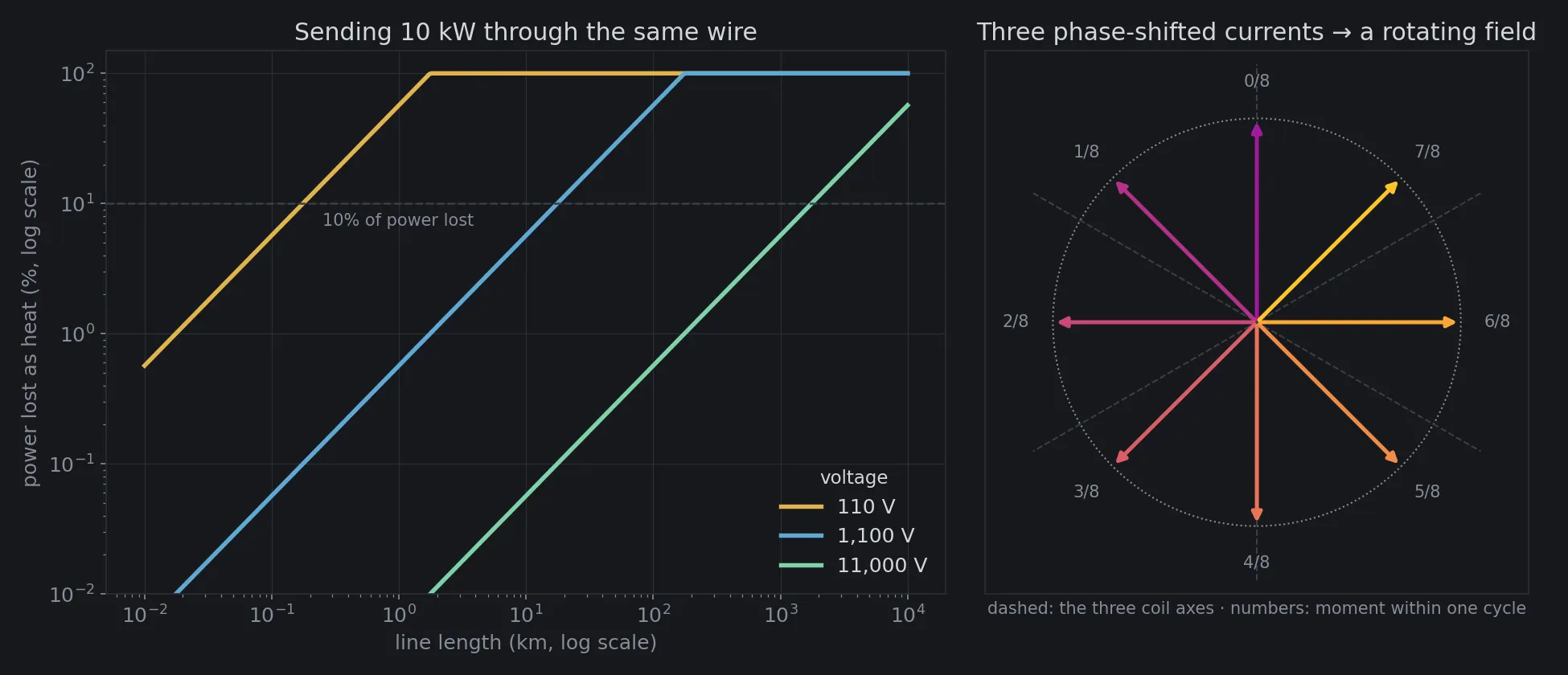
Every tenfold increase in voltage gives a hundredfold increase in distance (Figure 1, left). Edison knew this well and used very thick copper cables buried under the streets. But copper was expensive, and no wire is thick enough to beat a square in the denominator.
So why not send direct current at high voltage? The problem lies at both ends of the line. Nobody wants an 11,000 V wire running into the living room. You need a way to step the voltage up at the plant and step it down at the customer’s door. With the direct current of the time, there was no cheap, efficient way to do that.
The transformer: a device that only works with AC
In 1831 Michael Faraday discovered electromagnetic induction: when the magnetic field passing through a coil of wire changes, a voltage appears in the coil. The key word is changes. A steady magnetic field, however strong, produces nothing. As a formula, the induced voltage is proportional to the rate of change of the magnetic flux :
where is the number of turns.
A transformer is two coils wound around the same iron core. Current in the first coil creates a magnetic field in the core, and that field passes through the second coil. If the current in the first coil keeps reversing, the field in the core reverses with it, and the second coil keeps getting an induced voltage. Because both coils share the same flux, the voltage ratio equals the ratio of turns:
Give the second coil 100 times as many turns and the output voltage is 100 times higher, the current 100 times lower, and the power almost unchanged. A transformer has no moving parts and can be more than 95% efficient.
Alternating current reverses direction regularly, following a sine wave: 50 times a second (50 Hz) in Vietnam and Europe, 60 Hz in the United States. It is like a swing being pushed back and forth steadily, while direct current is a swing pushed once and then held to one side. A transformer can only “feel” the back-and-forth motion, so with direct current it is useless.
The practical transformer emerged in Europe in the mid-1880s from a design by Lucien Gaulard and John Gibbs. In 1885 George Westinghouse, a businessman who had grown rich inventing the railway air brake, bought the American rights, and his engineer William Stanley improved the design. In March 1886 Stanley set up a demonstration system in the town of Great Barrington, stepping 500 V down to 100 V to light the shops [1]. By the end of 1887 Westinghouse had 68 AC stations, against Edison’s 121 DC stations [1].
But AC at the time had one big weakness: there was no good AC motor. Lamps could be lit, but pumps, lifts and factory machinery still needed DC motors. The missing piece was in the head of a man who had once worked for Edison.
The Serbian engineer at the Edison Machine Works
In June 1884, Nikola Tesla, 27, a Serbian engineer born in the Lika region (now in Croatia), arrived in New York. He had been brought over by Charles Batchelor, who had managed Edison’s installation in Paris, to work at the Edison Machine Works. Tesla repaired electrical systems and improved generators. About six months later he left. His diary says only, written across the pages from 7 December 1884 to 4 January 1885: “Good By to the Edison Machine Works” [14].
Why he left is unclear. The best-known version comes from Tesla himself, in his 1919 autobiography: the manager promised him a 50,000 bonus to redesign 24 types of generators, and when he finished he was told it had been "a practical joke" [[6]](#ref-6). Later retellings turned it into Edison himself making and breaking the promise. Historians find the figure hard to believe: 50,000 was a fortune at the time, the company did not have that kind of cash on hand, and Batchelor was known for paying sparingly [14].
The next few years were hard. Investors pushed Tesla out of the company bearing his name and kept his patents, and he ended up digging ditches for $2 a day [14].
Then his chance came. On 16 May 1888 Tesla gave a lecture to the American Institute of Electrical Engineers (AIEE): “A New System of Alternate Current Motors and Transformers” [7]. The same month he was granted a patent for an electromagnetic motor [8]. In July 1888 Westinghouse bought those patents for 2.50 per horsepower** of AC capacity, and hired Tesla as a consultant in Pittsburgh at $2,000 a month [14].
Tesla’s piece of the puzzle: the rotating field
DC motors of the time needed a commutator and brushes: copper segments rubbing constantly to reverse the current at just the right moment and keep the rotor turning. They wore out and threw sparks. Tesla’s idea was to get rid of them altogether: make the magnetic field itself rotate.
Think of a Mexican wave in a stadium. Nobody leaves their seat; each person just stands up and sits down in turn, yet the “wave” runs around the stadium. Tesla’s rotating field works the same way. Place three coils around a circle, 120° apart, and feed them three alternating currents, each one lagging the previous by a third of a cycle. Each coil alone produces a field that just pulses back and forth along its own axis, but the combined field of all three has a constant strength and turns steadily, one full turn per cycle (Figure 1, right).
Mathematically, coil points in direction (120° apart), carries the current , and produces a field along its axis. Adding the three vectors with the product-to-sum identities, the “pulsing” parts cancel out and all that is left is:
a vector of length rotating at angular speed . Put a metal rotor in the middle. The rotating field induces currents in the rotor, and those currents are dragged along by the field. The rotor chases the field round without brushes and without any wire connected to the moving part. That is the induction motor, the kind found today in ceiling fans, pumps, washing machines, lifts and most industrial machinery.
The Italian engineer Galileo Ferraris published a similar idea in the same year, 1888, and Westinghouse also bought an option on Ferraris’s patent [1]. But it was Tesla’s patents that became the legal foundation of the Westinghouse AC system. Tesla also proposed the 60 Hz frequency for the American system, to suit his motor [14].
Now alternating current had all three pieces: generators, transformers for long-distance transmission, and motors to drive machines. Edison had only one advantage left: safety.
The dirty war (1888–1890)
High voltage really is dangerous, and in the late 1880s the streets of New York were a tangle of low-hanging, poorly insulated wires. Accidents happened, newspapers covered them heavily, and the Edison camp turned that fear into a weapon.
In June 1888 a little-known electrical engineer, Harold P. Brown, wrote to the New York Post calling alternating current inherently dangerous and demanding that it be limited to 300 V. Westinghouse wrote to Edison proposing a meeting to calm things down. Edison declined, saying he was busy in his laboratory [1].
From July 1888 Brown staged public demonstrations on animals to show that AC was more dangerous than DC. One of them took place in Edison’s own laboratory at West Orange, with Edison watching [1]. In August 1889 the New York Sun published stolen letters of Brown’s showing that the Edison company and its rival Thomson-Houston had coordinated with him and paid for his campaign [1].
At the same time, New York State was looking for a new method of capital punishment that it considered more humane. Brown undertook to supply the equipment and arranged to buy Westinghouse generators through intermediaries, so that the first electric chair would use the rival’s own current. The first execution by electric chair, on 6 August 1890, did not go as its supporters had promised [1].
In November 1889 Edison himself published “The Dangers of Electric Lighting” in the North American Review. He argued that burying the wires would only move the danger elsewhere, and that alternating current was safe only at low voltage, which is to say at the level that threw away its very advantage [9]. Edison was not entirely wrong, but he chose to attack through fear rather than solve the problem of distance.
Edison loses his company, Westinghouse lights Chicago
While Edison fought in the newspapers, the real war was decided in the boardroom. The financiers behind Edison’s company, led by J. P. Morgan, saw what Edison did not want to see: the market was moving to AC. On 15 April 1892, Edison General Electric merged with Thomson-Houston, a company long active in AC, to form General Electric. Edison learned of it only the day before. His name disappeared from the company’s name [1].
That same year, the Chicago World’s Fair put its lighting out to tender. General Electric first bid 554,000. A local Chicago company bid $510,000 for an alternating-current system, with Westinghouse as contractor. Westinghouse won by undercutting GE by about 70 cents a lamp and, by many accounts, made no profit at all on the contract [10].
One obstacle remained: Edison’s lamp patent now belonged to GE, and GE sued to stop Westinghouse using Edison-style bulbs. Westinghouse got round it with a lamp sealed by a ground-glass stopper, based on an old Sawyer–Man patent he owned. The lamps worked but burned out quickly, so throughout the fair a whole crew did nothing but replace bulbs [10]. In his exhibit, Tesla demonstrated induction motors and the “Egg of Columbus”: a copper egg that stood on end and spun in a rotating magnetic field [10].
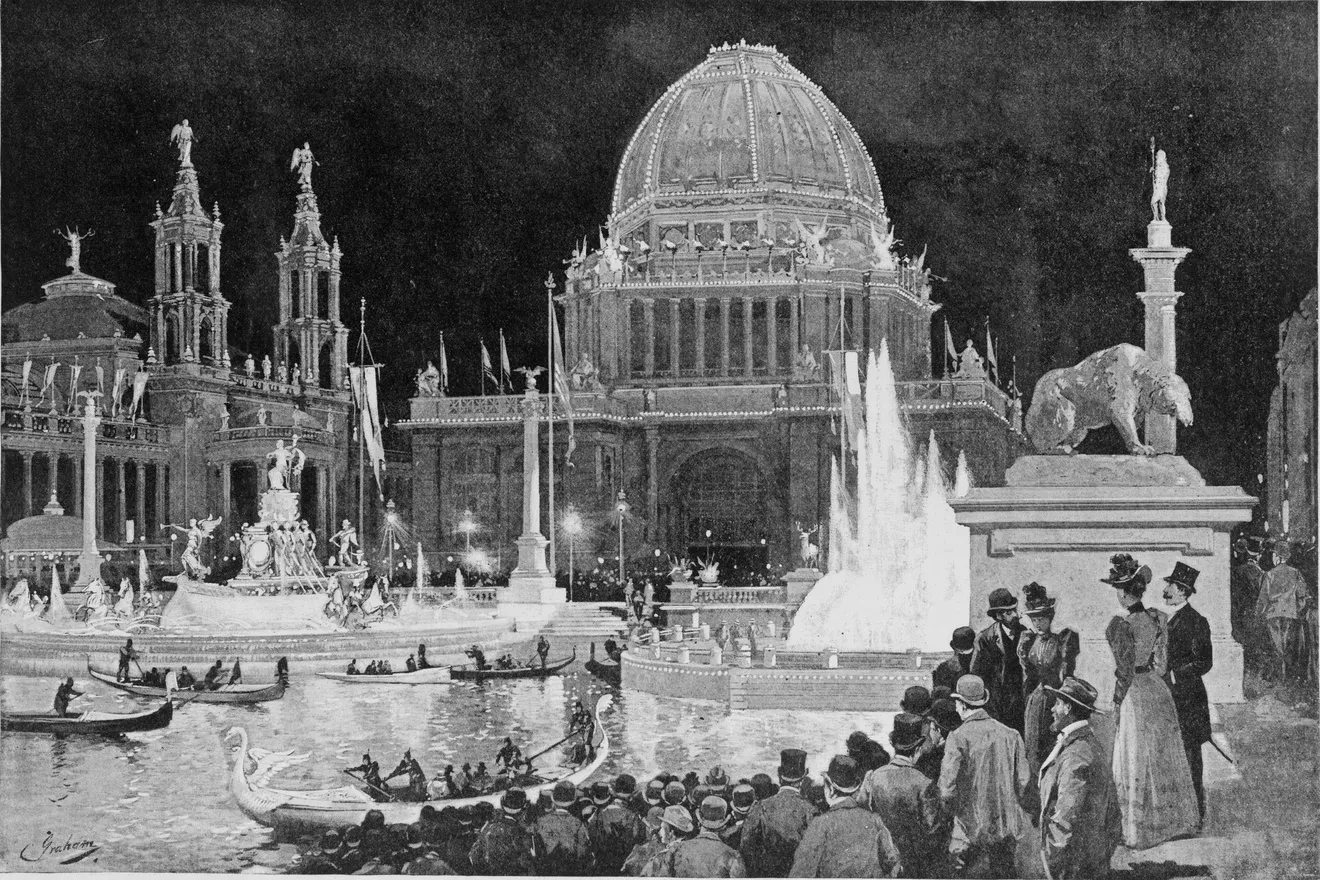
Over six months, about 27 million visits were made to the fair [10]. Most visitors had no idea what AC or DC meant, but they had seen what alternating current could do.
Niagara: the final battle
Chicago was a victory of image. The technical victory came from Niagara Falls. People had long wanted to turn the power of the falls into electricity for the industrial city of Buffalo, about 40 km away. With direct current that distance was impossible. At the end of 1892 Westinghouse won the contract to build an alternating-current power station at Niagara. General Electric got the transmission lines and transformers [1].
On 16 November 1896, power from Niagara Falls reached Buffalo for the first time, at 11,000 V, as two-phase alternating current at 25 Hz [12]. That is the row we met in the table above: at 11,000 V, 40 km is a short hop.
In the same year, 1896, Westinghouse and General Electric signed an 11-year patent-sharing agreement [1]. The war was effectively over. In 1897 Edison sold his last shares in the New York electric company that bore his name. Around 1908, according to a later account, he told William Stanley’s son: “Tell your father I was wrong” [1]. Many read it as an admission that he had underestimated alternating current.
Some myths, corrected
The Edison-and-Tesla story has been retold online so often that many wrong details are taken as fact.
“The war was Edison versus Tesla.” In fact Edison’s real opponent was George Westinghouse, who had the money, the factories, the engineers and the nerve to bet his whole company. Tesla contributed key patents, but after 1889 he stayed largely outside the commercial fight.
“Tesla tore up his royalty contract to save Westinghouse.” The core is true: in early 1891 the Westinghouse company ran into financial trouble, the banks demanded cost cuts, and Tesla agreed to give up the 216,000 [14].
“Edison used Topsy the elephant to smear alternating current.” Topsy, an elephant at Luna Park, did not survive the event of 4 January 1903, ten years after the war of the currents had ended. Edison had long since left the lighting business and had nothing to do with it. The film was shot by the Edison Manufacturing Company, a film studio bearing his name, and that name alone gave birth to the myth [13].
The two men’s lives ended very differently. Edison kept inventing and passed away in 1931, still one of the most famous people in the world. Tesla chased ever more ambitious projects, such as wireless power, most of which came to nothing. He spent his last years in New York hotels, leaving unpaid bills behind, and passed away on 7 January 1943, aged 86. In 1960 the SI unit of magnetic flux density was named the tesla [14].
Today, who wins at your wall socket?
Look at the socket and alternating current has won outright. The electricity entering a Vietnamese home is AC at 220 V, 50 Hz. Transformers raise it to hundreds of thousands of volts so it can travel hundreds of kilometres, then lower it in several steps before it reaches the pole at the end of the street. The backbone of Vietnam’s grid is the 500 kV North–South line. Its first circuit was energised at 19:06 on 27 May 1994, joining the country’s three regional grids into one [15]. It is the same calculation , with a voltage about 45 times higher than Niagara’s.
But look more closely and the war has gone into extra time, and this time direct current is scoring.
- Ultra-long-distance high-voltage direct current (HVDC). Over very long lines, alternating current suffers losses that direct current does not. A very long line is like a long hose with elastic walls: every time the current reverses, the part sitting inside the hose has to be filled and emptied again, and that effort never reaches the far end. Engineers call this the capacitance and reactance of the line. On top of that, two AC grids that want to connect must run in sync at the same frequency, like two people working a crosscut saw in rhythm. Since the second half of the 20th century, power semiconductors have made it possible to convert AC to DC and back efficiently, which is exactly what Edison lacked. The Changji–Guquan line in China carries 12,000 MW of direct current at ±1,100 kV over 3,284 km [16].
- All electronics run on direct current. Phones, laptops, LED bulbs, even the data centres running AI that consume more and more power (article in Vietnamese): inside, they all run on DC. Your charger is a small transformer plus a circuit that rectifies AC into DC.
- New energy produces direct current. Solar panels and storage batteries are DC. To feed the grid, their output must go through an inverter, a device that does the exact opposite of your charger: it turns DC into AC.
On 14 November 2007, Con Edison, the descendant of Edison’s electric company, cut off its last direct-current customer in New York [1]. Yet at the same time the world has never had so many devices running on DC. Perhaps the fairest answer is that both won: alternating current runs the long distances, direct current lives inside every device, and in between sit converters that nobody in the 19th century could have imagined.
Try it yourself: line losses and the rotating field
The code below produces Figure 1 and the distance table above. The first part uses for three voltages, with the same 10 kW and the same two 50 mm² copper wires. The model ignores voltage drop and reactance; beyond 100% it no longer makes sense, so the chart is capped there. The second part adds up the fields of three coils 120° apart at eight moments in one cycle, showing that the combined vector rotates with a constant length of 1.5 times the field of one coil. There is no randomness; you only need numpy and matplotlib.
import matplotlib.pyplot as pltimport numpy as np
plt.rcParams.update({"figure.facecolor": "#16181c", "axes.facecolor": "#16181c", "text.color": "#d4d7dc",                     "axes.edgecolor": "#2a2e35", "axes.labelcolor": "#878d97",                     "xtick.color": "#878d97", "ytick.color": "#878d97", "font.size": 12})COLORS = {110: "#e0b44c", 1_100: "#5fa8d3", 11_000: "#7fd1a8"}
# 1. Line losses: send P = 10 kW (about 100 bulbs of 100 W) through two 50 mm² copper wiresP = 10_000                       # Wrho, A = 1.72e-8, 50e-6          # resistivity of copper (Ω·m), wire cross-section (m²)r = 2 * rho / A * 1_000          # out-and-back resistance, Ω per km of lined = np.logspace(-2, 4, 400)      # distance: 10 m → 10,000 km
def loss_fraction(U, km):    """Share of power turned into heat: I = P/U, P_loss = I²R  →  P_loss/P = P·R/U²."""    return P * r * km / U**2
for U in COLORS:    reach = 0.10 * U**2 / (P * r)            # distance at which losses reach 10%    print(f"U = {U:>6} V: current {P / U:5.1f} A, 10% of power lost after {reach:8.3f} km")
fig, (a1, a2) = plt.subplots(1, 2, figsize=(13, 5.6), gridspec_kw={"width_ratios": [1.45, 1]})for U, color in COLORS.items():    a1.loglog(d, np.minimum(loss_fraction(U, d), 1) * 100, color=color, lw=2.6, label=f"{U:,} V")a1.axhline(10, color="#3a3f48", ls="--", lw=1.2)a1.text(0.25, 8.5, "10% of power lost", color="#878d97", fontsize=10, va="top")a1.set(xlabel="line length (km, log scale)", ylabel="power lost as heat (%, log scale)",       title="Sending 10 kW through the same wire", ylim=(0.01, 150))a1.legend(frameon=False, loc="lower right", title="voltage", title_fontsize=11)
# 2. Tesla's rotating field: three coils 120° apart, currents 120° out of phasecoil_angle = np.radians([90, 210, 330])t = np.linspace(0, 1, 9)[:-1]                      # 8 moments in one cyclefor k, tk in enumerate(t):    current = np.cos(2 * np.pi * tk - np.radians([0, 120, 240]))    Bx, By = (current * np.cos(coil_angle)).sum(), (current * np.sin(coil_angle)).sum()    a2.annotate("", xy=(Bx, By), xytext=(0, 0),                arrowprops=dict(arrowstyle="-|>", color=plt.cm.plasma(0.35 + 0.6 * k / 8), lw=2.4))    a2.text(1.18 * Bx, 1.18 * By, f"{k}/8", color="#878d97", fontsize=10, ha="center", va="center")for g in coil_angle:    a2.plot([-1.9 * np.cos(g), 1.9 * np.cos(g)], [-1.9 * np.sin(g), 1.9 * np.sin(g)], color="#3a3f48", ls="--", lw=1)a2.add_patch(plt.Circle((0, 0), 1.5, fill=False, color="#878d97", lw=1, ls=":"))a2.set(xlim=(-2, 2), ylim=(-2, 2), aspect="equal", xticks=[], yticks=[],       title="Three phase-shifted currents → a rotating field")a2.set_xlabel("dashed: the three coil axes · numbers: moment within one cycle", fontsize=10)
a1.set_axisbelow(True)a1.grid(color="#2a2e35", lw=0.6, which="major")fig.tight_layout()fig.savefig("ac-dc-hao-phi-va-tu-truong-quay-en.png", dpi=150)
Output:
U = 110 V: current 90.9 A, 10% of power lost after 0.176 kmU = 1100 V: current 9.1 A, 10% of power lost after 17.587 kmU = 11000 V: current 0.9 A, 10% of power lost after 1758.721 kmTry setting P to the demand of a whole city (a few hundred MW) and U = 500_000 to see why Vietnam’s North–South line needs 500 kV.
Back to that night in Chicago
On the night of 1 May 1893, the people standing in the Grand Court did not know they were watching the end of a war. They only saw light. Behind that light were a square in Joule’s law, a law of induction Faraday had found sixty years earlier, and the idea of a magnetic wave running round three coils.
Edison did not lose because he was less clever than Tesla or Westinghouse. He lost because he had bet on a system that physics would not let travel far, and then tried to defend it with fear instead of engineering. A century later, when engineering finally allowed it, direct current came back, this time working alongside alternating current rather than against it.
Tài liệu tham khảo
- [1]War of the currents. Wikipedia.
- [2]Jill Jonnes. Empires of Light: Edison, Tesla, Westinghouse, and the Race to Electrify the World. Random House, 2003.
- [3]W. Bernard Carlson. Tesla: Inventor of the Electrical Age. Princeton University Press, 2013.
- [4]Milestones: Pearl Street Station, 1882. IEEE / Engineering and Technology History Wiki.
- [5]History and the Census: Electricity. U.S. Census Bureau.
- [6]Nikola Tesla. My Inventions. Electrical Experimenter, 1919.
- [7]Nikola Tesla. A New System of Alternate Current Motors and Transformers. Lecture to the American Institute of Electrical Engineers, 16 May 1888, 1888.
- [8]Nikola Tesla. Electro-Magnetic Motor, US Patent 381,968, 1888.
- [9]Thomas A. Edison. The Dangers of Electric Lighting. The North American Review, 149(396), 625–634, 1889.
- [10]World's Columbian Exposition. Wikipedia.
- [11]What Was the Opening Day of the 1893 World's Fair Like?. Chicago Detours.
- [12]Harnessing Niagara Falls. Edison Tech Center.
- [13]Topsy (elephant). Wikipedia. Citing The Edison Papers (Rutgers): "Did Edison really electrocute Topsy the Elephant?", 2023.
- [14]Nikola Tesla. Wikipedia.
- [15]Kỷ niệm 30 năm hoàn thành đường dây 500 kV Bắc – Nam mạch 1 (27/5/1994 – 27/5/2024). Giáo dục Việt Nam, 2024. 30th anniversary of the first 500 kV North–South line (in Vietnamese).
- [16]±1100 kV UHVDC Changji–Guquan. ABB.