What is quantum tunneling? A particle escaped, Gamow did not
What is quantum tunneling? George Gamow's answer to how particles escape the nucleus, his two failed border crossings, and why the Sun can shine.
Mục lục
A kayak on the Black Sea
In 1932, a young couple pushed a kayak out from the coast of Crimea. To the south lay Turkey, more than 200 km across open sea. This was not a holiday. They were trying to leave the Soviet Union without permission [3].
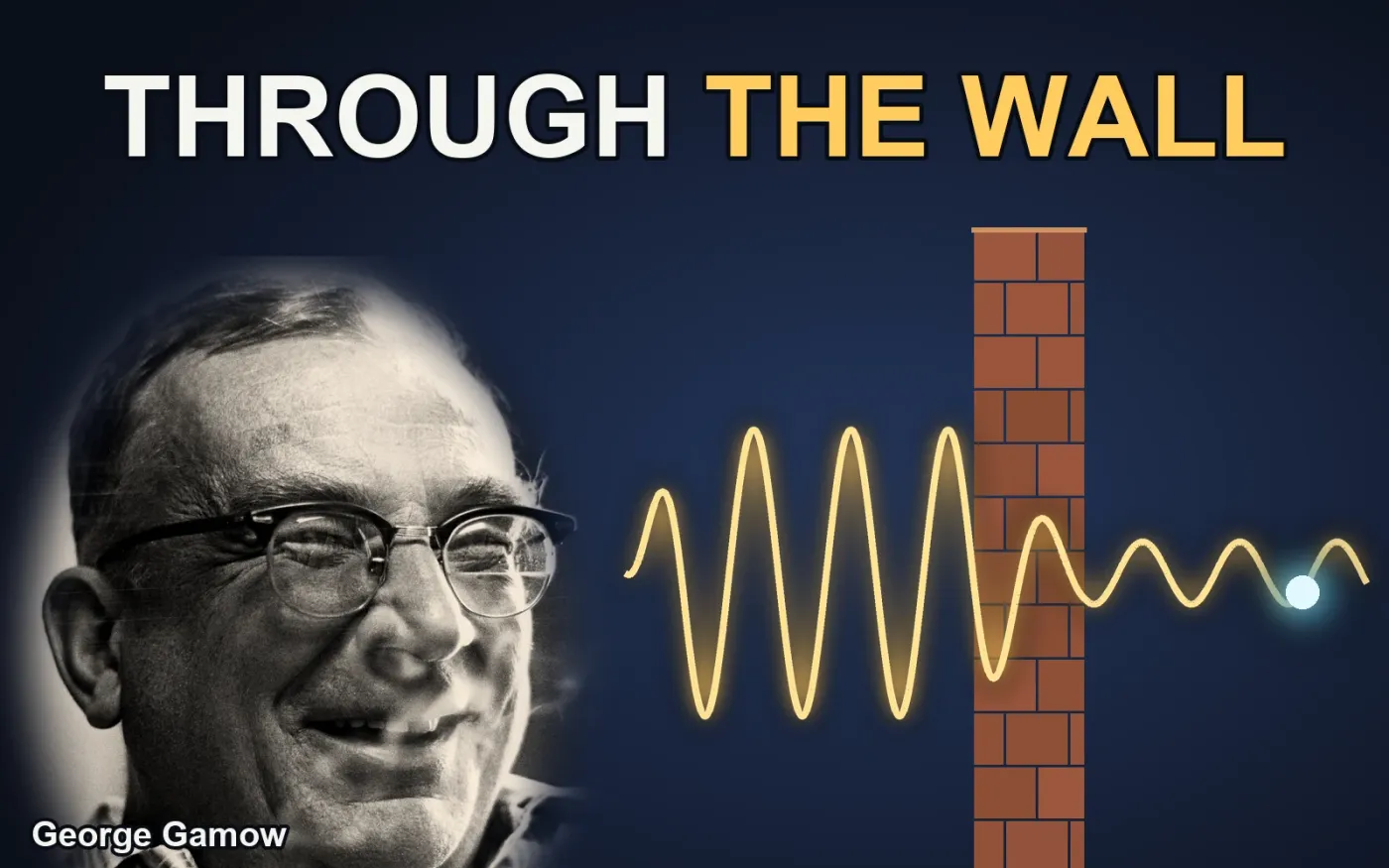
The man at the paddle was George Gamow, 28 years old. Four years earlier he had answered a question that had defeated even Ernest Rutherford: how can a particle escape a wall it does not have the energy to climb? The answer is now called quantum tunneling. A particle is described by a wave, and that wave does not stop abruptly at the edge of a wall. It fades inside. If the wall is thin enough, what is left of the wave on the far side gives the particle a small but real chance of turning up there.
The wind rose. Water came into the boat, then the wind shifted and drove the two of them back toward Crimea [3].
The particle in Gamow’s solution got out of its wall. Gamow had not. This article follows his calculation, which explains why one particle waits 14 billion years while another waits less than a millionth of a second. It also shows why the Sun manages to shine, and how Gamow finally left.
The puzzle of the two tugboats
In the summer of 1928, Gamow, then 24, travelled from Leningrad to Göttingen. On one of his first working days he went to the university library to read the new journals. There he found a paper by Rutherford about something that made no sense [1] [7].
Rutherford had fired alpha particles at uranium nuclei. An alpha particle is a tight cluster of two protons and two neutrons, like four friends with linked arms who never let go. Rutherford’s bullets carried about twice the energy of the alpha particles uranium itself emits, and still they could not get in. How can a wall stop a strong particle going in, yet fail to stop a weak one coming out?
To rescue the situation, Rutherford built a story. As Gamow told it, the particle left the nucleus as a neutral helium atom, so electric forces did not hinder it. Once outside, its two electrons went back to the nucleus, like two tugboats that tow a great ship out of harbor and then return. Gamow found the image entertaining, and did not believe it [1].
He thought about it differently. The particle does not need to climb the wall. Its wave seeps through. By his own account, the main ideas of his paper were ready the next day. On 29 July he sent it to the journal Zeitschrift für Physik [1] [5].
In the United States, Ronald Gurney and Edward Condon reached the same idea independently. They finished their paper on 30 July, exactly one day after Gamow, and published it in Nature that September [1] [6]. Theirs was a qualitative explanation. Gamow’s paper went further by producing numbers to compare with experiment [1] [4].
What is quantum tunneling?
Picture a motorbike with its engine off, coasting up the ramp of a bridge. With enough speed it gets over. Without it, the bike climbs partway and rolls back. Classical physics says there is no third outcome. That ramp is a potential barrier: a region where an object would need more energy than it actually has.
The world of particles does not work that way. As the article on quantum superposition explains, a particle is described by amplitudes, and the wave function is a map of the amplitude at each position. You can think of it as how loud your neighbor’s karaoke is at each spot in your home. At the wall, the sound does not cut out at the surface. It weakens inside the wall, and you can still hear it in the next room. Singing passes through a wall by a different mechanism than a particle does, so take this only as a picture of something that fades without reaching zero.
When you measure, you never find half a particle. You find a whole one on this side or that side, with a probability given by the strength of the wave there. Most of the time, the particle bounces back. Very rarely, it appears on the far side, with exactly the energy it started with.
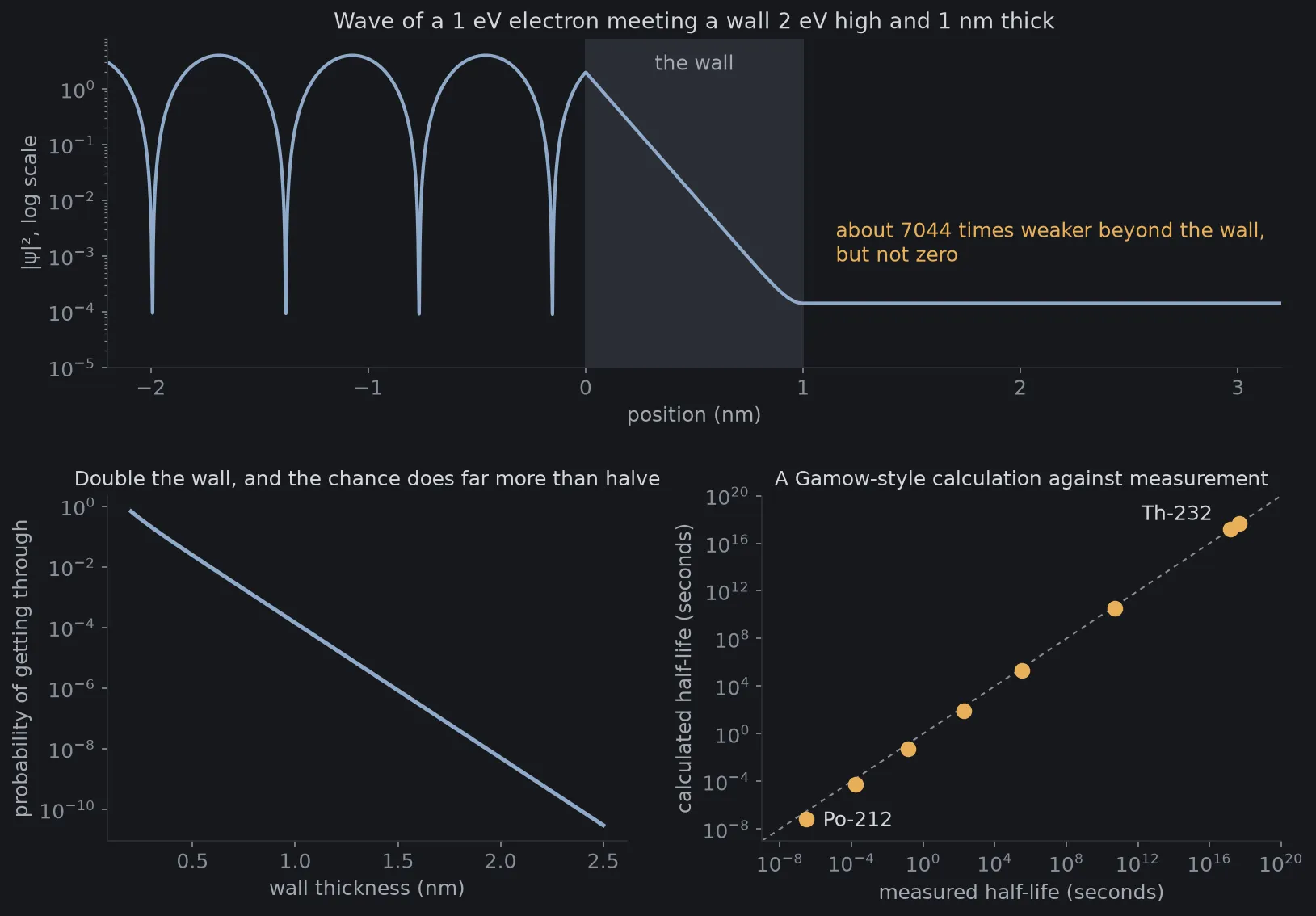
Figure 1 shows the calculation for an electron. In the top panel, the wave oscillates before the wall, falls steadily inside, and carries on at a much lower strength. The lower left panel shows what makes tunneling so different from intuition: the probability falls exponentially. Each extra slice of wall multiplies the probability by the same small fraction, like compound interest running in reverse. For a 1 eV electron meeting a wall 2 eV high, each extra 0.1 nm reduces the probability about 2.8 times. A 1 nm wall gives about . A 2 nm wall gives about , nearly 30,000 times smaller for only twice the thickness.
Why does one particle wait 14 billion years and another less than a millionth of a second?
Rutherford’s puzzle was only half the problem. The other half was much larger. The half-life is the time for half the nuclei in a sample to change, a bit like a pot of popcorn: nobody knows when any one kernel will pop, but the pot as a whole keeps a steady rhythm. In 1911, Hans Geiger and John Nuttall saw that slightly more energetic alpha particles came with far shorter half-lives, and nobody could say why [1] [15].
Gamow pictured the alpha particle as someone locked in a room, knocking on the wall again and again. Each knock is like buying one lottery ticket with a very small chance of winning. The particle is small and the room is tiny, so it knocks about times a second. With a little more energy, the wall is thinner at the height the particle reaches, and because of the exponential, the ticket gets much more likely to win.
I recomputed that calculation for four nuclei, using measured energies and half-lives [14]:
| Nucleus | Decay energy | Measured half-life | Knocks before getting out (my calculation) |
|---|---|---|---|
| Thorium-232 | 4.08 MeV | 14 billion years | about |
| Radium-226 | 4.87 MeV | 1,600 years | about |
| Radon-222 | 5.59 MeV | 3.8 days | about |
| Polonium-212 | 8.95 MeV | 0.29 millionths of a second | about |
The energy differs by only about 2.2 times, while the half-life differs by about times. That is the fingerprint of an exponential, and it also shows how tall the wall is: for thorium-232, I estimate the top at about 27 MeV, nearly seven times the energy the particle carries. Rutherford’s puzzle dissolves as well. His bullets were still below the top of the wall and got only one try each, while a particle inside has billions of years of knocking. No tugboats are needed.
In the lower right of Figure 1, eight nuclei sit close to the diagonal across a range of about 24 orders of magnitude. My results stay within about a factor of 5 of the measurements. Part of that fit is luck: the model depends strongly on the nuclear radius, and making the radius 5% larger shifts the result for thorium-232 about sixfold. The solid part is the trend: a formula derived from quantum mechanics led to the rule Geiger and Nuttall had found by measurement [15].
The first real wall: a postcard from Rome
The paper carried Gamow into European physics very quickly. He presented it at Max Born’s seminar, then worked at Niels Bohr’s institute in Copenhagen and at Rutherford’s laboratory in Cambridge. According to his biographer Viktor Frenkel, at the end of the 1920s almost no physicist in the Soviet Union travelled as freely as he did, with the possible exception of Abram Ioffe [1] [3].
In spring 1931 he returned to Leningrad, and that year everything changed. In October, Rome hosted a major conference on nuclear physics, with Bohr, Marie Curie, Heisenberg, Pauli and Fermi. Gamow was invited and sent his report. He was not given permission to go. Max Delbrück read the report for him, and from Rome came a postcard, started by Paul Ehrenfest, signed by almost all of those physicists [1].
Gamow called this the “Rome fiasco”. According to Frenkel, this is probably when he began to think about leaving for a long time [1]. Materially he lacked nothing: several posts, a spacious apartment beside the Radium Institute, books in print, and corresponding membership of the Academy of Sciences at 27 [1] [3]. That year he also married Lyubov Vokhmintseva, a theoretical physics graduate of Moscow State University, whom he called Rho [1] [4]. The one thing he did not have was the right to step outside.
Two attempts by kayak
What we know about these journeys comes mainly from Gamow’s memoir and from writers who rely on it, so read them as one participant’s account [2] [3]. Sources also disagree about the distance: some give 250 km, others 280 km [3] [4].
In 1932, a year of hunger, the two of them managed to obtain a kayak and some food, then took a train to Crimea. They set out from Alupka, planning to reach Turkey and ask Bohr for help from there. An east wind flooded the boat, then the wind turned and pushed them back. They came ashore near Balaklava, about 50 km west of where they had started [3].
Gamow also described a second attempt, from Murmansk to Norway, again by kayak, and again defeated by the weather [4].
Compared with an alpha particle, Gamow was at an obvious disadvantage. Thorium-232 holds about lottery tickets. Gamow held two. The escape attempts were famous enough that Frenkel recalls the reply he got when proposing to write about Gamow: the hope that it would not merely describe his attempts to cross or swim the frontier [1]. That worry had a point. What Gamow left behind lies in the formula, not on the boat.
The door that unexpectedly opened
In 1933, after those failures, the Soviet education authorities delegated Gamow to the Solvay Conference on nuclear physics in Brussels [3] [4]. The door that two kayaks could not open swung ajar, but at first only for one person.
Gamow did not want to go alone. A passport for his wife seemed almost impossible, so he turned to Nikolai Bukharin, who was by then out of favor. Bukharin could only arrange a meeting with Vyacheslav Molotov. Molotov agreed to help. At first only one passport appeared, and Gamow refused to go. Then a second one turned up [1] [3].
The couple took the train through Finland, Sweden and Denmark, then travelled on to Belgium with the Bohrs [1]. The conference ran from 22 to 29 October 1933. His permission covered only two weeks in Belgium [1].
He decided not to go back, and immediately ran into another wall. Paul Langevin had written the invitation, and Bohr and Ioffe are said to have vouched for him, so his staying put them in a difficult position. Bohr called. Marie Curie spoke with Langevin, and Langevin released Gamow from any obligation. Gamow then worked at the Pierre Curie Institute in Paris [1] [3].
Gamow still did not want a complete break. On 5 November he applied to Leningrad for unpaid leave. In a letter to Pyotr Kapitza, who worked in England while keeping his citizenship and his freedom to travel, he wrote that he wanted to be in the “Kapitza state”, borrowing a turn of phrase from quantum mechanics [1]. That state did not exist for him. Ioffe stopped his salary. The proceedings of a Leningrad conference noted that Gamow’s report “could not be included for technical reasons”. In 1938 he was removed from the corresponding members of the Academy [1].
So to be precise: Gamow never crossed the border by boat. He left through a door opened by a passport, and that door never opened in the other direction.
Why does the Sun shine if it is not hot enough?
Gamow’s idea, unlike Gamow, needed no permit. As early as 1929 it had reached somewhere further than any of his journeys: the center of the Sun.
In 1920, in Cardiff, Arthur Eddington proposed that stars get their energy from fusing hydrogen into helium [10]. There was a serious objection: two protons are both positively charged, so they repel each other like matching poles of two magnets. By classical reckoning, pressing them close enough together would take about 10 billion degrees, while the center of the Sun is only about 16 million degrees [11]. Eddington held his ground. In 1926 he wrote of his critics: “We do not argue with the critic who urges that the stars are not hot enough for this process; we tell him to go and find a hotter place” [9].
That was a confident reply, but not a solution. The solution came from Göttingen. In 1929, Robert Atkinson and Fritz Houtermans, who had written a paper with Gamow, turned the idea around: if an alpha particle can tunnel out, a proton can tunnel in [1] [12]. The Sun does not need any proton to climb to the top of the wall. The fastest protons in the crowd reach a part of the wall that is thin enough, and there are so many protons that this is enough for a star to shine. In 1939, Hans Bethe worked out the reaction chains in stars in detail [13].
Every ray of sunlight on your doorstep traces back to an event that classical physics calls impossible.
Where is tunneling today?
A microscope that sees single atoms
In 1981, at IBM’s research lab in Zürich, Gerd Binnig and Heinrich Rohrer turned the sensitivity of the exponential into a tool [16] [17]. A very sharp tip is brought close to a surface without touching it. Electrons tunnel across the gap, creating a tiny current. Widen the gap by 0.1 nm and the current falls about 10 times [18]. So the tip can “feel” the bumps of individual atoms, like a finger reading braille without touching the paper. Depth resolution reaches about 0.01 nm [17]. The two received the Nobel Prize in Physics in 1986.
The USB stick in your pocket
Each flash memory cell keeps electrons in a compartment surrounded by insulation, like cash in a locked safe. That is why data survives with the power off. To write, the chip applies a high voltage that tilts the wall and effectively thins it, and electrons tunnel through the insulator into the compartment. The classic NAND cell uses this mechanism for both writing and erasing [19] [20]. Each cycle slowly wears the insulator, which is one reason SSDs have a write endurance limit [20]. Specific designs vary by manufacturer and chip generation.
The downside: leakage in chips
The same effect is a nuisance elsewhere. As the article on what a 3nm chip is describes, when a transistor’s insulator is only a few atomic layers thick, electrons leak through even with the switch off, producing heat while doing nothing. Figure 1 shows why this arrives so abruptly: thin the layer a little, and the leakage rises exponentially.
A circuit you can hold in your hand
For decades, tunneling belonged to individual particles. In 1984 and 1985, John Clarke, Michel Devoret and John Martinis showed that a superconducting circuit big enough to hold in the hand could tunnel as a single unit. This work won the 2025 Nobel Prize in Physics, and according to the Royal Swedish Academy of Sciences it opened the way to new quantum technologies, including quantum computers (article in Vietnamese) [21].
Three common misunderstandings about tunneling
Does the particle make a hole in the wall? No. The wall stays intact and no tunnel is left behind. The name is only an image. Gamow did not use the word in 1928 either, as it came into use later [1].
Does the particle borrow energy to cross? This is a common way of putting it, but it misleads. Measured on the far side, the particle has the same energy as before, with nothing lost and nothing owed. The particle does not get temporarily richer. Its wave simply never had a sharp boundary at the edge of the wall.
So could a person walk through a wall? In principle, the probability is not zero. In practice, for a 60 kg person who is 1 joule short of clearing a 10 cm wall, a rough estimate gives about . That number is so small that no span of cosmic time would be enough to wait for it. Large mass makes the wave vanish almost at once inside the wall, which is why you only see tunneling in the world of electrons, protons and alpha particles.
The same thing in symbols
This section is for readers who want the formulas. You can skip it without losing the main idea.
For a rectangular wall of height and thickness , with a particle of energy , the wave inside falls as , so the probability of getting through is roughly
The mass sits inside , so heavier objects fade faster. The thickness sits in the exponent, and that is the source of the sensitivity.
The wall around a nucleus is not flat. It is an electric wall, high near the nucleus and falling away with distance. Gamow integrated the exponent along that wall to get a penetration factor . Multiplying by the number of knocks per second gives the decay rate
Expanding gives exactly the form of the Geiger and Nuttall rule: [15].
Recompute Gamow’s calculation yourself
The Python below does three things: it solves the Schrödinger equation exactly for a rectangular wall, applies Gamow’s model to eight nuclei, and estimates the probability of a person walking through a wall. It also draws Figure 1. The model assumes the alpha particle already exists inside the nucleus, which is only an approximation [1], and takes the radius from a commonly used formula. Nothing here is random, so no seed is needed. You need numpy and matplotlib.
import matplotlib.pyplot as pltimport numpy as np
plt.rcParams.update({"figure.facecolor": "#16181c", "axes.facecolor": "#16181c", "text.color": "#d4d7dc",                     "axes.edgecolor": "#2a2e35", "axes.labelcolor": "#a4a9b2",                     "xtick.color": "#878d97", "ytick.color": "#878d97", "font.size": 12})
# Part 1: an electron meets a wall. Units are eV and nanometres; HBAR2_2M is ħ²/(2m) for an electron.HBAR2_2M = 0.0381E, V = 1.0, 2.0                     # a 1 eV electron meets a wall 2 eV high

def solve_wall(L):    """Solve the Schrödinger equation for a wall of thickness L: return k, κ and the 4 coefficients r, a, b, t."""    k, kappa = np.sqrt(E / HBAR2_2M), np.sqrt((V - E) / HBAR2_2M)    down, up, out = np.exp(-kappa * L), np.exp(kappa * L), np.exp(1j * k * L)    A = np.array([[1, -1, -1, 0], [1j * k, kappa, -kappa, 0],                  [0, down, up, -out], [0, -kappa * down, kappa * up, -1j * k * out]], dtype=complex)    return k, kappa, np.linalg.solve(A, np.array([-1, 1j * k, 0, 0], dtype=complex))

def through_probability(L):    return abs(solve_wall(L)[2][3]) ** 2

for L in (0.5, 1.0, 1.5, 2.0):    print(f"wall {L} nm thick: probability of getting through {through_probability(L):.1e}")print(f"each extra 0.1 nm: probability falls {through_probability(1.0) / through_probability(1.1):.1f} times")
# Part 2: Gamow's calculation. Units are MeV and femtometres.E2, HBARC, M_ALPHA = 1.44, 197.3, 3727.4     # e²/(4πε₀), ħc, alpha particle rest energyC, YEAR = 3e23, 3.156e7                      # speed of light (fm/second), seconds in a year# Name, protons, mass number, decay energy (MeV), measured half-life (seconds)NUCLEI = [("Th-232", 90, 232, 4.082, 1.40e10 * YEAR), ("U-238", 92, 238, 4.270, 4.463e9 * YEAR),          ("Ra-226", 88, 226, 4.871, 1600 * YEAR), ("Rn-222", 86, 222, 5.590, 3.8215 * 86400),          ("Po-218", 84, 218, 6.115, 3.097 * 60), ("Po-216", 84, 216, 6.906, 0.144),          ("Po-214", 84, 214, 7.833, 163.5e-6), ("Po-212", 84, 212, 8.954, 294.4e-9)]

def gamow(Z, A, Q, radius_constant=1.2):    """One alpha particle in a nucleus: return knocks per second, probability per knock, half-life."""    M = M_ALPHA * (A - 4) / A                                  # reduced mass    R = radius_constant * ((A - 4) ** (1 / 3) + 4 ** (1 / 3))  # inner edge of the wall    b = 2 * (Z - 2) * E2 / Q                                   # outer edge of the wall    x = R / b    G = np.sqrt(2 * M * Q) / HBARC * b * (np.arccos(np.sqrt(x)) - np.sqrt(x * (1 - x)))    knocks = C * np.sqrt(2 * Q / M_ALPHA) / (2 * R)    return knocks, np.exp(-2 * G), np.log(2) * np.exp(2 * G) / knocks

print("nucleus  knocks/s  total knocks  calc(s)  measured(s)  calc/measured")for name, Z, A, Q, T in NUCLEI:    knocks, P, T_calc = gamow(Z, A, Q)    print(f"{name}  {knocks:.0e}  {1 / P:.0e}  {T_calc:.1e}  {T:.1e}  {T_calc / T:.1f}")print("Th-232, radius 5% larger: calc/measured =", f"{gamow(90, 232, 4.082, 1.26)[2] / NUCLEI[0][4]:.2f}")print("top of the Th-232 wall:", round(2 * 88 * E2 / (1.2 * (228 ** (1 / 3) + 4 ** (1 / 3))), 1), "MeV")
# Part 3: a 60 kg person, 1 joule short, walking through a 10 cm wallexponent = 2 * np.sqrt(2 * 60 * 1.0) / 1.055e-34 * 0.1 / np.log(10)print(f"person through a wall: probability about 10^(-{exponent:.0e})")
# Plotfig = plt.figure(figsize=(12.5, 8.6))g = fig.add_gridspec(2, 2, height_ratios=[1, 1.05], hspace=0.38, wspace=0.26)ax = fig.add_subplot(g[0, :])L = 1.0k, kappa, (r, a, b, t) = solve_wall(L)x = np.linspace(-2.2, 3.2, 2000)psi = np.where(x < 0, np.exp(1j * k * x) + r * np.exp(-1j * k * x),               np.where(x < L, a * np.exp(-kappa * x) + b * np.exp(kappa * x), t * np.exp(1j * k * x)))ax.axvspan(0, L, color="#2a2e35")ax.plot(x, np.abs(psi) ** 2, color="#8fa9c9", lw=2)ax.set_yscale("log")ax.set_ylim(1e-5, 8)ax.set_xlim(-2.2, 3.2)ax.text(0.5, 2.2, "the wall", ha="center", color="#a4a9b2")ax.text(1.15, 8e-4, f"about {1 / abs(t) ** 2:.0f} times weaker beyond the wall,\nbut not zero", color="#e8b05a")ax.set_xlabel("position (nm)")ax.set_ylabel("|ψ|², log scale")ax.set_title("Wave of a 1 eV electron meeting a wall 2 eV high and 1 nm thick", color="#d4d7dc", fontsize=13)
ax = fig.add_subplot(g[1, 0])thickness = np.linspace(0.2, 2.5, 100)ax.semilogy(thickness, [through_probability(d) for d in thickness], color="#8fa9c9", lw=2.4)ax.set_xlabel("wall thickness (nm)")ax.set_ylabel("probability of getting through")ax.set_title("Double the wall, and the chance does far more than halve", color="#d4d7dc", fontsize=12)
ax = fig.add_subplot(g[1, 1])measured = [n[4] for n in NUCLEI]calculated = [gamow(*n[1:4])[2] for n in NUCLEI]limits = [1e-9, 1e20]ax.loglog(limits, limits, color="#878d97", ls=(0, (3, 3)), lw=1)ax.scatter(measured, calculated, s=70, color="#e8b05a", zorder=3)for n, d, c in zip(NUCLEI[:1] + NUCLEI[-1:], [measured[0], measured[-1]], [calculated[0], calculated[-1]]):    ax.annotate(n[0], (d, c), xytext=(-58, 2) if n[0] == "Th-232" else (10, -4), textcoords="offset points", color="#d4d7dc")ax.set_xlim(limits)ax.set_ylim(limits)ax.set_xlabel("measured half-life (seconds)")ax.set_ylabel("calculated half-life (seconds)")ax.set_title("A Gamow-style calculation against measurement", color="#d4d7dc", fontsize=12)for a_ in fig.axes:    for sp in ("top", "right"):        a_.spines[sp].set_visible(False)fig.savefig("xuyen-ham-luong-tu-en.png", dpi=150, bbox_inches="tight")
Output:
wall 0.5 nm thick: probability of getting through 2.4e-02wall 1.0 nm thick: probability of getting through 1.4e-04wall 1.5 nm thick: probability of getting through 8.5e-07wall 2.0 nm thick: probability of getting through 5.0e-09each extra 0.1 nm: probability falls 2.8 timesnucleus knocks/s total knocks calc(s) measured(s) calc/measuredTh-232 8e+20 5e+38 4.7e+17 4.4e+17 1.1U-238 8e+20 2e+38 1.5e+17 1.4e+17 1.1Ra-226 8e+20 4e+31 3.4e+10 5.0e+10 0.7Rn-222 9e+20 3e+26 2.1e+05 3.3e+05 0.6Po-218 9e+20 1e+23 7.9e+01 1.9e+02 0.4Po-216 1e+21 8e+19 5.8e-02 1.4e-01 0.4Po-214 1e+21 9e+16 5.7e-05 1.6e-04 0.3Po-212 1e+21 1e+14 6.4e-08 2.9e-07 0.2Th-232, radius 5% larger: calc/measured = 0.17top of the Th-232 wall: 27.4 MeVperson through a wall: probability about 10^(-9e+33)The last column of the table is the ratio of calculated to measured half-life. The line right below it shows the limit of the model: make the radius 5% larger, and the ratio for thorium-232 drops from 1.1 to 0.17. You can change L in the plotting section to see how the wave beyond the wall responds.
Back to the Crimean shore
On their last day in Leningrad in 1933, the Gamows left their luggage at the Finland Station, then had lunch with friends: duck with apples. As one friend remembered it, they planned to catch the ballet Romeo and Juliet before boarding the train, “as a dessert”. The friends strolled along the embankment on a warm autumn evening and parted with a promise to meet again soon. The meeting, she wrote, never took place [1].
Gamow moved to the United States in 1934, taught at George Washington University, contributed to the Big Bang theory, proposed ideas about the genetic code, and wrote the popular science series about Mr Tompkins. He was nominated for the Nobel Prize several times without receiving it, and passed away in Colorado in 1968 [3] [8] [22].
Twice he went out on the water, and twice he was pushed back. The idea of the 24-year-old in the Göttingen library kept going: into the answer about the Sun, into the USB stick in your pocket, into a needle tip that sees atoms. A wave does not stop at the edge of a wall.
Free geometry illustrations for students and teachers: EyeViz.
Tài liệu tham khảo
- [1]V. Ya. Frenkel'. George Gamow: world line 1904–1933 (on the 90th anniversary of his birth). Physics-Uspekhi 37(8), 767–789, 1994.
- [2]George Gamow. My World Line: An Informal Autobiography. Viking Press, 1970.
- [3]The Joyous Science: An Essay on the Biography and Scientific Activity of George Gamow. T-invariant, 2024.
- [4]George Gamow. Wikipedia.
- [5]G. Gamow. Zur Quantentheorie des Atomkernes. Zeitschrift für Physik 51, 204–212, 1928.
- [6]R. W. Gurney and E. U. Condon. Wave Mechanics and Radioactive Disintegration. Nature 122, 439, 1928.
- [7]E. Rutherford. Structure of the radioactive atom and origin of the α-rays. Philosophical Magazine 4, 580–605, 1927.
- [8]Gamow, George. Complete Dictionary of Scientific Biography (Encyclopedia.com).
- [9]Review of The Internal Constitution of the Stars (quotes Eddington, p. 301 of the book). Bulletin of the American Mathematical Society, 1927.
- [10]Eddington in Cardiff 100 years ago today: the first proposal that stars are powered by fusion. In the Dark, 2020.
- [11]Stellar Interiors II (ASTR 421 lecture). University of New Mexico.
- [12]R. d’E. Atkinson and F. G. Houtermans. Zur Frage der Aufbaumöglichkeit der Elemente in Sternen. Zeitschrift für Physik 54, 656–665, 1929.
- [13]H. A. Bethe. Energy Production in Stars. Physical Review 55, 434–456, 1939.
- [14]Decay chain (thorium and uranium series tables). Wikipedia.
- [15]Geiger–Nuttall law. Wikipedia.
- [16]G. Binnig, H. Rohrer, Ch. Gerber, E. Weibel. Surface Studies by Scanning Tunneling Microscopy. Physical Review Letters 49, 57–61, 1982.
- [17]Scanning tunneling microscope. Wikipedia.
- [18]Scanning Tunneling Microscopy (lab notes). University of Liverpool.
- [19]NAND Flash Endurance Testing (application note AN2107). Swissbit.
- [20]The Invention of NAND Flash. 3D InCites, 2018.
- [21]The Nobel Prize in Physics 2025: press release. NobelPrize.org, 2025.
- [22]The Distinguished Life and Career of George Gamow. University of Colorado Boulder.