Quantum superposition explained with three filters
What is quantum superposition? Three polarizing filters, single photons and the BB84 protocol show why measuring changes a state and exposes eavesdroppers.
Mục lục
Stack two polarizing lenses at right angles and the overlap goes almost black. Now slip a third lens between them, tilted 45 degrees. The dark area lights up again. Adding a barrier lets more light through.
For a bright beam, nineteenth-century physics already explained this. The strangeness appears when the light is dimmed to single photons. To make sense of it we need quantum superposition: the state of a system is written as a sum of several possibilities, each carrying a number called an amplitude. Amplitudes can add up or cancel, and a measurement returns just one result.
Superposition also depends on the question you ask. A photon that is “definitely vertical” for one question is a superposition for another. That fact lets two people detect an eavesdropper on their line, the idea behind the BB84 protocol of 1984.
Three polarizing filters: an experiment you can do yourself
You need an LCD screen and two lenses from polarized sunglasses. Many LCD screens emit light that is already polarized, so the screen itself acts as the first filter.
Look at the screen through one lens and rotate it slowly until the screen goes nearly black. Keep that lens in place, slide the second lens between it and the screen, and turn it about 45 degrees. The picture comes back. If the screen never darkens, it may not emit linearly polarized light, which is common on some OLED displays.
Intuition treats a filter like a sand sieve: another sieve can only remove more. The experiment shows a filter does more than that. It changes what passes through it.
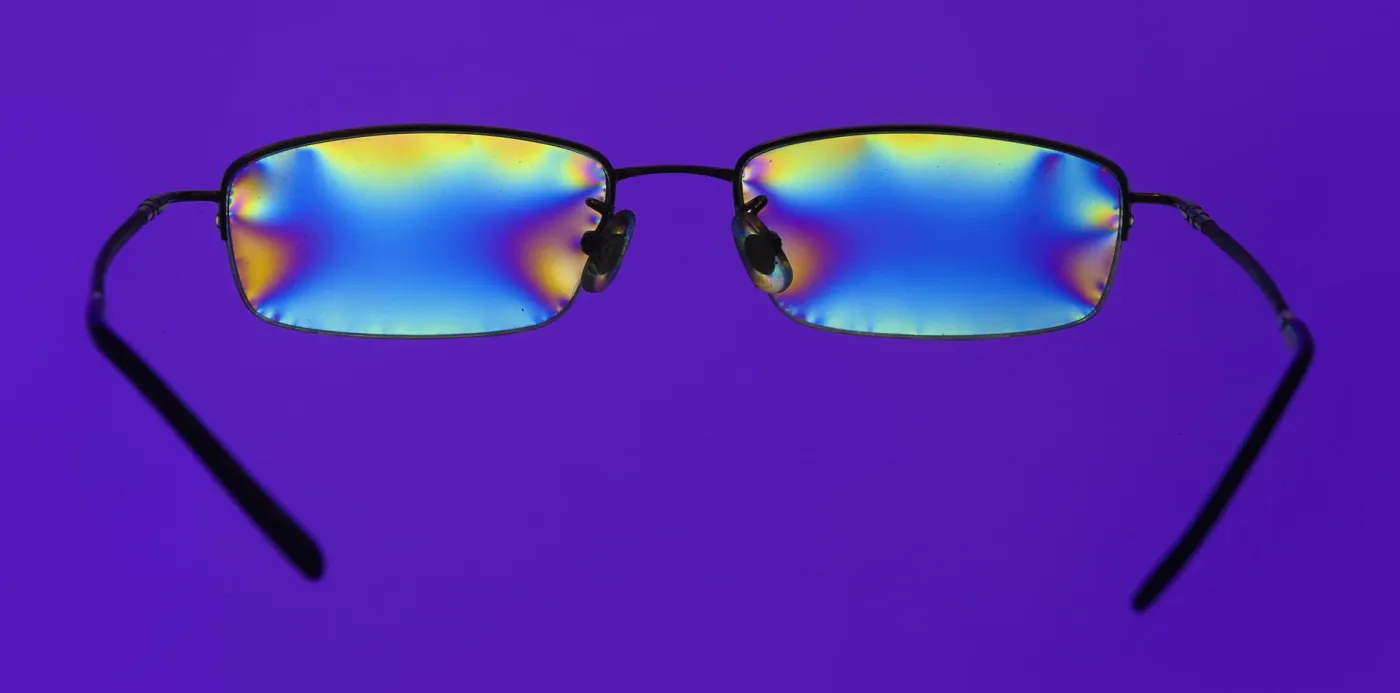
The cover photo is a variation on this experiment: a pair of plastic glasses placed between two polarizers. Stress in the plastic alters the polarization of light by an amount that differs with color, so rainbow bands appear across the lenses.
What is polarized light?
Think of a rope tied to a post and shaken up and down: the wave runs along the rope while the rope moves in one direction. The direction in which a light wave oscillates is its polarization. A polarizing filter is like a fence with vertical slats: a rope shaken up and down slips through the gap, and one shaken sideways is blocked.
As the story is usually told, around 1808 Étienne-Louis Malus looked through a crystal at sunlight reflected from the windows of the Luxembourg Palace, turned the crystal, and saw the brightness change. He published the work in 1809 [1]. Cheap sheet polarizers came later: Edwin Land put Polaroid material into sunglasses from 1936 [2].
Malus’s law says that polarized light passing a filter at angle keeps a fraction of its intensity. At 0 degrees everything passes, at 90 degrees nothing does, and at 45 degrees half remains.
With ideal filters, ordinary light through a vertical filter drops to 1/2. Through the 45-degree filter it drops to 1/4. Through a horizontal filter, again 45 degrees off, it drops to 1/8, or 12.5%. Without the middle filter, vertical light meets a horizontal filter and nothing remains. The secret is that after the middle filter the light is no longer vertically polarized, so the last filter is no longer at right angles to it.
For waves this is easy to picture. A tilted oscillation splits into two components, like a diagonal arrow split into the two sides of a right triangle, and the filter keeps the component along its axis. No quantum physics is needed yet.
Down to a single photon
Light is made of photons, packets of energy that cannot be divided, much like coins: you cannot hand someone half of your only coin. In 1986 Philippe Grangier, Gérard Roger and Alain Aspect sent single photons at a half-silvered mirror, which splits an ordinary beam in two, with detectors at both exits. Each photon was registered at only one exit [4].
So what happens when a vertical photon meets a 45-degree filter? The wave answer is “half remains”, but a photon cannot half remain. It either passes whole or not at all, with a probability of 50%. Send a million photons and about half a million get through, so overall it still looks like “half remains”. Paul Dirac used exactly this situation at the start of his 1930 textbook: an obliquely polarized photon meets a tourmaline crystal, and the probability of passing follows from the angle [3].
The striking part comes next. A photon that has just passed the 45-degree filter is polarized at 45 degrees and keeps no memory of having been vertical. Send it through another 45-degree filter and it certainly passes. Send it through a vertical filter and it passes only half the time.
The complete rule has two parts: a photon polarized at angle meeting a filter at angle passes with probability , and if it passes its angle becomes . Applied to three filters, this gives 1/2 × 1/2 = 1/4 of the vertically polarized photons, matching the wave result.
What is quantum superposition?
A vertical photon is random at a 45-degree filter and certain at a vertical one. So is it undecided or certain? The answer lies in an arrow on a map.
You walk north. On an ordinary map that direction is 100% north. A friend uses a map rotated by 45 degrees, with northeast and northwest as axes. On that map the same walk is the sum of a northeast part and a northwest part. The walk has not changed, only the way it is broken down.
A polarization state is an arrow of the same kind. On the vertical and horizontal axes, a vertical photon is “100% vertical”. On the right-tilted and left-tilted axes, the same photon is the sum of two equal parts.
When a state is written as a sum of possibilities, we call it a superposition. Each part has an amplitude, like the length of the arrow along each axis, and the probability is the square of the amplitude. Two equal parts have amplitude , which squares to 1/2.
A 45-degree filter asks “tilted right or tilted left?”. To this question a vertical photon has no definite answer. A vertical filter asks a different question, and the answer is certain. So superposition is not a special kind of state but a relation between a state and a question. Two such questions cannot both have definite answers, just as a person can face only one direction at a time.
Three common misunderstandings of superposition
“Superposition means we just don’t know.” A coin under your hand is already heads or tails. Superposition differs because the possibilities can still interfere, as the next section calculates. The article on Schrödinger’s cat works through this with the double-slit experiment.
“The photon is vertical and horizontal at the same time.” This suggests two photons. There is really one photon in exactly one state, and that state can be broken into two parts. An arrow pointing northeast is not two arrows at once.
“A quantum computer tries every answer at once.” Measure right away and you get one random result. The power comes from arranging for wrong answers to cancel, as explained in are quantum computers really the future? (article in Vietnamese).
Why does the middle filter let light through?
Now use amplitudes. We can compute the step from vertical to horizontal along two routes: through tilted right or through tilted left. The quantum rule says to multiply amplitudes along each route, then add the routes.
| Route | Step 1 | Step 2 | Product |
|---|---|---|---|
| Vertical → tilted right → horizontal | |||
| Vertical → tilted left → horizontal | |||
| Sum | 0 |
The sum is 0, so the probability is 0. This is destructive interference, like noise-cancelling headphones that play an opposite-phase sound wave so that the two waves add up to nearly nothing.
Put a right-tilted filter in the middle and the second route is blocked. Nothing is left to cancel. The amplitude is , which squares to , the number we found above.
The puzzle now has a short answer: the middle filter adds no light, it breaks a cancellation. Losing a route raises the result, something ordinary probability cannot do, because probabilities have no minus sign.
The more filters, the more light gets through
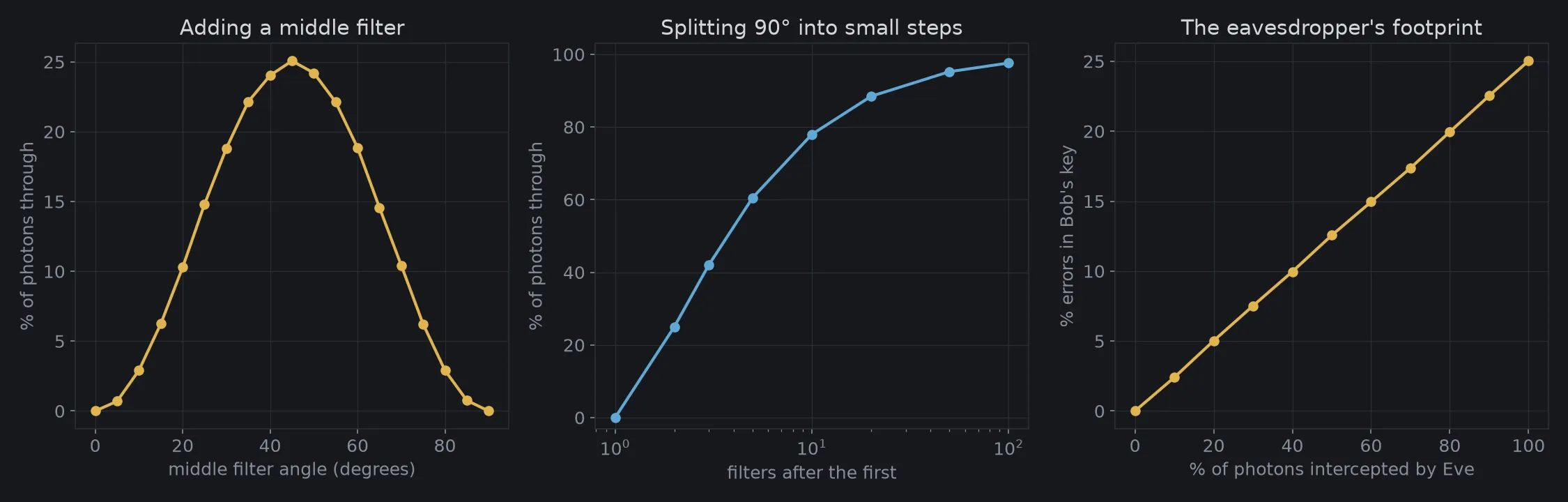
Instead of one middle filter, split the 90-degree turn into many small steps. Each filter is only slightly off the previous one, so nearly every photon passes and turns with the new filter each time. I simulated 200,000 vertical photons that must end up horizontal:
| Filters after the first | Angle per step | Fraction through |
|---|---|---|
| 1 | 90° | 0% |
| 2 | 45° | 25% |
| 5 | 18° | 60.5% |
| 10 | 9° | 78.0% |
| 100 | 0.9° | 97.6% |
It is like a motorbike taking a right-angle bend: one hard turn risks a skid, while many gentle leans get you through smoothly. The table assumes ideal filters. Real ones lose light at every layer, so you cannot reproduce the 100-filter row at home.
Does a photon carry its answer in advance?
Could a photon carry a “hidden label” listing its answer for every angle, one we simply cannot read? For a single photon, this idea has not been ruled out. The simulation in this article itself attaches an “angle” number to each photon and still gets the right fractions. So three filters are not evidence of superposition. They are only an easy way to see it.
Quantum mechanics parts ways with such labels only for entangled pairs of photons. In 1964 John Bell proved that if each particle carries its answers in advance, and the two particles do not influence each other instantly, then correlations between two measurement sites must satisfy an inequality [5]. Picture two people questioned in separate rooms: if they rely only on notes prepared beforehand, how often they can agree has a calculable limit.
Experiments with entangled photons have exceeded that limit. Alain Aspect, John Clauser and Anton Zeilinger shared the 2022 Nobel Prize in Physics for this work [6].
From filters to secrets: how does BB84 work?
Stephen Wiesner wrote about “conjugate coding” in the 1970s, though the paper was not printed until 1983 [7]. In 1984 Charles Bennett and Gilles Brassard turned the idea into a key exchange protocol, presented in Bangalore and later known as BB84 [8].
Alice and Bob want to share a secret string of bits, and Eve wants to listen in. Ordinary cryptography such as RSA rests on a hard computation; whoever can do it reads along and leaves no trace. BB84 rests on two different facts. First, measuring with the wrong question gives a random result and alters the photon. Second, an unknown quantum state cannot be copied, the no-cloning theorem [9]. Eve cannot photocopy a letter without opening its sealed envelope.
The protocol uses two kinds of question: basis + (vertical or horizontal) and basis × (tilted right or tilted left). Each basis can encode bits 0 and 1.
| Step | Action |
|---|---|
| 1 | Alice picks a random bit and basis for each photon and sends it |
| 2 | Bob picks a random measurement basis for each photon |
| 3 | They publish the bases they used, not the bits |
| 4 | They keep rounds with matching bases, about half |
| 5 | They publicly compare some bits and discard everything if there are too many errors |
| 6 | The rest, after error correction and shortening, is the secret key |
With matching bases, Bob reads Alice’s bit correctly. With different bases the result is random, so that round is dropped. Here are six photons (illustrative values):
| Photon | 1 | 2 | 3 | 4 | 5 | 6 |
|---|---|---|---|---|---|---|
| Alice’s basis | + | × | + | × | × | + |
| Alice’s bit | 0 | 1 | 1 | 0 | 1 | 0 |
| Bob’s basis | + | + | + | × | × | × |
| Kept? | yes | no | yes | yes | yes | no |
| Shared bit | 0 | 1 | 0 | 1 |
They can announce “photons 1, 3, 4 and 5 matched” without anyone learning a single bit, like two readers comparing page numbers without reading the pages aloud. Six photons give four shared bits: 0, 1, 0, 1. With no interference and perfect equipment, the kept bits agree 100%.
Now Eve steps in. The simplest attack is to intercept each photon, measure it, and send a new one to Bob. Eve does not know Alice’s basis, so she guesses wrong about half the time and the photon switches to her basis. In those rounds, even when Alice and Bob match, Bob is right only 50% of the time.
The arithmetic is short: . If Eve intercepts everything, 25% of the kept bits are wrong [10]. My simulation with 400,000 photons gives 24.92%, and errors rise in a straight line with the share of photons intercepted, as the right panel of Figure 1 shows. The chance of comparing 100 bits and seeing no error is .
BB84 does not stop Eve from blocking the line. It detects her, and the two parties do not use that key. Real lines always have noise, so a threshold is needed: by Shor and Preskill’s analysis, BB84 can still produce a secure key when the error rate is below about 11% [11].
Has BB84 run in the real world?
Yes. Bennett’s group published an experiment in 1992 [12]. In 2017 China’s Micius satellite distributed keys to the ground over distances of up to about 1,200 km [13]. In 2018 it acted as a relay to create keys between China and Austria, about 7,600 km apart [14].
But equipment is not as perfect as theory. A relay must be trusted, because it knows the key. In 2010 Lars Lydersen’s group used bright light to remotely control the photon detectors in two commercial systems [15]. No law of physics was broken. Only the machine was attacked, like a good lock on a loose hinge.
The security community is not unanimous either. The US NSA does not recommend quantum key distribution for national security systems. Its stated reasons include that it is only a partial solution, needs special-purpose equipment, raises infrastructure costs and adds denial-of-service risk [16]. Alice and Bob must also still authenticate each other on the public channel, or Eve can impersonate both.
The preferred route is post-quantum cryptography: algorithms that run on ordinary computers, based on problems with no known fast solution. In August 2024 NIST published its first three standards, including ML-KEM for key exchange [17]. It is like changing the lock through a software update rather than rebuilding the house. In exchange, its security still rests on assumptions about hardness, not directly on physics.
The same thing in notation
You can skip this section without losing the main idea. Let be vertical, horizontal, tilted right and tilted left. The two sets of axes are related by:
The minus sign in the second expression is what causes the cancellation:
Splitting 90 degrees into steps gives a transmitted fraction of . The loss per step is on the order of , the total loss on the order of , so the fraction tends to 100%.
Simulate the three filters and BB84 yourself
The code below produces exactly Figure 1 and the numbers in this article, with a fixed seed of 42, and needs only numpy and matplotlib. It is a simulation to check the arithmetic with noiseless equipment, not a real cryptosystem.
import matplotlib.pyplot as pltimport numpy as np
plt.rcParams.update({"figure.facecolor": "#16181c", "axes.facecolor": "#16181c", "text.color": "#d4d7dc",                     "axes.edgecolor": "#2a2e35", "axes.labelcolor": "#878d97",                     "xtick.color": "#878d97", "ytick.color": "#878d97", "font.size": 12})GOLD, BLUE = "#e0b44c", "#5fa8d3"rng = np.random.default_rng(42)
# 1. The rule for one photon: polarized at angle a, meeting a filter at angle b.#    It passes with probability cos²(a − b). If it passes, its angle becomes b.def through_filters(angles, n=200_000):    """Send n vertically polarized photons (0°) through filters, return the fraction left."""    alive, a = np.ones(n, dtype=bool), 0.0    for b in angles:        passed = rng.random(n) < np.cos(np.radians(b - a)) ** 2        alive &= passed        a = b    return alive.mean()
print(f"two filters 0° and 90°: {through_filters([90]):.4f}")print(f"three filters 0°, 45°, 90°: {through_filters([45, 90]):.4f}")
middle_angle = np.arange(0, 91, 5)three_filters = [through_filters([g, 90]) for g in middle_angle]
# 2. Split the 90° turn into small steps: more filters, more photons through.filter_count = np.array([1, 2, 3, 5, 10, 20, 50, 100])many_filters = [through_filters(np.linspace(90 / k, 90, k)) for k in filter_count]for k, p in zip(filter_count, many_filters):    print(f"{k:3d} filters after the first: {p:.3f}   theory {np.cos(np.radians(90 / k)) ** (2 * k):.3f}")
# 3. BB84: Alice sends bits in basis + or x, Eve intercepts some photons, Bob picks a random basis.def bb84(intercepted, n=400_000):    alice_bit, alice_basis = rng.integers(0, 2, n), rng.integers(0, 2, n)    photon_bit, photon_basis = alice_bit.copy(), alice_basis.copy()    hit = rng.random(n) < intercepted    eve_basis = rng.integers(0, 2, n)    # Measuring in the wrong basis gives a random bit, and the resent photon carries Eve's basis.    eve_wrong = hit & (eve_basis != photon_basis)    photon_bit[eve_wrong] = rng.integers(0, 2, eve_wrong.sum())    photon_basis[hit] = eve_basis[hit]    bob_basis = rng.integers(0, 2, n)    bob_bit = photon_bit.copy()    bob_wrong = bob_basis != photon_basis    bob_bit[bob_wrong] = rng.integers(0, 2, bob_wrong.sum())    keep = alice_basis == bob_basis                 # keep only rounds with matching bases    return keep.mean(), (alice_bit[keep] != bob_bit[keep]).mean()
keep, error = bb84(0)print(f"no eavesdropper: kept {keep:.3f} of photons, error rate {error:.4f}")keep, error = bb84(1)print(f"Eve intercepts every photon: error rate {error:.4f}")print(f"comparing 100 bits and seeing no error: probability {0.75 ** 100:.1e}")
share = np.linspace(0, 1, 11)error_rate = [bb84(f)[1] for f in share]
fig, (a1, a2, a3) = plt.subplots(1, 3, figsize=(15, 4.8))a1.plot(middle_angle, np.array(three_filters) * 100, "o-", color=GOLD, lw=2)a1.set(xlabel="middle filter angle (degrees)", ylabel="% of photons through", title="Adding a middle filter")a2.semilogx(filter_count, np.array(many_filters) * 100, "o-", color=BLUE, lw=2)a2.set(xlabel="filters after the first", ylabel="% of photons through", title="Splitting 90° into small steps", ylim=(-3, 103))a3.plot(share * 100, np.array(error_rate) * 100, "o-", color=GOLD, lw=2)a3.set(xlabel="% of photons intercepted by Eve", ylabel="% errors in Bob's key", title="The eavesdropper's footprint")for a in (a1, a2, a3):    a.grid(color="#2a2e35", lw=0.6)fig.tight_layout()fig.savefig("chong-chap-luong-tu-en.png", dpi=150)
Output:
two filters 0° and 90°: 0.0000three filters 0°, 45°, 90°: 0.2510 1 filters after the first: 0.000 theory 0.000 2 filters after the first: 0.250 theory 0.250 3 filters after the first: 0.421 theory 0.422 5 filters after the first: 0.605 theory 0.605 10 filters after the first: 0.780 theory 0.781 20 filters after the first: 0.884 theory 0.884 50 filters after the first: 0.952 theory 0.952100 filters after the first: 0.976 theory 0.976no eavesdropper: kept 0.500 of photons, error rate 0.0000Eve intercepts every photon: error rate 0.2492comparing 100 bits and seeing no error: probability 3.2e-13Try changing bb84(1) to bb84(0.1): errors drop to about 2.5%, below the 11% threshold. If Eve intercepts little she is hard to detect, but she also learns little, and the key-shortening step at the end of the protocol removes that information.
Back to the three filters
Two crossed lenses go dark because two possibilities erase each other. A third lens brings the light back because it asks a different question, and that question breaks the cancellation. Nowhere in this chain is anything literally both one thing and another. There is one state, many ways to break it down, and a rule for adding amplitudes that differs from how we add everyday probabilities.
That a question changes its answer sounds like a limit on measurement. BB84 turns that limit into a tool: whoever asks the wrong question leaves a trace. Next time a screen goes dark through your sunglasses, slip in a second lens and watch the effect with your own eyes.
Free geometry illustrations for students and teachers: EyeViz.
Tài liệu tham khảo
- [1]Étienne-Louis Malus. Wikipedia.
- [2]Edwin Herbert Land. Encyclopaedia Britannica.
- [3]P. A. M. Dirac. The Principles of Quantum Mechanics (chapter 1, section "The Polarization of Photons"). Oxford University Press, 1930.
- [4]P. Grangier, G. Roger, A. Aspect. Experimental Evidence for a Photon Anticorrelation Effect on a Beam Splitter: A New Light on Single-Photon Interferences. Europhysics Letters 1, 173–179, 1986.
- [5]J. S. Bell. On the Einstein Podolsky Rosen paradox. Physics Physique Fizika 1, 195, 1964.
- [6]The Nobel Prize in Physics 2022: press release. NobelPrize.org, 2022.
- [7]Stephen Wiesner. Conjugate coding. ACM SIGACT News 15, 78–88, 1983.
- [8]C. H. Bennett, G. Brassard. Quantum cryptography: Public key distribution and coin tossing (Bangalore conference, 1984; reprinted 2014). Theoretical Computer Science 560, 7–11, 2014.
- [9]W. K. Wootters, W. H. Zurek. A single quantum cannot be cloned. Nature 299, 802–803, 1982.
- [10]N. Gisin, G. Ribordy, W. Tittel, H. Zbinden. Quantum cryptography. Reviews of Modern Physics 74, 145–195, 2002.
- [11]P. W. Shor, J. Preskill. Simple Proof of Security of the BB84 Quantum Key Distribution Protocol. Physical Review Letters 85, 441–444, 2000.
- [12]C. H. Bennett, F. Bessette, G. Brassard, L. Salvail, J. Smolin. Experimental quantum cryptography. Journal of Cryptology 5, 3–28, 1992.
- [13]S.-K. Liao et al.. Satellite-to-ground quantum key distribution. Nature 549, 43–47, 2017.
- [14]S.-K. Liao et al.. Satellite-Relayed Intercontinental Quantum Network. Physical Review Letters 120, 030501, 2018.
- [15]L. Lydersen et al.. Hacking commercial quantum cryptography systems by tailored bright illumination. Nature Photonics 4, 686–689, 2010.
- [16]Quantum Key Distribution (QKD) and Quantum Cryptography (QC). National Security Agency.
- [17]NIST Releases First 3 Finalized Post-Quantum Encryption Standards. National Institute of Standards and Technology, 2024.