GPS and relativity: why satellite clocks run fast
Clocks on GPS satellites gain 38 microseconds a day on clocks on the ground. Ignore relativity and your phone's position would be off by about 11 km per day.
Mục lục
You open the map on your phone and the blue dot lands right where you are, within a few metres. Behind that blue dot is GPS, and a fact few people know: GPS only works because engineers account for Einstein’s relativity. The clock on every GPS satellite runs faster than a clock on the ground by about 38 microseconds a day. That sounds tiny, but left uncorrected it converts into a distance of roughly 11 km per day.
This article explains why a navigation system depends on what sounds like the most remote piece of physics there is: time does not pass at the same rate everywhere. The first half needs no formulas. The second half has two short calculations and a piece of code so you can check them yourself.
GPS finds you by measuring time
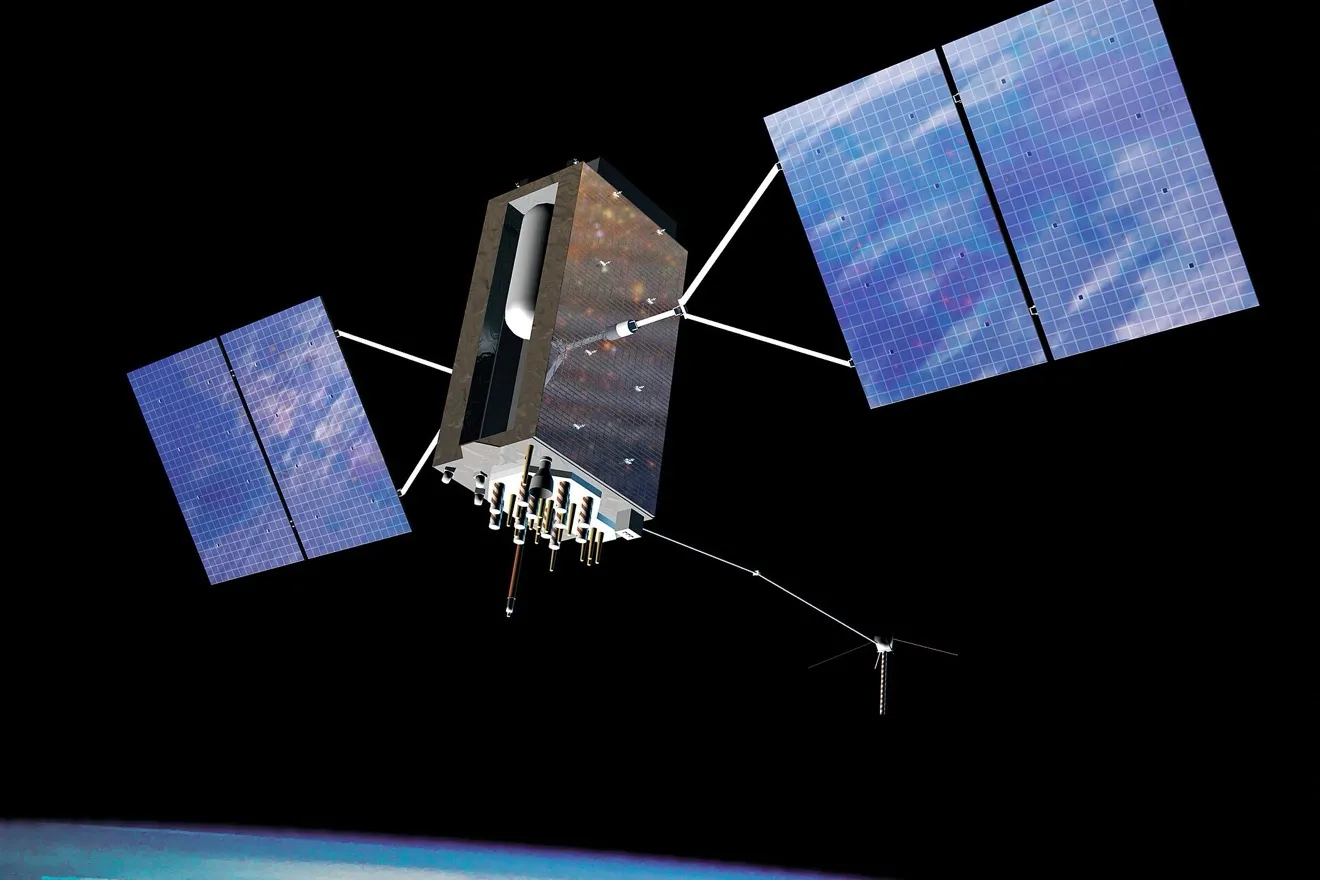
The GPS system has about thirty satellites flying at an altitude of about 20,200 km, each circling the Earth twice a day[2]. Every satellite continuously broadcasts a signal that says exactly two things: where I am, and what time it is on my clock.
Your phone sends nothing up to the satellites. It only listens. When it receives a signal, it compares the time stamped in the signal with the time of arrival, works out how long the signal travelled, and multiplies by the speed of light to get the distance to the satellite. Knowing the distance to three satellites is enough to pin down a position in space. Because the clock in a phone is cheap and imprecise, the receiver needs a fourth satellite to also solve for its own clock error: four unknowns (three coordinates and time), four satellites. When it sees more satellites, it uses all of them and picks the best-fitting position, in the spirit of the least squares method Gauss found in 1801.
The hard part is the speed of light. Light travels 30 cm in a billionth of a second (one nanosecond). So a satellite clock that is off by 1 nanosecond makes the measured distance wrong by 30 cm. Off by 1 microsecond, a millionth of a second, and the error is 300 metres. That is why every GPS satellite carries atomic clocks, the most precise kind of clock that can be sent into space, and ground stations monitor and correct them constantly.
And precisely because the clocks are that precise, an effect nobody ever feels in daily life suddenly becomes make-or-break for the system.
Why do GPS satellite clocks run faster than clocks on the ground?
Einstein’s relativity says time does not flow the same way everywhere. For a clock on a GPS satellite, two effects pull in opposite directions.
First: a moving clock runs slow. This is special relativity (1905). A GPS satellite flies at about 3.9 km/s, roughly four times the speed of a rifle bullet. Seen from the ground, its clock runs slow by about 7 microseconds a day.
Second: where gravity is weaker, clocks run fast. This is general relativity (1915). The closer you are to a heavy body like the Earth, the slower time passes. The satellite is more than 20,000 km up, where gravity is much weaker, so its clock runs faster than a clock on the ground by about 45 microseconds a day.
The two effects work against each other, and the second one wins. Added together, a GPS satellite clock runs about 38 microseconds a day fast[1]. Multiplied by the speed of light, 38 microseconds corresponds to about 11 km.
Not every satellite runs fast. The International Space Station (ISS) flies low, only about 400 km up, and very fast, almost 7.7 km/s. There the speed effect wins, so a clock on the ISS runs slow compared with the ground by about 25 microseconds a day. An astronaut who spends half a year up there comes back four or five thousandths of a second “younger” than people on the ground. Between the two cases there is an altitude, about 3,200 km, where the two effects cancel exactly (Figure 1 at the end of the article).
1977: a switch in case Einstein was wrong
The most interesting story about GPS and relativity happened before the system officially existed. On 23 June 1977 the United States launched the experimental satellite NTS-2, carrying the first caesium atomic clock ever flown in orbit.
At the time engineers knew an orbiting clock would need a relativistic correction, but some still doubted its size, or even whether it was real. So the satellite was fitted with a frequency synthesiser that could be switched on or off from the ground: if the orbiting clock really ran fast by the amount general relativity predicted, they would switch it on to bring the clock back into step[1].
For the first 20 days or so the synthesiser was left off, and the clock’s rate was measured against the ground. The result: faster by 442.5 parts in a million million. Relativity predicted 446.5 parts in a million million. The two numbers agreed within the accuracy of the clock itself. The switch was turned on, and from then on nobody doubted it any more[1].
Corrected at the factory: 10.22999999543 MHz
Today, GPS satellite clocks are deliberately “set wrong” before launch. The system’s reference frequency is 10.23 MHz. But the clock on a satellite is set to 10.22999999543 MHz, a little slow, by exactly the amount relativity will speed it up once it reaches orbit. Seen from the ground, it ticks at exactly 10.23 MHz[1].
That is not all. Satellite orbits are not perfectly circular: when a satellite swings closer to the Earth it both flies faster and sits deeper in gravity, so its clock wobbles by a few tens of nanoseconds over each orbit. Your receiver calculates and subtracts this wobble itself, from the orbit data the satellite broadcasts[1]. Every time your phone finds its position, a relativistic correction is running inside it.
Is “11 km of error per day” true?
The figure of 10 or 11 km per day is quoted a lot, and it is worth understanding properly. It is a conversion of magnitude: 38 microseconds times the speed of light. It shows the effect is thousands of times larger than the error GPS can tolerate.
In practice, without the correction the error would not pile up neatly at exactly 11 km a day. Your receiver already solves for an extra time unknown, so part of an error shared by all satellites would be absorbed there. But the satellite clocks would drift further and further from system time, the clock models broadcast to the ground would be more and more wrong, and the system would break down far faster than the few-metre accuracy we are used to. The conclusion stands: without relativity there is no GPS as we know it.
Time passing differently: evidence in the real world
GPS is not the only time relativity has been tested with real clocks.
In 1971, physicists Joseph Hafele and Richard Keating took four atomic clocks on commercial airliners around the world. Once flying east, once flying west, and then compared them with clocks left on the ground. Flying east, the clocks on the plane lost 59 nanoseconds (predicted: 40). Flying west, they gained 273 nanoseconds (predicted: 275)[3]. The two directions differ because the Earth itself rotates eastward: a plane flying east adds that rotation speed, so it moves faster relative to a clock at rest in space.
In 2010, scientists at the US National Institute of Standards and Technology (NIST) used two optical clocks, many times more precise than ordinary atomic clocks. They raised one clock about 33 cm above the other and measured it running faster, exactly as general relativity predicts. They also measured a clock slowing down when moving at under 10 m/s, slower than a cyclist[4].
In other words, even in your own home a clock upstairs runs faster than a clock downstairs. The difference is just far too small for anyone to notice in a lifetime. Only when humans needed to measure distance in billionths of a second did that difference become an engineering problem.
The two formulas behind 38 microseconds
This section uses a little maths. If you only care about the main idea, you can skip it.
The speed effect. A clock moving at speed runs slow by a fraction of approximately
where is the speed of light. A GPS satellite follows a near-circular orbit of radius km, so km/s, where is the gravitational constant times the Earth’s mass. Plugging in, the fraction is about , and multiplying by 86,400 seconds in a day gives about −7.2 microseconds.
The gravity effect. A clock at distance from the Earth’s centre runs faster than a clock on the surface (radius ) by a fraction of approximately
For GPS this fraction is about , or about +45.7 microseconds a day.
Together: +38.5 microseconds a day. The total fraction is about , which is exactly the gap between 10.23 MHz and 10.22999999543 MHz above.
The two formulas also give the altitude where the effects cancel. For a circular orbit , so the two fractions are equal when , that is : an orbit half an Earth radius above the surface, about 3,200 km.
This is an approximation: it ignores the Earth’s rotation and the fact that it is not perfectly round, and treats the orbit as circular. The full GPS corrections include those factors[1], but they change the result only in the small digits.
Work it out yourself: fast or slow at each altitude
The Python below computes both effects for a satellite on a circular orbit at every altitude from 200 km to 40,000 km, compared with a clock at rest on the ground, and draws Figure 1. You only need matplotlib.
import math
import matplotlib.pyplot as plt
plt.rcParams.update({"figure.facecolor": "#16181c", "axes.facecolor": "#16181c", "text.color": "#d4d7dc",                     "axes.edgecolor": "#2a2e35", "xtick.color": "#878d97", "ytick.color": "#878d97", "font.size": 12})
GM = 3.986004418e14      # gravitational constant times Earth's mass (m³/s²)R_EARTH = 6.371e6        # Earth's radius (m)C = 299_792_458          # speed of light (m/s)DAY = 86_400             # seconds in a day

def drift_per_day(altitude_km):    """How many microseconds per day a clock on a circular orbit at this altitude runs fast (+) or slow (−)    compared with a clock at rest on the ground (Earth's rotation ignored for simplicity)."""    r = R_EARTH + altitude_km * 1_000    v = math.sqrt(GM / r)                                  # circular orbital speed    special = -v**2 / (2 * C**2)                           # moving fast → clock slows down    general = GM / C**2 * (1 / R_EARTH - 1 / r)            # high up, weaker gravity → clock speeds up    return special * DAY * 1e6, general * DAY * 1e6, v

orbits = {"International Space Station": 408, "GPS": 20_200, "geostationary satellite": 35_786}label_offset = {"International Space Station": (8, -32), "GPS": (10, -44), "geostationary satellite": (-150, -48)}  # label positions on the plotfor name, h in orbits.items():    sr, gr, v = drift_per_day(h)    print(f"{name:<28} altitude {h:>6} km  v = {v / 1000:4.2f} km/s  "          f"speed {sr:+6.1f} μs  gravity {gr:+6.1f} μs  total {sr + gr:+6.1f} μs/day")
sr, gr, _ = drift_per_day(20_200)net = (sr + gr) * 1e-6print(f"GPS: {net * 1e6:.1f} μs/day × speed of light = {net * C / 1000:.1f} km/day")print(f"in 1 nanosecond light travels {C * 1e-9 * 100:.0f} cm")
# Altitude where the two effects cancel: v²/2 = GM(1/R − 1/r) with v² = GM/r  →  r = 1.5 R.print(f"the two effects cancel at an altitude of {0.5 * R_EARTH / 1000:,.0f} km")
# Plot: clock drift versus altitude.hs = [h for h in range(200, 40_001, 100)]nets = [sum(drift_per_day(h)[:2]) for h in hs]fig, ax = plt.subplots(figsize=(10, 5.2))ax.axhline(0, color="#2a2e35", lw=1)ax.plot([h / 1000 for h in hs], [drift_per_day(h)[0] for h in hs], color="#8fa9c9", lw=1.5, ls="--", label="from speed (slower)")ax.plot([h / 1000 for h in hs], [drift_per_day(h)[1] for h in hs], color="#a4a9b2", lw=1.5, ls=":", label="from altitude (faster)")ax.plot([h / 1000 for h in hs], nets, color="#e8b05a", lw=2.5, label="total")for name, h in orbits.items():    y = sum(drift_per_day(h)[:2])    ax.plot(h / 1000, y, "o", color="#e8b05a", ms=8)    ax.annotate(f"{name}\n{y:+.1f} μs/day", (h / 1000, y), xytext=label_offset[name],                textcoords="offset points", color="#d4d7dc", fontsize=10)ax.axvline(0.5 * R_EARTH / 1e6, color="#2a2e35", lw=1)ax.text(0.5 * R_EARTH / 1e6 + 0.4, 38, "≈ 3,200 km:\nthe two effects\ncancel out", color="#878d97", fontsize=10)ax.set_xlim(0, 40)ax.set_xlabel("orbital altitude (thousand km)", color="#a4a9b2")ax.set_ylabel("clock drift vs the ground (μs/day)", color="#a4a9b2")ax.set_title("Does a clock in orbit run faster or slower than one on the ground?", color="#d4d7dc", fontsize=12)ax.grid(color="#22262c")ax.legend(frameon=False, labelcolor="#a4a9b2", fontsize=10, loc="lower right")fig.savefig("gps-dong-ho-quy-dao-en.png", dpi=150, bbox_inches="tight")
International Space Station altitude 408 km v = 7.67 km/s speed -28.3 μs gravity +3.6 μs total -24.6 μs/dayGPS altitude 20200 km v = 3.87 km/s speed -7.2 μs gravity +45.7 μs total +38.5 μs/daygeostationary satellite altitude 35786 km v = 3.07 km/s speed -4.5 μs gravity +51.1 μs total +46.5 μs/dayGPS: 38.5 μs/day × speed of light = 11.5 km/dayin 1 nanosecond light travels 30 cmthe two effects cancel at an altitude of 3,186 km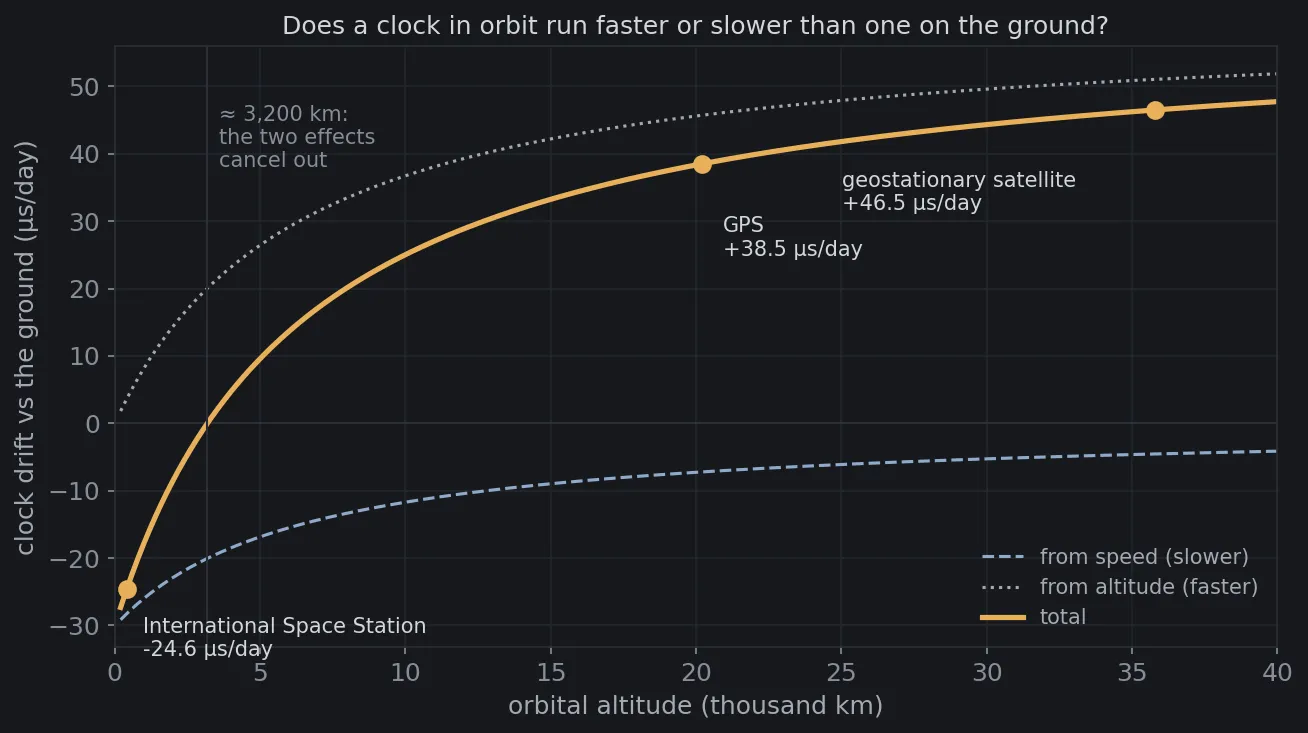
The results match the figures in the GPS literature: −7.2 and +45.7 microseconds a day[1]. You can change the altitudes in orbits to try satellites of Europe’s Galileo system (about 23,200 km) or China’s BeiDou, and see how much their clocks are “set wrong” at the factory.
Time is something you can measure
Einstein’s idea was once seen as abstract philosophy: one person’s time is not necessarily another’s. But once people needed to know where they were standing to within a few metres, the idea had to become a specific number, 10.22999999543 MHz, built into the hardware of every satellite. The story starts with Galileo asking what motion is relative to and Newton writing down the law of gravity, and ends with the phone in your pocket.
Next time the blue dot on the map lands exactly where you stand, remember that twenty thousand kilometres above your head, a few dozen clocks are running faster than yours, and somebody worked that out in 1977.
Free geometry illustrations for students and teachers: EyeViz.
Tài liệu tham khảo
- [1]Neil Ashby. Relativity in the Global Positioning System. Living Reviews in Relativity, 6, 1, 2003.
- [2]Space Segment. GPS.gov (US Government).
- [3]J. C. Hafele and Richard E. Keating. Around-the-World Atomic Clocks: Observed Relativistic Time Gains. Science, 177(4044), 168–170, 1972.
- [4]C. W. Chou, D. B. Hume, T. Rosenband and D. J. Wineland. Optical Clocks and Relativity. Science, 329(5999), 1630–1633, 2010.