Newton and Halley's question: how classical mechanics began
In 1684 Halley asked Newton one question. Three years later came Newton's laws and classical mechanics. The true story, the Moon test and a comet's return.
Mục lục
A wager in London, January 1684
One afternoon in January 1684, three men left a meeting of the Royal Society in London and stopped at a coffee house. Christopher Wren, the architect rebuilding St Paul’s Cathedral after the Great Fire. Robert Hooke, the most gifted experimenter in England. And Edmond Halley, a 27-year-old astronomer. Their conversation that day would lead to the birth of classical mechanics.
All three suspected that the Sun pulls on the planets with a force that weakens with the square of the distance: twice as far, four times weaker. But none of them could prove that such a force would make a planet move along exactly the ellipse Kepler had measured 75 years earlier. Wren made a wager: whoever produced a proof within two months would get a book worth 40 shillings from him. Hooke said he already had the answer but wanted to keep it to himself. Two months passed, and nobody claimed the prize[1].
In August that year, Halley went to Cambridge to see a mathematics professor known for being hard to approach, and asked him exactly that question. The man answered at once: “An ellipse. I have calculated it.”
Three years after that answer, the world had the Principia, with Newton’s three laws of motion and the law of universal gravitation. Together they are the foundation of classical mechanics, the rules that describe every motion from a falling apple to a spacecraft. The story includes a quarrel over credit, a book that almost went unprinted for lack of money, and a comet that came back right on time after both men had passed away.
This is the second episode in a series on physicists, after Galileo and “And yet it moves”.
What are Newton’s three laws, and where are they around you?
Before meeting Newton, let’s watch his three laws at work in everyday life. They are short enough to fit on a postcard.
First law (inertia): with no force, an object keeps its motion. At rest, it stays at rest; moving in a straight line at constant speed, it keeps doing so. When a bus brakes hard, you lurch forward, not because anything pushes you, but because your body keeps going while the bus stops. Newton took this idea from Galileo, who used it to explain why we don’t feel the Earth turning.
Second law: force equals mass times acceleration, . To change how something moves, you need a force, and the heavier it is, the more force it takes. Another way to write it reveals something interesting: force equals the change in momentum divided by the time the change takes. For the same stop, making it last longer makes the force smaller.
That is why airbags save lives. With illustrative numbers: a 70 kg person in a car at 50 km/h (about 14 m/s) is in a crash. If the seat belt and airbag bring them to rest in 0.1 seconds, the average force on the body is about newtons, roughly the weight of a tonne. If their head hits a rigid steering wheel and stops in 0.01 seconds, the force is ten times bigger. An airbag only stretches the stop by a few hundredths of a second, and that is enough.
Third law: forces always come in pairs. Push on a wall and the wall pushes back on you just as hard. A rocket pushes gas out backwards and the gas pushes the rocket forwards, which is why it works even in a vacuum. In 1920 The New York Times mocked the opposite idea, and only printed a correction on 17 July 1969, while Apollo 11 was on its way to the Moon.
The three laws plus the law of universal gravitation (every object attracts every other with a force proportional to their masses and inversely proportional to the square of the distance between them) are enough to work out the flight of a ball or the orbit of a satellite. So who came up with them?
The boy who threatened to burn the house down
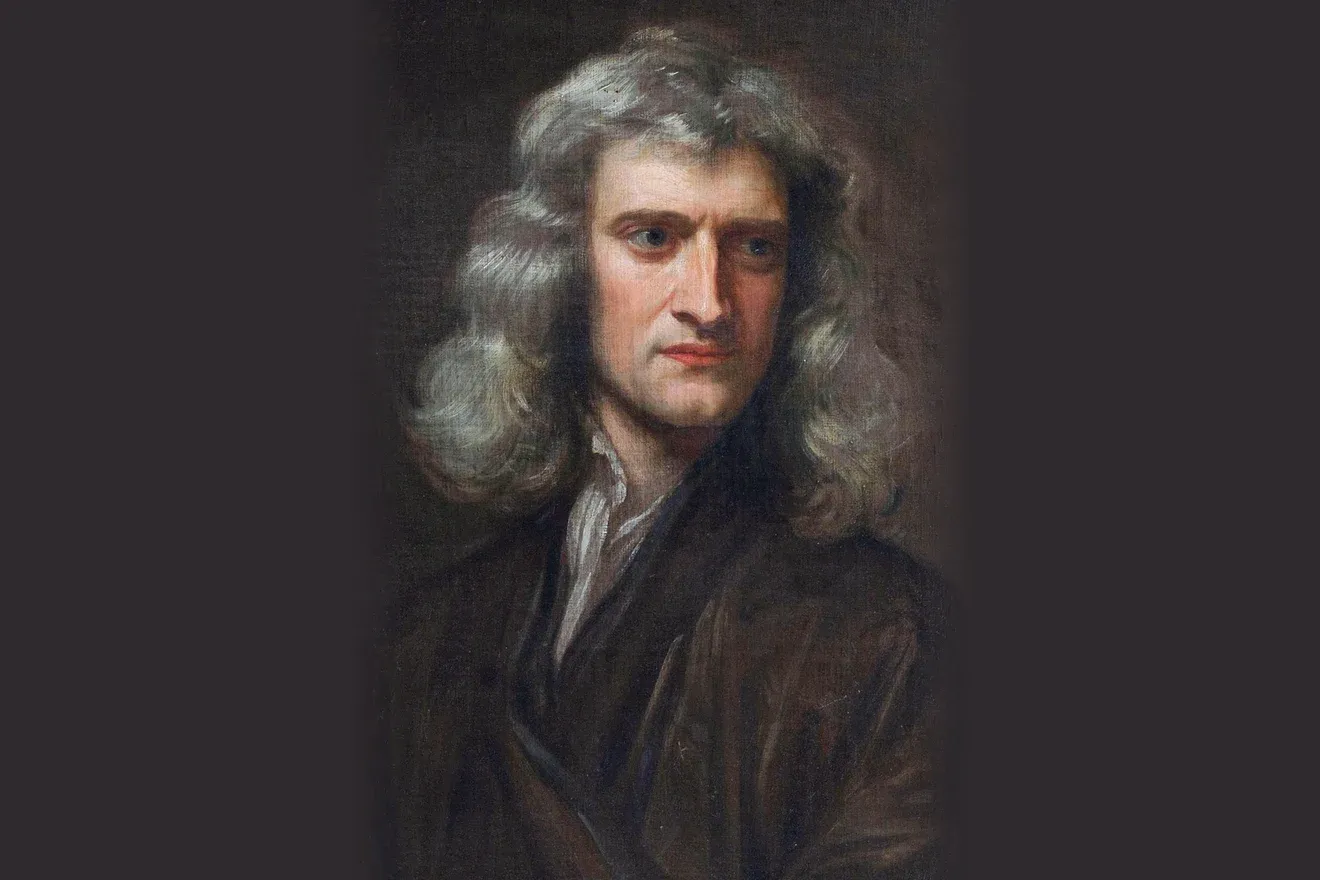
Isaac Newton was born on Christmas Day 1642 in the village of Woolsthorpe, England, the year Galileo passed away. His father had passed away three months before he was born. The premature baby was so small that, as he later told it, he could have fitted into a quart pot[1].
When Isaac was three, his mother remarried an elderly clergyman in a nearby village and left her son with his grandmother. At 19, in a notebook listing his “sins”, Newton wrote a chilling line: “Threatning my father and mother Smith to burne them and the house over them.” Smith was his stepfather’s name[1].
The lonely boy grew into an extremely secretive man, suspicious and unable to bear criticism. He entered Cambridge in 1661 as a poor student who did menial work to pay his way, and by 1669, at 26, he held the prestigious Lucasian chair of mathematics. Most of what he discovered, he kept in a drawer.
The plague years and the apple
In the summer of 1665 plague swept across England. Cambridge University closed, and the 22-year-old student went home. His almost two years at Woolsthorpe were later called Newton’s miracle years. During that time he developed calculus, used a prism to split white light into a rainbow, and began to think about gravity[3].
And the apple? The story is real, but smaller than the legend. In 1726, aged 83, Newton was drinking tea under some apple trees with a young friend, William Stukeley, and told him that the idea of gravity had come to him in just such a setting, when an apple fell. He had wondered: why does an apple always fall straight down, and never sideways or upwards? Stukeley recorded the story in his memoir[5].
The truly bold idea was not the apple but the next question: does the force that pulls the apple down reach all the way to the Moon? If so, the Moon is also “falling” towards the Earth; it just moves sideways fast enough to keep falling forever without ever hitting the ground.
Newton did a calculation to check, which we’ll redo below. By his own later account, the result agreed “pretty nearly” but not exactly, partly because the measured radius of the Earth at the time was inaccurate[1]. He put it away. Almost twenty years later, the idea was still in the drawer.
“I have calculated it”
The person who pulled it out was Robert Hooke. In late 1679 Hooke wrote to Newton, suggesting that a planet’s motion could be split into two parts: moving straight on by inertia, and being pulled aside by the Sun. In a letter early in 1680, Hooke added that the pull probably weakened with the square of the distance. Newton did not reply. But those letters, he later admitted, pushed him to sit down and prove that such a force produces an elliptical orbit. He finished the proof, and put it away again[11].
So when Halley arrived in August 1684 and asked, if the attraction weakens with the square of the distance, what curve does a planet follow?, Newton answered without thinking. According to the mathematician Abraham de Moivre, Halley, “struck with joy and amazement”, asked how he knew, and Newton replied: “I have calculated it.” He searched his papers but could not find the calculation, and promised to redo it and send it to Halley[1].
In November a nine-page manuscript reached Halley in London, titled On the Motion of Bodies in Orbit. It did not just prove the elliptical orbit; it derived all three of Kepler’s laws from a single principle. Halley understood at once what he was holding, and went back to Cambridge to persuade Newton to turn it into a book.
This time Newton didn’t stop. For almost two years he forgot to eat and sleep, and the nine pages became three books, more than 500 pages.
The Royal Society ran out of money because of a book about fish
In April 1686 Book 1 was presented to the Royal Society. Hooke immediately demanded credit: he had suggested the inverse-square law, so the book should say so. Newton was furious. He threatened to drop Book 3 altogether, the part applying the theory to the solar system, the most important part. Then he went through the manuscript and struck out almost every mention of Hooke’s name[11].
Halley had to manage the two men, and there was another problem. The Royal Society had just spent heavily on printing Francis Willughby’s History of Fishes, an expensive book that didn’t sell, so it had no money left to print Newton’s. Halley, not a rich man, paid for the printing out of his own pocket and corrected the proofs himself. As for the Society, according to its records, it paid Halley, then its clerk, his salary in… unsold copies of the fish book[4].
On 5 July 1687, Philosophiæ Naturalis Principia Mathematica (Mathematical Principles of Natural Philosophy) was published[2].
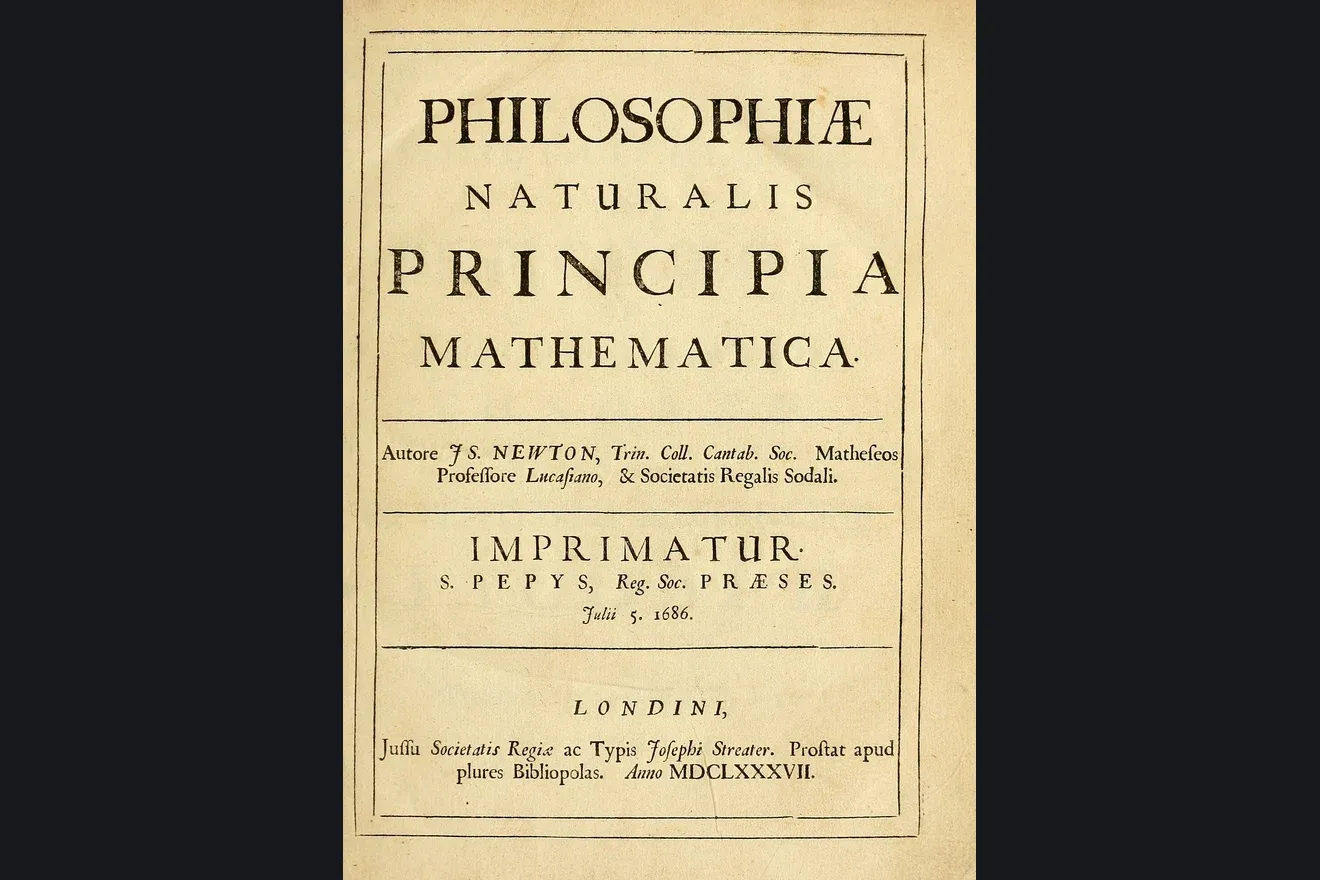
Something few people notice: the Principia uses almost no calculus, even though Newton had invented it twenty years earlier. He wrote in Euclid-style geometry, the language every scientist of the time could read. His proof of Kepler’s second law (a planet sweeps out equal areas in equal times) is a drawing made of triangles, and the code section near the end of this article runs exactly that drawing.
From the apple to the Moon: Newton’s calculation
Let’s redo the calculation Newton made at Woolsthorpe, with modern numbers. The idea: if gravity weakens with the square of the distance, how much weaker must it be at the Moon’s distance than at the ground?
The Moon is about 384,400 km from the Earth’s centre, roughly 60 times the Earth’s radius (6,371 km). So there, the acceleration of a falling object should be times smaller than at the surface:
How fast does the Moon actually “fall”? An object moving in a circle of radius , taking time per revolution, always has an acceleration towards the centre of . The Moon goes around the Earth once every 27.32 days, so:
The two numbers agree. In one second an apple falls almost 5 metres, while the Moon “falls” towards us only about 1.4 millimetres, but it is the same force. For the first time, the heavens and the Earth obey the same law, not two separate worlds as Aristotle taught.
Weighing the Sun without a scale
Combine the second law with the law of gravitation for a planet of mass moving in a circle around the Sun, of mass :
The planet’s mass cancels out. The result is Kepler’s third law: the square of the period is proportional to the cube of the orbit’s radius. Kepler found it in 1619 by trawling through stacks of tables, without knowing why. Newton derived it in two lines. (For an elliptical orbit, just replace with the semi-major axis, half the longest diameter of the ellipse.)
The formula does something remarkable: it weighs the Sun. Turn it around: . Plug in the Earth–Sun distance (149.6 million km), one year (365.25 days) and the gravitational constant , and you get a solar mass of about kg, some 333,000 times the Earth’s. No need to travel there; a clock and a ruler are enough.
The same formula says the International Space Station, about 420 km up, must travel at about 7.7 km/s and goes once around the Earth in about 93 minutes. The astronauts on board are not “without gravity”: they are falling continuously, just like the Moon.
The biggest test: a comet comes back
A good theory must predict what hasn’t happened yet. The boldest prediction made with Newton’s laws came from Halley himself.
Halley used Newton’s method to compute the orbits of twenty-four comets in the historical record, and noticed that the comets of 1531, 1607 and 1682 had almost identical orbits. In 1705 he wrote that they were the same comet, moving on a very elongated ellipse, and that it would return around 1758[7].
It was a promise Halley knew he would not live to see kept. He passed away in 1742, aged 85. Newton had passed away 15 years earlier.
As 1758 approached, three French mathematicians, Alexis Clairaut, Joseph Lalande and Nicole-Reine Lepaute, spent months calculating by hand the pull of Jupiter and Saturn, then announced that the comet would pass closest to the Sun in mid-April 1759, give or take a month.
On Christmas night 1758, Johann Palitzsch, a German farmer and amateur astronomer, pointed his telescope at the sky and saw it. The comet passed closest to the Sun on 13 March 1759, within Clairaut’s margin[8]. From then on it has been called Halley’s Comet. Its last visit was in 1986, and the next is in the summer of 2061.
Almost a century later came something even harder to believe. Uranus was drifting slightly off its calculated orbit. The French astronomer Urbain Le Verrier guessed that an unseen planet was pulling on it and, with pen and paper alone, worked out where that planet should be. On 23 September 1846, having received his letter, Johann Galle in Berlin pointed a telescope at that spot and found Neptune, less than a degree from the predicted position[9]. A planet found by mathematics before anyone had seen it.
In 1801, Gauss found the lost asteroid Ceres with Newton’s laws too, plus the method of least squares.
Where does classical mechanics fail?
After so much success, people once thought physics was nearly finished. But Le Verrier’s own method found the first crack.
In 1859 Le Verrier noticed that the orbit of Mercury was slowly turning faster than Newton’s laws allow, by 43 arcseconds per century in today’s figures. Again he guessed there was an invisible planet near the Sun, and named it Vulcan. Nobody ever saw it.
In 1915 Einstein used general relativity to compute the 43 arcseconds without any extra planet[10]. Newton’s laws are not wrong; they are an approximation: extremely accurate as long as things move much slower than light and gravity is not too strong. Close to the Sun, Mercury reaches that limit. At the scale of atoms, classical mechanics also fails and gives way to quantum mechanics, the physics now being used to build quantum computers (article in Vietnamese).
Newton himself was uneasy on one point: how can the Sun “pull” the Earth across 150 million kilometres of empty space? He only wrote: “I frame no hypotheses.” The answer had to wait for Einstein: mass curves spacetime.
The giant’s dark side
Newton’s most famous line is probably: “If I have seen further, it is by standing on the shoulders of giants.” He wrote it in 1676, in a letter to… Robert Hooke. Some read it as a dig at Hooke, who was short and stooped, though historians still argue about this.
The feud lasted until Hooke passed away in March 1703. Eight months later, Newton became President of the Royal Society. No portrait known for certain to be of Hooke survives; the story that Newton had it removed has no evidence behind it.
The next fight was uglier. The German mathematician Leibniz had invented calculus independently, and published first. In 1712 the Royal Society set up a “neutral” committee to decide who came first. Its report found in Newton’s favour. The author of that report, in secret, was Newton himself.
Where is Newton today?
On the path of every spacecraft. When NASA sent the Voyager probes past Jupiter and Saturn, using their gravity like slingshots to fling them towards the edge of the solar system, the heart of the calculation was Newton’s laws, plus a few small corrections from relativity.
In video games. Every time a car in a game rolls over or a stack of crates topples, the software is doing what Newton did: add up the forces, divide by the mass to get the acceleration, then move everything forward a little, about 60 times a second. Many popular physics libraries, such as Box2D, step forward by alternating “change the velocity a little, move the position a little”, the same family of methods you’ll see in the code below.
In weather forecasts. Weather models divide the atmosphere into millions of cells and apply to each parcel of air. And every bridge and building stays standing because the forces on it balance, exactly as the first and third laws say.
And in how science works: a few mathematical laws, everything deduced from them, then tested by experiment. Relativity and quantum mechanics were both built to that pattern.
Draw the orbit of Halley’s Comet yourself
The Python below draws Figure 2. The function fly does exactly what Newton did in the first proof of the Principia: split time into equal intervals; in each one, the body flies straight at constant speed (first law), then gets a “tug” towards the Sun, inversely proportional to the square of the distance. Newton proved that this procedure always sweeps out triangles of equal area, however coarse the time step. The smaller the step, the closer the polygon gets to the real orbit.
The first part runs Halley’s Comet around one orbit, with steps of just under 2 hours. The second part deliberately uses a coarse step of 1/20 of a year so you can see each triangle. There is nothing random in the simulation, so no seed is needed; all you need is numpy and matplotlib.
import matplotlib.pyplot as pltimport numpy as np
plt.rcParams.update({"figure.facecolor": "#16181c", "axes.facecolor": "#16181c", "text.color": "#d4d7dc",                     "axes.edgecolor": "#2a2e35", "xtick.color": "#878d97", "ytick.color": "#878d97", "font.size": 12})
# Units: distance in AU (the Earth–Sun distance), time in years.# In these units, Kepler's third law gives G·M(Sun) = 4π², which keeps things tidy.GM = 4 * np.pi**2
def fly(x, y, vx, vy, dt, steps):    """Exactly Newton's proof: fly straight at constant speed for dt, then get one "tug" from the Sun."""    path = np.empty((steps + 1, 2))    path[0] = x, y    for i in range(steps):        x, y = x + vx * dt, y + vy * dt          # 1. fly straight at constant speed (first law)        r3 = (x * x + y * y) ** 1.5        vx -= GM * x / r3 * dt                   # 2. a tug towards the Sun,        vy -= GM * y / r3 * dt                   #    inversely proportional to the distance squared (second law + gravity)        path[i + 1] = x, y    return path
# ── Part 1: Halley's Comet ──────────────────────────────────────────────────a, q = 17.83, 0.586                      # semi-major axis and closest distance to the Sun (AU)v_q = np.sqrt(GM * (2 / q - 1 / a))      # speed at the closest point (vis-viva equation)dt = 0.0002                              # time step: just under 2 hourspath = fly(q, 0.0, 0.0, v_q, dt, int(80 / dt))
# When the comet comes back to its closest point: the first time y changes sign from negative to positivey = path[:, 1]i_back = np.where((y[:-1] < 0) & (y[1:] >= 0))[0][0]period = (i_back + 1) * dtr = np.hypot(path[:i_back, 0], path[:i_back, 1])AU_per_year = 149.6e6 / (365.25 * 86400)  # 1 AU/year ≈ 4.74 km/sprint(f"simulated period: {period:.1f} years (Kepler: a^1.5 = {a**1.5:.1f} years)")print(f"closest to the Sun: {r.min():.3f} AU, farthest: {r.max():.1f} AU (Neptune's orbit: 30.1 AU)")v_far = v_q * q / r.max()                # conservation of angular momentum: v·r is the same at both endsprint(f"speed at the closest point: {v_q * AU_per_year:.1f} km/s, at the farthest: {v_far * AU_per_year:.2f} km/s")years_inside_jupiter = (r < 5.2).sum() * dtyears_beyond_neptune = (r > 30.1).sum() * dtprint(f"inside Jupiter's orbit: {years_inside_jupiter:.1f} years; beyond Neptune's orbit: {years_beyond_neptune:.1f} years")
# Kepler's second law: the area swept in each step should be the samearea = 0.5 * np.abs(path[:i_back, 0] * path[1:i_back + 1, 1] - path[:i_back, 1] * path[1:i_back + 1, 0])print(f"area swept per step: largest relative difference {(area.max() - area.min()) / area.mean():.1e}")
# ── Part 2: Newton's proof, with a very coarse time step ────────────────────a2, q2 = 1.0, 0.6                        # an elliptical orbit with a 1 AU semi-major axis (period 1 year)Q2 = 2 * a2 - q2                         # start at the farthest point from the Sun, where the planet is slowtriangles = 12                           # each step is 1/20 of a year: deliberately coarse to show each trianglecoarse = fly(-Q2, 0.0, 0.0, -np.sqrt(GM * (2 / Q2 - 1 / a2)), 1 / 20, triangles)coarse_area = 0.5 * np.abs(coarse[:-1, 0] * coarse[1:, 1] - coarse[:-1, 1] * coarse[1:, 0])print(f"{triangles} triangles, area: {coarse_area.min():.6f} to {coarse_area.max():.6f} AU²")
# ── Plot ────────────────────────────────────────────────────────────────────fig, (ax1, ax2) = plt.subplots(1, 2, figsize=(14, 6.4), gridspec_kw={"width_ratios": [1.35, 1]})
for name, R in [("Earth", 1.0), ("Jupiter", 5.2), ("Saturn", 9.58), ("Uranus", 19.2), ("Neptune", 30.1)]:    ax1.add_patch(plt.Circle((0, 0), R, fill=False, ec="#3a3f48", lw=1, ls=(0, (3, 3))))    if R > 3:        ax1.text(0, R + 0.6, name, ha="center", color="#878d97", fontsize=9)ax1.plot(path[:i_back + 1, 0], path[:i_back + 1, 1], color="#8fa9c9", lw=1)every_year = path[: i_back + 1 : int(1 / dt)]  # the comet's position, one dot per yearax1.scatter(every_year[:, 0], every_year[:, 1], color="#e8b05a", s=14, zorder=5)ax1.scatter([0], [0], color="#f5d36b", s=60, zorder=6)ax1.text(-35.5, 6.5, f"{years_beyond_neptune:.0f} years beyond Neptune's orbit:\nthe comet is slow, the dots bunch up",         color="#e8b05a", fontsize=10)ax1.text(6.5, -7.5, f"inside Jupiter's orbit:\nonly about {years_inside_jupiter:.0f} years", color="#e8b05a", fontsize=10)ax1.set_xlim(-37, 31)ax1.set_ylim(-32, 33)ax1.set_aspect("equal")ax1.axis("off")ax1.set_title(f"Halley's Comet under Newton's laws: one orbit in {period:.0f} years, one dot per year",              color="#d4d7dc", fontsize=12)
colours = ["#8fa9c9", "#e8b05a"]for i in range(triangles):    triangle = np.array([[0, 0], coarse[i], coarse[i + 1]])    ax2.fill(triangle[:, 0], triangle[:, 1], color=colours[i % 2], alpha=0.35, lw=0)ax2.plot(coarse[:, 0], coarse[:, 1], color="#d4d7dc", lw=1.4, marker="o", ms=4)angle = np.linspace(0, 2 * np.pi, 400)e = 1 - q2 / a2ax2.plot(a2 * np.cos(angle) - a2 * e, a2 * np.sqrt(1 - e**2) * np.sin(angle), color="#878d97", lw=1, ls=":")ax2.scatter([0], [0], color="#f5d36b", s=60, zorder=6)ax2.text(0.07, 0.07, "Sun", color="#f5d36b", fontsize=10)ax2.text(-0.4, -1.2, f"{triangles} triangles: equal times, equal areas", ha="center", color="#d4d7dc", fontsize=11)ax2.set_aspect("equal")ax2.axis("off")ax2.set_title("Newton's proof: fly straight, tug towards the Sun, repeat", color="#d4d7dc", fontsize=12)fig.tight_layout()fig.savefig("newton-sao-choi-halley-en.png", dpi=150, bbox_inches="tight")
simulated period: 75.3 years (Kepler: a^1.5 = 75.3 years)closest to the Sun: 0.586 AU, farthest: 35.1 AU (Neptune's orbit: 30.1 AU)speed at the closest point: 54.6 km/s, at the farthest: 0.91 km/sinside Jupiter's orbit: 2.2 years; beyond Neptune's orbit: 35.0 yearsarea swept per step: largest relative difference 4.2e-1112 triangles, area: 0.143966 to 0.143966 AU²A few things worth noticing in the output:
- A period of 75.3 years, matching Kepler’s third law. The real period varies from 74 to 79 years because Jupiter and Saturn pull the comet off course, exactly what Clairaut had to calculate by hand.
- The comet rushes past the Sun at 54.6 km/s, but at its farthest point slows to 0.91 km/s, 60 times slower. It spends 35 years beyond Neptune’s orbit, and only about 2 years inside Jupiter’s, the only stretch when it can be seen with the naked eye.
- The area swept in each step differs by less than one part in a billion, which is just rounding error: Kepler’s second law holds exactly, as Newton proved.
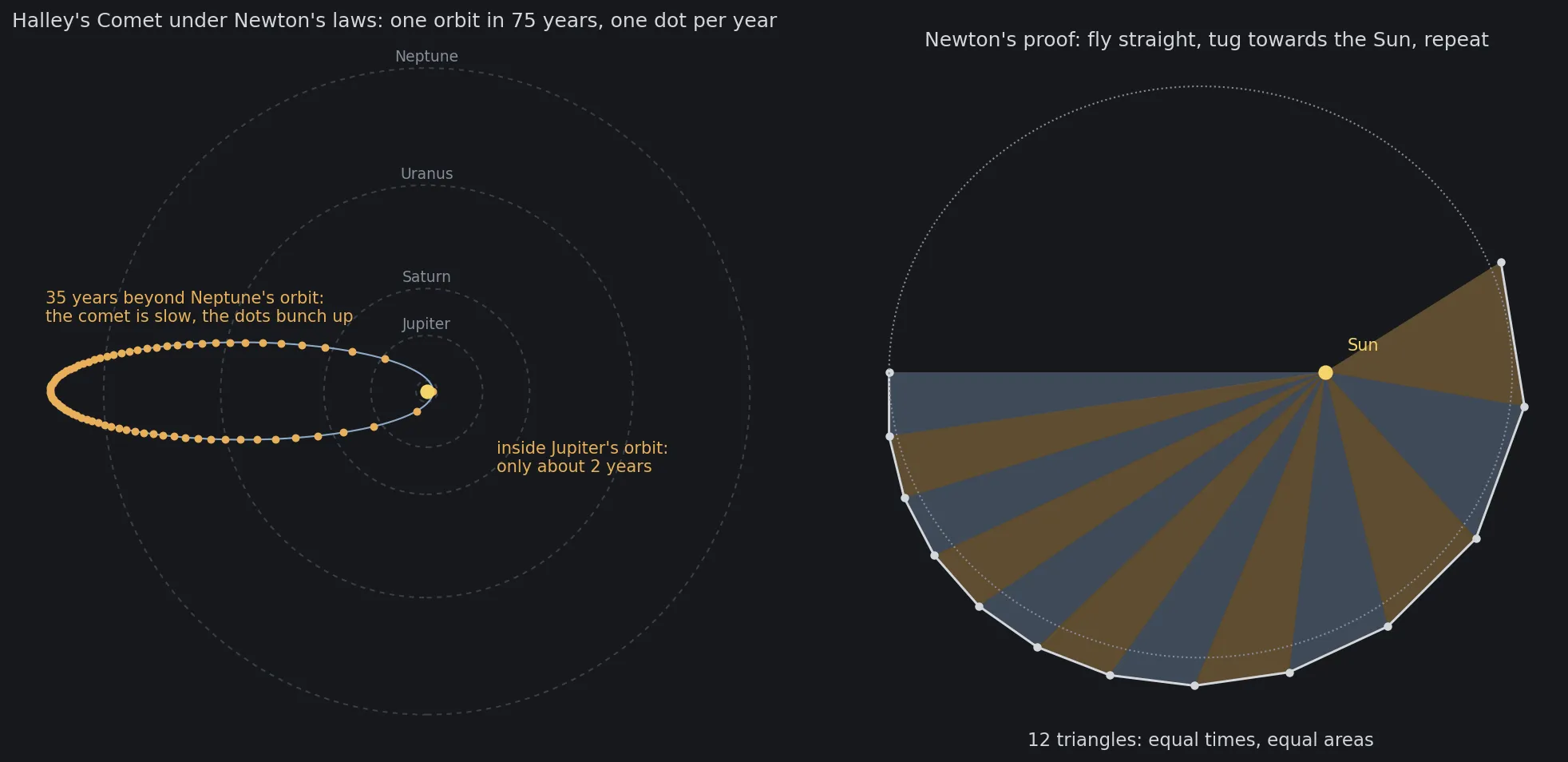
Try changing the time step 1 / 20 in the second part to 1 / 40 and triangles to 24. The smaller the step, the more closely the polygon hugs the ellipse, but the triangles always stay equal. Or change a, q in the first part to draw a different comet, for example Encke’s Comet with a, q = 2.22, 0.34: it goes around the Sun in only about 3.3 years.
Back to Cambridge, 1684
Halley came to Cambridge with a question that had defeated the best minds in London, and left with the promise of a man who had solved it five years earlier and put it in a drawer. Without that question and Halley’s own money, the Principia might never have been written.
Newton passed away in 1727 and was buried in Westminster Abbey, among kings and poets, a rare honour for a scientist at the time. The poet Alexander Pope wrote two famous lines for him: “Nature and Nature’s laws lay hid in night; God said, Let Newton be! and all was light.”
Halley got no poem. He got something better: every 76 years or so, a comet bearing his name comes back right on time, a reminder that Newton’s laws work. The next visit is in 2061.
More stories about the people who made science: Galileo and “And yet it moves”, Gauss and the lost asteroid, and Euler and the seven bridges of Königsberg.
Free geometry illustrations for students and teachers: EyeViz.
Tài liệu tham khảo
- [1]Richard S. Westfall. Never at Rest: A Biography of Isaac Newton. Cambridge University Press, 1980.
- [2]Isaac Newton. Philosophiæ Naturalis Principia Mathematica. Royal Society, London, 1687.
- [3]J. J. O'Connor and E. F. Robertson. Isaac Newton (1643–1727), biography. MacTutor History of Mathematics, University of St Andrews.
- [4]J. J. O'Connor and E. F. Robertson. Edmond Halley (1656–1742), biography. MacTutor History of Mathematics, University of St Andrews.
- [5]William Stukeley. Memoirs of Sir Isaac Newton's Life. Royal Society (1752 manuscript, digitised).
- [6]Philosophiæ Naturalis Principia Mathematica. Wikipedia.
- [7]Edmond Halley. A Synopsis of the Astronomy of Comets. London, 1705.
- [8]Halley's Comet. Wikipedia.
- [9]Discovery of Neptune. Wikipedia.
- [10]Tests of general relativity: perihelion precession of Mercury. Wikipedia.
- [11]Newton–Hooke priority controversy for the inverse square law. Wikipedia.