Kepler's laws: how 8 arcminutes broke 2,000 years of circles
Kepler's laws of planetary motion began with an 8-arcminute error in the orbit of Mars. The true story of Tycho's data, a poisoning rumour and the ellipse.
Mục lục
Eight arcminutes in Prague
In Prague, in the first years of the 17th century, Johannes Kepler had a model of the orbit of Mars that he had worked through at least 70 times. It was built from circular motions, like every astronomical model since ancient Greece. It matched the positions of Mars measured by Tycho Brahe to within 2 arcminutes, the size of Tycho’s own measurement error[6].
Then Kepler checked the model against other observations by Tycho. In places it was off by 8 arcminutes. That is the width of a 1 cm coin held a little over 4 metres from your eye, about a quarter of the width of the Moon in the sky. Kepler did not blame the measurements. In Astronomia Nova he wrote: “these eight minutes alone will lead us along a path to the reform of the whole of Astronomy”[4].
That path led to Kepler’s three laws. A planet moves on an ellipse with the Sun at one focus. The line joining the planet to the Sun sweeps out equal areas in equal times. The square of the period is proportional to the cube of the semi-major axis of the orbit[8]. The first two laws were printed in 1609, the third in 1619. They replaced the circles and epicycles that astronomy had used for about 2,000 years, from ancient Greece to Copernicus himself. Uniform circular motion was considered normal, and any deviation was an “anomaly” to be patched with another circle[12].
Behind the story are a teacher with poor eyesight, a nobleman who guarded his data, a legal dispute with a family in mourning, and a poisoning rumour that lasted four hundred years. This is one episode in a series on physicists, alongside Galileo and “And yet it moves” and Newton and Halley’s question.
What do Kepler’s three laws say?
Before meeting Kepler, let us see what his three laws describe. All three can be checked with a piece of string and a pen.
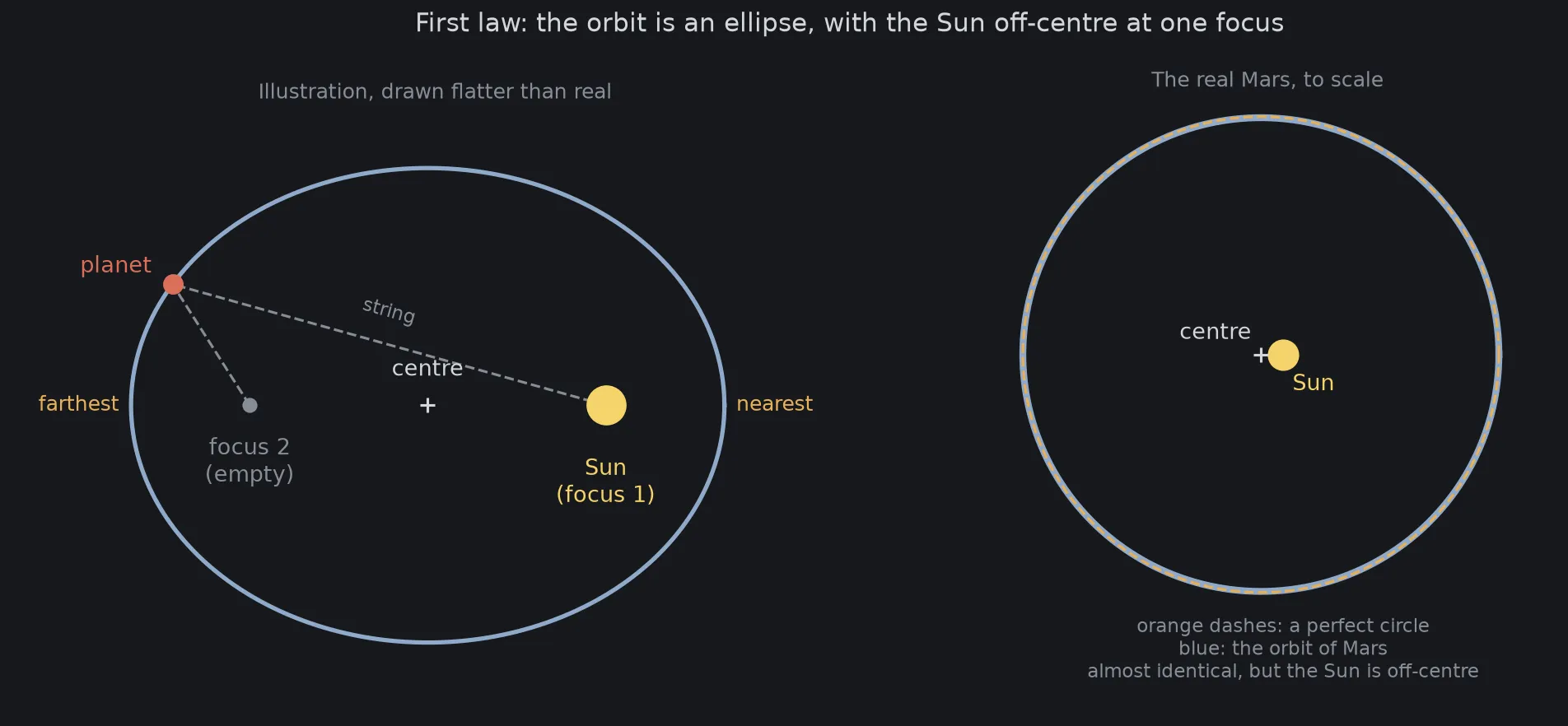
First law: the Sun is not in the middle. You can draw an ellipse with two pins, a loop of string and a pen. Put the loop around the pins, pull it tight with the pen tip and move the pen all the way round. The two pins are the two foci. A planet’s orbit is an ellipse like this, and the Sun sits at one of the two pins, not at the centre. The other pin is only a geometric point; nothing is there[8].
The ellipse of Mars is actually very close to a circle. Its shortest width is about 99.56% of its longest, and on paper your eye can hardly tell it from a circle. But because the Sun is off-centre, the distance from Mars to the Sun changes from about 1.38 AU at its nearest to 1.67 AU at its farthest[10]. An AU is the average distance from the Earth to the Sun, about 150 million km: a ruler made for the solar system, so we do not have to write long strings of kilometres.
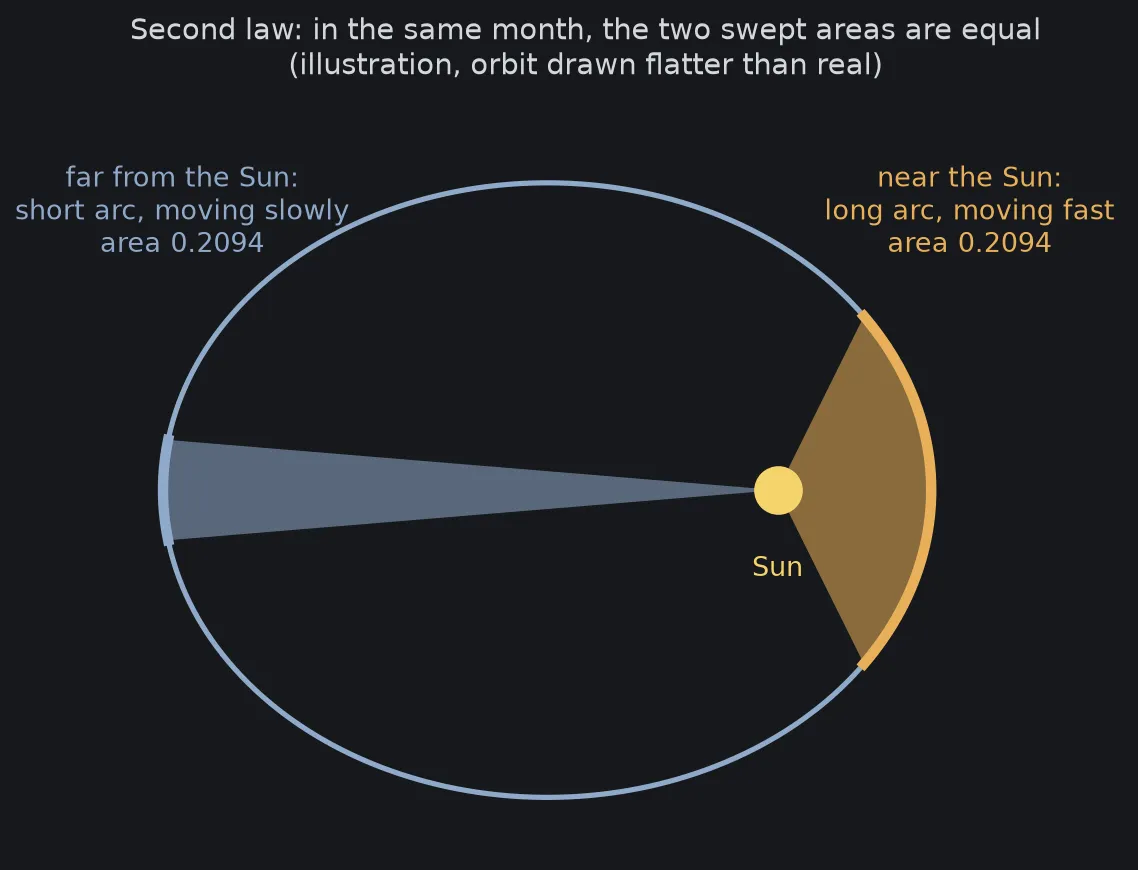
Second law: equal times, equal areas. Imagine an elastic band joining the Sun to a planet. As the planet moves, the band sweeps out a region shaped like a slice of cake. In equal intervals of time, the slices have equal areas[8]. Near the Sun the band is short, so the slice has to be wide: the planet moves faster. Far away the band is long and the slice is narrow: the planet moves more slowly. It is like a motorbike on a roundabout, fast near the centre and slower on the outer edge.
Third law: the farther out, the longer the year. Let be the period, the time to go once round, in Earth years. Let be the semi-major axis, half the longest length of the ellipse, like measuring an oval table end to end and halving it, in AU. For everything orbiting the Sun:
An object with a semi-major axis of 4 AU has , so a period of about 8 years. The orbit is four times larger, but the year is eight times longer, not four. Mars has AU, so a Martian year lasts about 1.88 Earth years, or 687 days[10].
Those three short sentences took almost ten years of calculation by hand. To see why, we go back to a boy in southern Germany.
The short-sighted boy who watched a comet
Johannes Kepler was born on 27 December 1571 in Weil der Stadt, in southern Germany[3]. At six he watched the Great Comet of 1577. At nine he watched a lunar eclipse in 1580. But smallpox in childhood left him with weak eyesight and clumsy hands[5]. Kepler would never be a good observer.
At the University of Tübingen, Kepler studied astronomy with Michael Mästlin. Mästlin taught a few chosen students the heliocentric model of Copernicus: the Sun in the middle, the Earth one of the planets[3]. Kepler held to that model from then on. He was sent to teach mathematics in Graz, and in 1596 he printed his first book, Mysterium Cosmographicum (The Cosmographic Mystery). In it he nested the five regular solids between the orbits of the six known planets, to explain why there were exactly six[3].
The idea turned out to be wrong. But to test it, Kepler needed distances to the planets more accurate than anything available. He was good at calculation but could barely see. The best data in Europe belonged to someone else.
Tycho Brahe: the man who held the keys to the data
Tycho Brahe was a Danish nobleman. Over twenty years at his observatory Uraniborg on the island of Hven, he measured planetary positions with large sighting instruments and no telescope, since telescopes were not turned to the sky until about 1609[7]. Most of his measurements were accurate to within 1 arcminute. An arcminute is one sixtieth of a degree, the width of a 1 cm coin seen from 34 metres. In 1599 he became Imperial Mathematician to the Holy Roman Emperor Rudolf II in Prague[7].
Kepler sent his book to Tycho. On 4 February 1600 the two men met for the first time at Benátky castle, about 35 km from Prague[5]. Tycho found Kepler’s ideas interesting but guarded his data closely, handing it over only in small pieces. Kepler was given Mars to work on and estimated it would take up to two years, because he could not simply copy all the data[5].
The two did not get on. Talks over a formal working agreement ended in an angry argument, and on 6 April Kepler left for Prague. They later made peace[5].
Then on 24 October 1601, Tycho passed away unexpectedly, eleven days after a dinner at a nobleman’s palace[7]. Two days later, Kepler was appointed to succeed him as Imperial Mathematician[5]. For the first time, Kepler had the whole archive in his hands. Legally, though, the data belonged to Tycho’s heirs. Disputes over its use meant Kepler’s book on Mars could not be printed until 1609[5].
Did Kepler poison Tycho?
Tycho passed away just when Kepler needed his data most, and rumours followed. In 1901 Tycho’s tomb in Prague was opened and samples of his hair and moustache were taken. In the 1990s, analyses in Sweden and Denmark found unusually high levels of mercury, and the theory that Tycho had been poisoned was born. Kepler, the person with the most to gain, was named among the suspects[11].
In 2010 a Danish and Czech team opened the tomb again and took samples of bone, beard and teeth. The results, announced in 2012: the mercury in his bones was not abnormally high over the last 5 to 10 years of his life, and the levels in his beard were too low to be lethal. The team concluded that mercury poisoning could be ruled out as the reason Tycho passed away[11]. The rumour about Kepler lost its main support.
The war with Mars: why did 8 arcminutes make Kepler abandon circles?
Kepler called his work on Mars “my war with Mars”. The calculation was so long that nearly a thousand large sheets of arithmetic survive today[3]. Mars was hard because its orbit departs from a circle about 5.6 times as much as the Earth’s does[10]. A circular model could fit the Earth roughly, but it would give itself away on Mars.
The second difficulty was that the observer was standing on a planet that was moving too. It is like sitting on one merry-go-round and watching someone on the next one: the motion you see is theirs mixed with your own. At times Mars even seems to move backwards against the stars, simply because the Earth, on the inner track, is overtaking it. To find the real path of Mars, Kepler first had to work out the path of the Earth[6].
Kepler’s first model, which he called the “vicarious hypothesis”, still used circles, with their centres shifted off to one side. It matched the observations used to build it to within 2 arcminutes. Kepler wrote that he had repeated the calculation at least 70 times, “at a very great loss of time”[6]. Then he tested it against other observations, and the error grew to 8 arcminutes[6].
Kepler’s argument was short. With the less accurate data of earlier astronomers, an 8-arcminute error could have been ignored. But, he wrote, “to us, on whom Divine benevolence has bestowed the most diligent of observers, Tycho Brahe”, this error had been revealed by Tycho’s observations[4]. With measurements good to 2 arcminutes, an error of 8 could not be a measuring mistake. If the data were right, the model had to be wrong. And what was wrong was an assumption nobody had questioned: that orbits must be built from circular motion.
Having dropped the circle, Kepler still had no answer. He tried an egg-shaped orbit, then dropped it too because it missed by 8 arcminutes in the other direction[6]. After about 40 failed attempts, in late 1604 he finally reached the ellipse[5]. A detail few people know: Kepler found the area law (the second law) before the ellipse law (the first law)[6]. The numbering is the textbook’s order, not the order of discovery.
The manuscript of Astronomia Nova was finished in 1607 and published in 1609: 70 chapters, more than 650 pages in English translation[6]. Unlike earlier books on astronomy, it did not only give results. Kepler also told the reader about the blind alleys, the miscalculations and the models he had thrown away.
A third law born during a trial
Nine years later, Kepler found the third law. In his own words in Harmonices Mundi, the idea came to him on 8 March 1618; he made a calculation error and set it aside, then returned to it on 15 May and found it was right[3]. The book was printed in 1619[2].
During the same years, Kepler was facing something else. In December 1615 he learned that his mother, Katharina, had been accused of witchcraft[5]. The case dragged on for years. She was held in prison from 1620 to 1621. Kepler took on her defence himself. On 4 October 1621 she was acquitted and released[5], partly because of objections to procedural failures in the case[3]. About six months later, she passed away.
The man who found a rule for the whole solar system wrote it down while he was proving in court that his mother was not a witch.
From the orbit of Mars to the paths of spacecraft
Kepler described how the planets move, but not why. The answer had to wait about 75 years, until Halley asked Newton what shape an orbit would take if the pull weakened with the square of the distance. Newton answered: an ellipse. Kepler’s three laws turned out to follow from the law of universal gravitation.
Why don’t spacecraft to Mars aim at where Mars is now?
When you throw a ball to someone who is running, you aim at where they will be. Flying to Mars is the same: while the spacecraft travels, Mars keeps moving along its orbit. The problem is to bring the spacecraft and the planet to the same place at the same time.
The introductory method NASA uses in teaching is the Hohmann transfer orbit: the spacecraft follows half of an ellipse whose near end touches the Earth’s orbit and whose far end touches the orbit of Mars[9]. It is like a motorbike moving from the inner lane of a roundabout to the outer lane along a gentle curve instead of cutting straight across.
The semi-major axis of that ellipse is the average of the two radii: AU. The third law gives the time for half an orbit:
About 8.5 months, matching the 259 days in NASA’s lesson[9]. This is the result for an idealised model, with two circular orbits in the same plane. Real missions also choose their paths by launch date and fuel, so their travel times vary around this figure[9].
Timing a year to weigh a star
In the full form derived by Newton, the third law includes mass:
where is the gravitational constant and and are the masses of the two bodies[8]. Turn the formula around and you can measure the mass of a star from nothing more than the period and distance of a planet orbiting it. That is how astronomers weigh stars that have planets. More than four centuries on, Kepler’s method is still a set of scales.
Draw Kepler’s two laws yourself
The Python code below draws Figure 1 and Figure 2. The illustrations use an ellipse with an eccentricity of 0.6. Eccentricity measures how far an ellipse departs from a circle, like how bent a buckled bicycle wheel is: 0 is perfectly round, and the closer to 1, the flatter. The real orbit of Mars on the right of Figure 1 uses NASA’s figures: a semi-major axis of 1.5237 AU and an eccentricity of 0.0934[10].
The Sun is at the origin. The planet’s position over time comes from Kepler’s equation . Think of as a clock hand moving steadily; solving for turns the ticking of that clock into a position on the ellipse. To measure the area of a slice, the code splits it into many thin triangles that share a corner at the Sun and adds them up.
from pathlib import Pathimport numpy as npimport matplotlib.pyplot as plt
plt.rcParams.update({"figure.facecolor": "#16181c", "axes.facecolor": "#16181c", "text.color": "#d4d7dc",                     "font.size": 13})YELLOW, ORANGE, BLUE, GREY = "#f5d36b", "#e8b05a", "#8fa9c9", "#878d97"
def position(a, e, M):    """Solve Kepler's equation M = E - e·sin E and return coordinates (Sun at the origin)."""    E = np.array(M, dtype=float, copy=True)    for _ in range(30):        E -= (E - e * np.sin(E) - M) / (1 - e * np.cos(E))    b = a * np.sqrt(1 - e**2)    return a * (np.cos(E) - e), b * np.sin(E)
def draw_ellipse(ax, a, e, **kw):    x, y = position(a, e, np.linspace(0, 2 * np.pi, 600))    ax.plot(x, y, **kw)
# ── Figure for the first law ────────────────────────────────────────────────fig, (ax1, ax2) = plt.subplots(1, 2, figsize=(14, 6))
# Left: an illustrative ellipse, deliberately flattened (e = 0.6) so it is easy to seea, e = 1.0, 0.6draw_ellipse(ax1, a, e, color=BLUE, lw=2.5)px, py = position(a, e, 2.3)                         # the pen tip: one position of the planetfor fx in (0, -2 * a * e):                           # the two pins = the two foci    ax1.plot([fx, px], [0, py], color=GREY, lw=1.5, ls="--")ax1.scatter([0], [0], s=500, color=YELLOW, zorder=5)ax1.scatter([-2 * a * e], [0], s=60, color=GREY, zorder=5)ax1.scatter([-a * e], [0], s=80, marker="+", color="#d4d7dc", zorder=5)ax1.scatter([px], [py], s=120, color="#d9705b", zorder=6)ax1.text(0, -0.17, "Sun\n(focus 1)", ha="center", va="top", color=YELLOW)ax1.text(-2 * a * e, -0.1, "focus 2\n(empty)", ha="center", va="top", color=GREY)ax1.text(-a * e, 0.1, "centre", ha="center", color="#d4d7dc")ax1.text(px - 0.07, py + 0.04, "planet", ha="right", color="#d9705b")ax1.text(px / 2, py / 2 + 0.07, "string", ha="center", color=GREY, fontsize=11,         rotation=np.degrees(np.arctan2(-py, -px)))ax1.text(a * (1 - e) + 0.04, 0, "nearest", va="center", color=ORANGE, fontsize=12)ax1.text(-a * (1 + e) - 0.04, 0, "farthest", va="center", ha="right", color=ORANGE, fontsize=12)ax1.set_title("Illustration, drawn flatter than real", color=GREY, fontsize=12)
# Right: the real Mars orbit to scale, laid over a circlea_m, e_m = 1.5237, 0.0934angle = np.linspace(0, 2 * np.pi, 600)draw_ellipse(ax2, a_m, e_m, color=BLUE, lw=4)ax2.plot(-a_m * e_m + a_m * np.cos(angle), a_m * np.sin(angle), color=ORANGE, lw=1.5, ls="--")ax2.scatter([0], [0], s=300, color=YELLOW, zorder=5)ax2.scatter([-a_m * e_m], [0], s=80, marker="+", color="#d4d7dc", zorder=5)ax2.text(0.06, -0.12, "Sun", va="top", color=YELLOW)ax2.text(-a_m * e_m - 0.06, 0.1, "centre", ha="right", color="#d4d7dc")ax2.text(0, -a_m - 0.15, "orange dashes: a perfect circle\nblue: the orbit of Mars\nalmost identical, but the Sun is off-centre",         ha="center", va="top", color=GREY, fontsize=11)ax2.set_title("The real Mars, to scale", color=GREY, fontsize=12)
for ax in (ax1, ax2):    ax.set_aspect("equal")    ax.axis("off")ax1.set_xlim(-2.0, 0.85); ax1.set_ylim(-1.0, 1.0)ax2.set_xlim(-1.95, 1.75); ax2.set_ylim(-2.3, 1.65)fig.suptitle("First law: the orbit is an ellipse, with the Sun off-centre at one focus", fontsize=15)fig.tight_layout()out = Path("images/kepler-tam-phut-cung")out.mkdir(parents=True, exist_ok=True)fig.savefig(out / "kepler-dinh-luat-1-en.png", dpi=150, bbox_inches="tight")plt.close(fig)
print(f"Mars: minor axis / major axis = {np.sqrt(1 - e_m**2):.4f}")print(f"Mars: nearest the Sun {a_m*(1-e_m):.3f} AU, farthest {a_m*(1+e_m):.3f} AU")
# ── Figure for the second law ───────────────────────────────────────────────fig, ax = plt.subplots(figsize=(11, 6))a, e = 1.0, 0.6draw_ellipse(ax, a, e, color=BLUE, lw=2.5)one_month = 2 * np.pi / 12                           # illustrative period: 12 monthsfor mid, colour, label, (tx, ty) in [(0, ORANGE, "near the Sun:\nlong arc, moving fast", (0.5, 0.62)),                                     (np.pi, BLUE, "far from the Sun:\nshort arc, moving slowly", (-1.55, 0.62))]:    xs, ys = position(a, e, np.linspace(mid - one_month / 2, mid + one_month / 2, 400))    S = abs(np.sum(xs[:-1] * ys[1:] - xs[1:] * ys[:-1])) / 2    ax.fill(np.r_[0, xs, 0], np.r_[0, ys, 0], color=colour, alpha=0.55, lw=0)    ax.plot(xs, ys, color=colour, lw=5)    ax.text(tx, ty, f"{label}\narea {S:.4f}", ha="center", color=colour)    print(f"{label.splitlines()[0]} area swept in 1 month = {S:.4f}")ax.scatter([0], [0], s=500, color=YELLOW, zorder=5)ax.text(0, -0.17, "Sun", ha="center", va="top", color=YELLOW)ax.set_aspect("equal")ax.axis("off")ax.set_xlim(-1.9, 0.9); ax.set_ylim(-0.95, 1.05)ax.set_title("Second law: in the same month, the two swept areas are equal\n(illustration, orbit drawn flatter than real)",             fontsize=14)fig.tight_layout()fig.savefig(out / "kepler-dinh-luat-2-en.png", dpi=150, bbox_inches="tight")plt.close(fig)
Output:
Mars: minor axis / major axis = 0.9956Mars: nearest the Sun 1.381 AU, farthest 1.666 AUnear the Sun: area swept in 1 month = 0.2094far from the Sun: area swept in 1 month = 0.2094The two slices agree to four digits. Each is exactly one twelfth of the area of the whole ellipse (): one month sweeps one twelfth, as the second law says. For the real Mars, the minor axis is 99.56% of the major axis, so on paper it looks like a circle. The code already uses Kepler’s equation, so it illustrates the laws rather than proving them again from observations.
You can change e = 0.6 in the second-law part to 0.0934 to see that the two slices for the real Mars look almost the same, or to 0.967 to see the flattened orbit of Halley’s Comet.
Back to the eight arcminutes
Eight arcminutes is the width of a coin seen from just over 4 metres. Astronomers before Tycho did not have data good enough to see it. Tycho had the data but kept it close, and passed away before he could use all of it. Kepler, with his weak eyes, could not measure for himself, but he was the one who kept calculating until the data spoke.
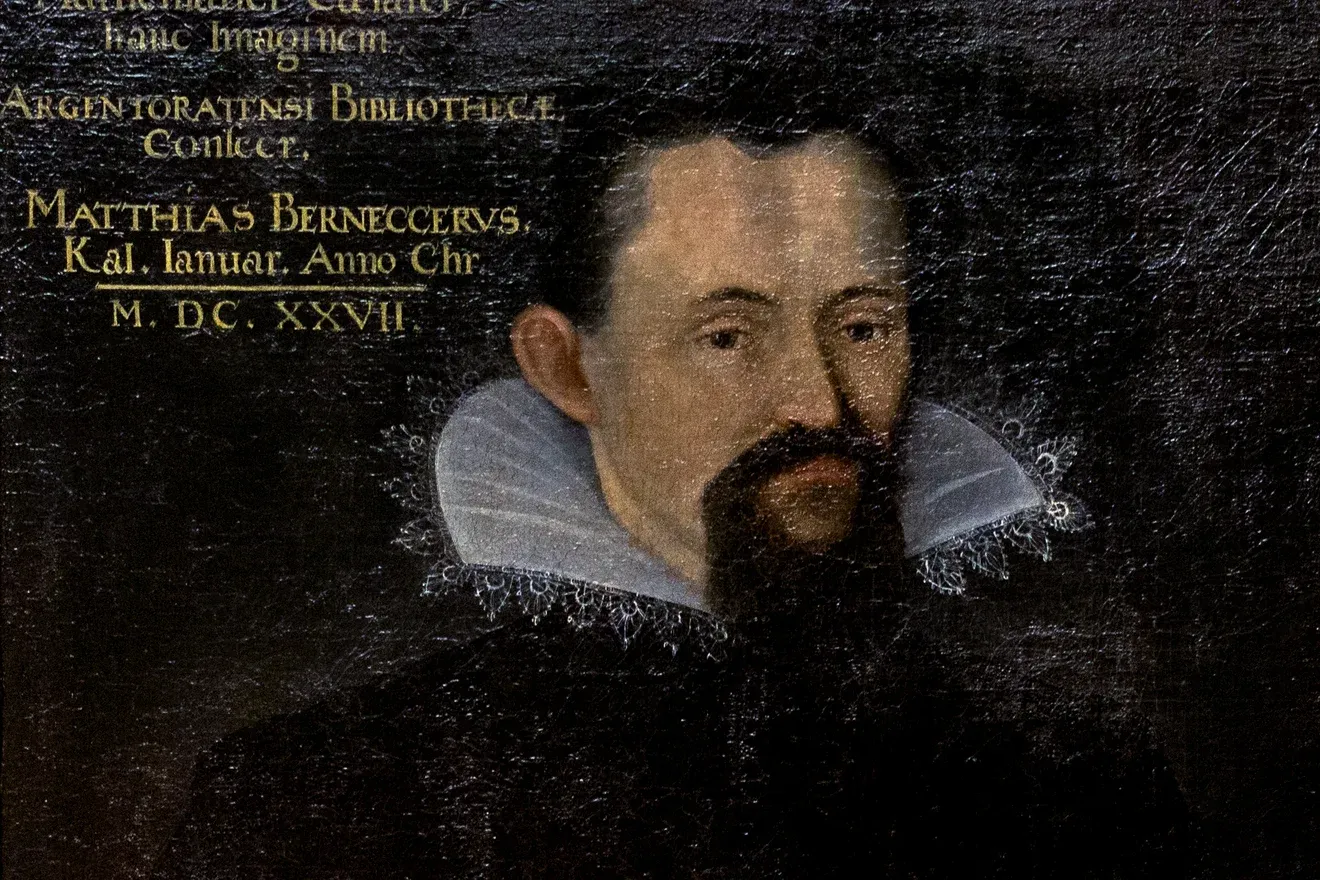
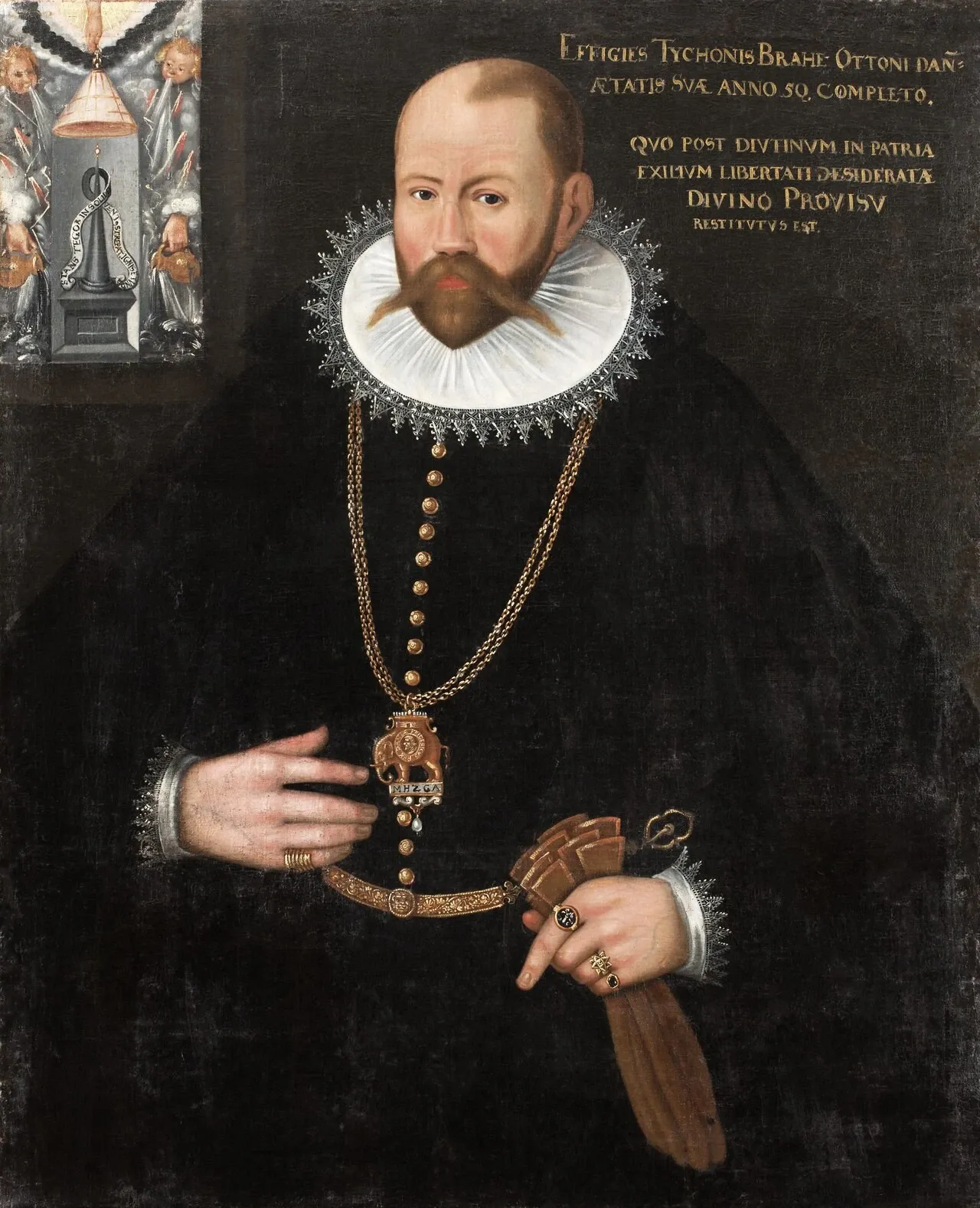
What Kepler did differently was not in the arithmetic but in trusting the measurements more than the circle. In 1627, the same year the portrait at the top of this article was hung in the Strasbourg library, he finished printing the Rudolphine Tables, tables of planetary positions built on Tycho’s data and his own laws[5]. Three years later, on 15 November 1630, Kepler passed away in Regensburg[3].
He wrote his own epitaph: “I used to measure the Heavens, now I measure the shadows of Earth. The mind belonged to Heaven, the body’s shadow lies here.”[4] Almost two centuries later, Gauss found the lost asteroid Ceres by fitting a Kepler ellipse to a few dozen observations.
Free geometry illustrations for students and teachers: EyeViz.
Tài liệu tham khảo
- [1]Johannes Kepler. Astronomia Nova (New Astronomy). Heidelberg, 1609.
- [2]Johannes Kepler. Harmonices Mundi (The Harmony of the World). Linz, 1619.
- [3]J. J. O'Connor and E. F. Robertson. Johannes Kepler (1571–1630), biography. MacTutor History of Mathematics, University of St Andrews.
- [4]Johannes Kepler: quotations. MacTutor History of Mathematics, University of St Andrews.
- [5]Johannes Kepler. Wikipedia.
- [6]Astronomia nova. Wikipedia.
- [7]J. J. O'Connor and E. F. Robertson. Tycho Brahe (1546–1601), biography. MacTutor History of Mathematics, University of St Andrews.
- [8]Orbits and Kepler’s Laws. NASA Science.
- [9]Let’s Go to Mars! Calculating Launch Windows. NASA Jet Propulsion Laboratory.
- [10]Mars Fact Sheet. NASA Goddard Space Flight Center.
- [11]Mercury poisoning ruled out as cause of Danish astronomer Tycho Brahe’s death. Phys.org (from Aarhus University), 2012.
- [12]Kepler’s laws of planetary motion. Wikipedia.