Schrödinger's cat explained: why do we never see it?
What is Schrödinger's cat? The 1935 thought experiment, how quantum superposition differs from "not knowing", and why decoherence hides the cat from us.
Mục lục
What is Schrödinger’s cat?
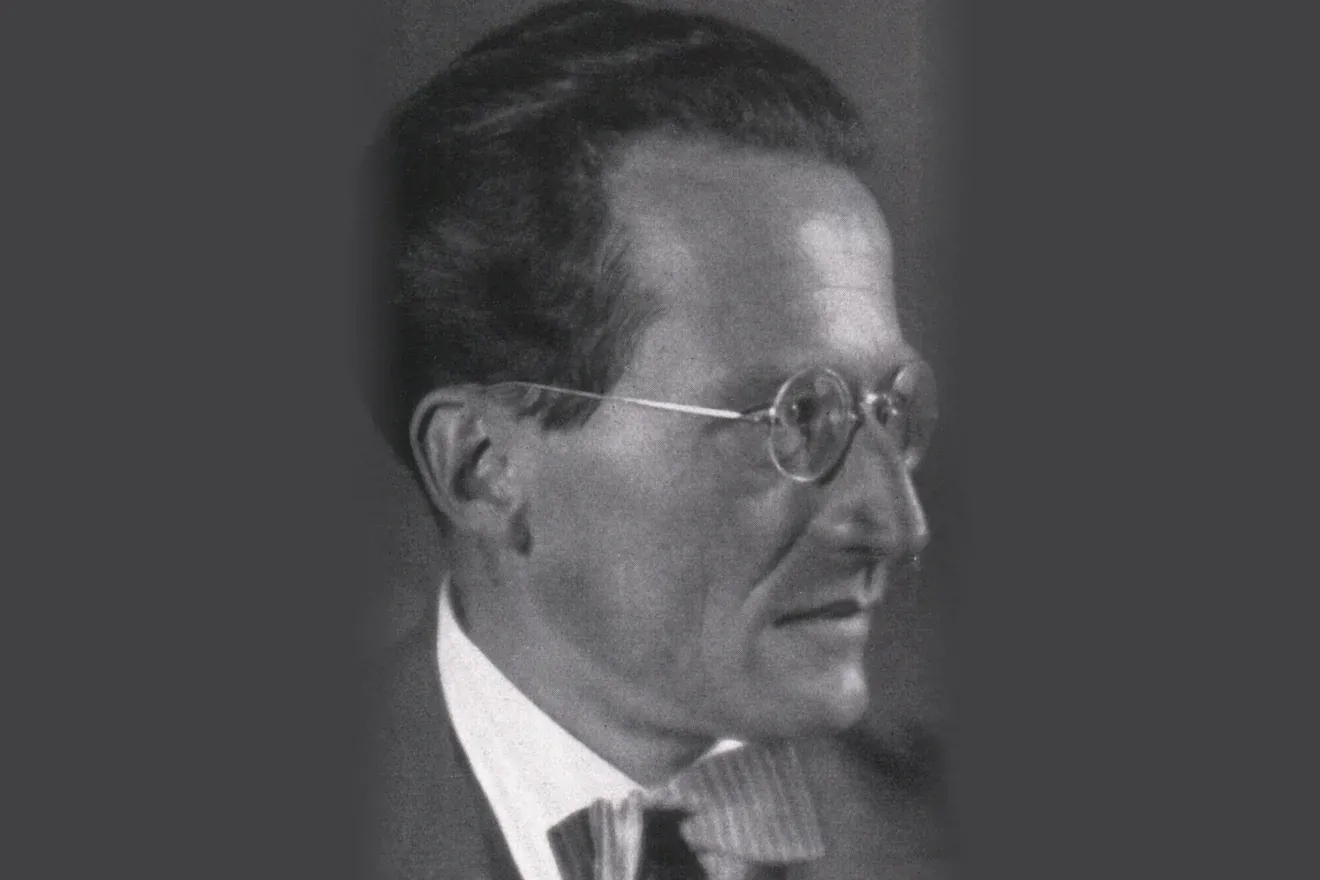
Schrödinger’s cat is a thought experiment proposed by the Austrian physicist Erwin Schrödinger in 1935. A cat is shut in a sealed box together with a mechanism linked to a single radioactive atom. If the atom decays, the mechanism breaks a vial of poison and the cat does not survive. If not, the cat lives. Taken literally, the rules of quantum mechanics say that while nobody has opened the box, the cat is neither “alive” nor “no longer alive”, but in a superposition of both.
What few people know: Schrödinger did not invent the cat to explain quantum mechanics. He invented it to mock one way of reading it. He wanted to show that if you carry the quantum rules for atoms over unchanged to everyday objects, you get something that sounds absurd. He himself called it a “quite ridiculous case”[1][2].
Almost a century later, the cat still poses a hard question: where is the boundary between the quantum world and the familiar one? This article tells how the cat was born, what “superposition” really means, and why we never see a cat suspended between two states.
A steel chamber, a Geiger counter and an hour of waiting
The original description is a single paragraph in the middle of Schrödinger’s three-part paper in the German journal Naturwissenschaften. In outline[2]:
A cat is penned up in a steel chamber, along with a device the cat cannot reach. In a Geiger counter there is a tiny bit of radioactive substance, so small that in the course of an hour perhaps one of its atoms decays, but also, with equal probability, perhaps none. If one does, the counter discharges and a relay releases a small hammer that shatters a vial of poison. Leave the whole system alone for an hour, and we would say the cat is still alive if no atom has decayed. But the wave function of the whole system, in Schrödinger’s words, would contain “the living and the no-longer-living cat (pardon the expression) mixed or smeared out in equal parts”.
Each link turns something small into something bigger: atom, counter, hammer, cat. Physicists in 1935 were used to saying that an atom is in a superposition of “decayed and not decayed”. Schrödinger asked: if you believe that, why not believe the same about the cat? Nowhere does the equation say “from here on, the quantum rules stop”, so the atom’s superposition must spread along the chain of machinery to the cat. A suspended atom is acceptable. A suspended cat is not acceptable to anyone.
Why did Schrödinger come up with the cat?
In 1935 Schrödinger was working in Oxford after leaving Germany, two years after his Nobel Prize in Physics for the wave equation that bears his name. That equation describes with great precision how the wave function of an electron changes. But what the wave function actually is was fiercely disputed.
The dominant camp, the Copenhagen interpretation associated with Niels Bohr and Werner Heisenberg, held that the wave function is a tool for computing probabilities: before a measurement, asking where the electron “really” is makes no sense; on measurement, the wave function “collapses” to one result.
Albert Einstein, who had helped found quantum theory (and whose relativity GPS has to correct for every day), did not accept this. In May 1935 Einstein, Boris Podolsky and Nathan Rosen published the famous paper known as EPR, arguing that quantum mechanics is incomplete: there must be something more real, more detailed, than the wave function[3].
Schrödinger read the EPR paper and the two men exchanged letters all summer. In an August letter, Einstein gave the example of a charge of gunpowder that might go off by itself within a year: on the Copenhagen reading, after a year the wave function would describe a blend of “not yet exploded” and “already exploded”, while in reality there is plainly only one of the two[4]. A few weeks later Schrödinger published his three-part paper, in which the gunpowder was replaced by a cat, more vivid and harder to argue with.
In the same year, Schrödinger named the phenomenon at the heart of the story: quantum entanglement (Verschränkung in German). Inside the box, the atom and the cat have no states of their own; there is only a joint state, “not decayed and cat alive” superposed with “decayed and cat not alive”.
Years later, Einstein still brought up the cat in letters to Schrödinger as the neatest refutation of treating the wave function as a complete description of reality[4]. The irony is that today the cat is usually used to introduce the very interpretation the two men wanted to refute.
Superposition is not “we don’t know yet”
This is the easiest point to get wrong. Hearing “the cat is both alive and not”, many people think: it simply means we don’t know yet, like a tossed coin under your hand, already heads or tails, only unseen.
If that were all, there would be no paradox, and Schrödinger would not have needed to write. The difference lies in something a coin never does: interference.
Look at the double-slit experiment. Fire electrons one at a time at a barrier with two narrow slits. Each electron leaves exactly one dot on the screen, like a marble. But after thousands of electrons, the dots line up in alternating bright and dark bands: interference fringes. There are places on the screen that an electron can reach with one slit open, but can no longer reach with both slits open.
If each electron “really went through one slit and we just don’t know which”, opening a second slit could only add dots everywhere; it could never create gaps. Dark bands appear only when the two possibilities, “through the left slit” and “through the right slit”, both exist and cancel each other at certain places. That is superposition. In quantum mechanics each possibility carries a number called an amplitude, which can be negative (even complex), so two possibilities can add up to zero. The article is quantum computing really the future? (in Vietnamese) explains this idea of “probabilities that may carry a minus sign” in detail, and why compute with light? (in Vietnamese) shows the same interference being used for computation.
So Schrödinger’s real question is: can the cat interfere with itself? If it can, it is truly in superposition. If it cannot, it is just a cat whose condition we don’t know yet.
So is the cat alive or not?
Open the box and you always see one result, each with probability 50%. On the numbers, every physicist agrees. They only disagree about what happens inside the box before it is opened. There are a few main interpretations:
Copenhagen: don’t ask about what can’t be measured. The wave function is only a tool for prediction; measurement is what produces a result. But what counts as a “measurement”? The Geiger counter is already a measuring device, so does the wave function collapse at the counter, or only when someone opens the box? This “where is the boundary” question is called the measurement problem, and the cat is the most memorable way to tell it.
Many worlds (Everett, 1957): nothing collapses. Hugh Everett proposed taking the wave function as real and always obeying the Schrödinger equation, with no collapse step[5]. When you open the box, you become entangled with the system too: in one branch you see the cat alive, in another you see that it did not survive. Each branch sees only one result, so everyone feels they witnessed a single event. The price: accepting countless parallel branches of reality.
Pilot wave (de Broglie, Bohm): the cat always has a definite state, and the wave function only “guides” the particles. The price: the wave function must act instantly across any distance.
Objective collapse: the theory needs fixing. Add a tiny extra term to the Schrödinger equation that makes superpositions of large objects collapse very quickly. This predicts something different from standard theory and so can be tested, but so far no experiment has found any sign of it.
No interpretation has been decisively ruled out by experiment, and physicists remain divided. But one thing became clear between the 1970s and the 1990s, and it answers a more practical question: why do we never see a cat in superposition?
Decoherence: the air “opened the box” before you did
Back to the double slit. Put a device there that records which slit each electron took, and the fringes vanish at once, leaving two blurry patches as with marbles. The striking part: nobody needs to read that device. It is enough that the “which slit” information is recorded somewhere in the universe.
That device doesn’t have to be a machine. A photon or an air molecule bouncing off the electron also carries away a little information about its position, making the “left” and “right” possibilities interfere a little less. This is called decoherence, developed from the 1970s by Heinz-Dieter Zeh and Wojciech Zurek[6].
The figure below is the simulation run at the end of the article. Top row: 20,000 particles fired through two slits, with three levels of “coherence” left between the two possibilities. : sharp bright and dark fringes. : the fringes fade. : a single blur, like adding the two slits’ patches. Bottom row: assume, as an illustration, that each air-molecule collision cuts the coherence by 1%; after 459 collisions, is below 1%.
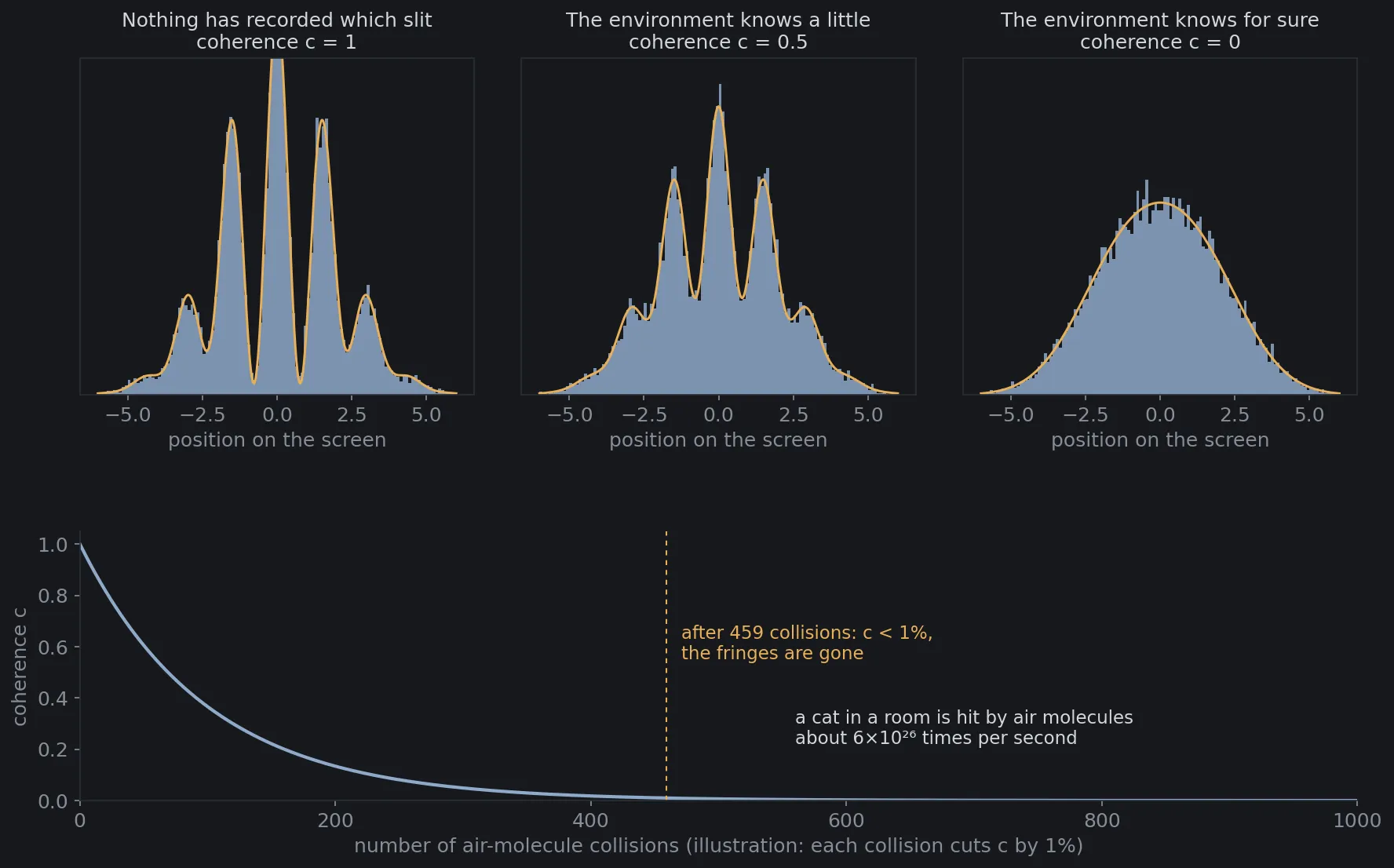
Now apply this to the cat. A house cat has a surface area of about m². Room air holds about molecules per cubic metre, moving at an average speed of nearly 470 m/s. A kinetic-theory calculation gives about molecules hitting the cat every second. At the illustrative 1% per collision, 459 collisions take only about seconds.
In reality, a single collision with a large object carries away almost all the “where is it” information, so things go even faster. Zurek estimated that for a 1-gram object at room temperature, with two positions 1 cm apart, the decoherence time is only about times the time the object takes to relax to thermal equilibrium[6]. That is before counting light and the heat radiation the cat gives off itself.
So the practical answer to Schrödinger is: the moment the Geiger counter clicks, the information has already spread into trillions upon trillions of particles in the box, and the two possibilities lose the ability to interfere in an instant shorter than anything we can measure. From then on, the cat behaves exactly like a cat whose condition we simply don’t know yet. The air in the box “opened the box” long before you touched the lid.
This is also why “observation” in quantum mechanics does not mean a human looking. An air molecule, a photon, a counter all “observe” in the physical sense; the observer’s consciousness plays no role. And for the same reason, don’t picture the cat as “both alive and not” in a literal sense: for a real cat, superposition turns into “we don’t know yet” almost immediately.
Real cats in the laboratory
To keep a “cat” alive longer, you have to isolate it very well: vacuum, cooling to near absolute zero. Since the 1990s laboratories have done exactly that, and they call a superposition of two very different possibilities a cat state.
- 1996, Boulder (USA): David Wineland’s group put a beryllium ion into a superposition of two positions about 80 nanometres apart, hundreds of times the size of the atom[8].
- 1996, Paris: Serge Haroche’s group trapped a microwave field of a few photons in a box of superconducting mirrors, put it into a cat state, and watched decoherence happen step by step: the more different the two possibilities, the faster the interference disappeared[7]. This is the phenomenon in Figure 1, measured in a real experiment.
- 2012: Haroche and Wineland received the Nobel Prize in Physics for methods of measuring and manipulating individual quantum systems[10].
- 2023, Zurich: Yiwen Chu’s group at ETH Zurich put a 16-microgram sapphire crystal, about the size of a fine grain of sand, into a cat state of two opposite-phase vibrations[9]. It is hundreds of millions of billions of times heavier than an atom. Still very far from a cat, but already something you could see under a magnifying glass.
Every qubit in a quantum computer is a little cat: it has to hold its superposition long enough to compute, while the environment keeps “opening the box”. Quantum error correction is, at heart, a fight against decoherence. Schrödinger’s cat, from a jibe in 1935, has become an engineering problem worth billions of dollars.
In symbols
This section is for readers who want to see how physicists write the cat down. Skipping it loses nothing essential.
The state of the whole system after one hour is written
The two numbers are amplitudes. The Born rule says probability is the squared magnitude of the amplitude: for each outcome. This is an entangled state: it cannot be written as “a state of the atom” times “a state of the cat”.
When the environment collides with the system, it gets swept along: and . The interference part is multiplied by how “similar” the two environment states , are: that is the coherence in Figure 1. If each collision keeps a fraction , then after collisions ; with and , .
That is also why, in the double-slit experiment, the density of dots on the screen is
The first two terms are the two slits’ patches, as with marbles. The last term is interference: it can be negative, it makes the dark bands, and it vanishes when .
Run the simulation yourself
The code below produces exactly Figure 1. The two “possibilities”, left slit and right slit, are two bell-shaped waves, each tilted in one direction so that at the screen their phase difference changes gradually. Each particle fired leaves one dot, at a position drawn at random from the formula above (fixed seed 42). The second part computes the coherence against the number of collisions, and the number of air molecules hitting a cat each second. You only need numpy and matplotlib.
import matplotlib.pyplot as pltimport numpy as np
plt.rcParams.update({"figure.facecolor": "#16181c", "axes.facecolor": "#16181c", "text.color": "#d4d7dc",                     "axes.edgecolor": "#2a2e35", "axes.labelcolor": "#878d97",                     "xtick.color": "#878d97", "ytick.color": "#878d97", "font.size": 12})rng = np.random.default_rng(42)
# Two "possibilities" for one particle: through the left slit or through the right slit.# Each possibility is a wave; at the screen, the two waves overlap.x = np.linspace(-6, 6, 2001)s, k = 1.6, 4.0                                    # width of each bright patch and how "tilted" each wave iswave_left = np.exp(-(x + 1.2) ** 2 / (4 * s**2)) * np.exp(+1j * k * x / 2)wave_right = np.exp(-(x - 1.2) ** 2 / (4 * s**2)) * np.exp(-1j * k * x / 2)
def density(c):    """Born rule: probability = |wave|². c is the "coherence" left between the two possibilities:    c = 1 when nothing has recorded which slit, c = 0 when the environment "knows" for sure."""    p = np.abs(wave_left) ** 2 + np.abs(wave_right) ** 2 + 2 * c * np.real(np.conj(wave_left) * wave_right)    return p / p.sum()
def fire(c, n=20_000):    """Fire n particles; each leaves exactly one dot, at a position drawn at random by the Born rule."""    return rng.choice(x, size=n, p=density(c))
# Every air molecule or photon that bounces off carries away a little "where is it" information.# Assume (illustration) each collision cuts the coherence by only 1%: c = 0.99^N after N collisions.N = np.arange(0, 1001)c_N = 0.99 ** NN_1pct = int(np.argmax(c_N < 0.01))print(f"after {N_1pct} collisions, coherence is below 1%")
# A cat in a room: air molecules hitting its fur every second (rough estimate)gas_density = 2.5e25                               # molecules / m³ at 25 °C, 1 atmmean_speed = 470                                   # m/s, mean speed of air moleculescat_area = 0.2                                     # m², surface area of a house cat (estimate)hits_per_second = gas_density * mean_speed / 4 * cat_areaprint(f"collisions per second: {hits_per_second:.0e}; {N_1pct} collisions take about {N_1pct / hits_per_second:.0e} s")
# ── Plot ────────────────────────────────────────────────────────────────────fig = plt.figure(figsize=(14, 8.2))g = fig.add_gridspec(2, 3, height_ratios=[1, 0.8], hspace=0.45, wspace=0.12)cases = [(1.0, "Nothing has recorded which slit"),         (0.5, "The environment knows a little"),         (0.0, "The environment knows for sure")]for j, (c, title) in enumerate(cases):    ax = fig.add_subplot(g[0, j])    ax.hist(fire(c), bins=120, range=(-6, 6), color="#8fa9c9", alpha=0.85)    ax.plot(x, density(c) * 20_000 * (12 / 120) / (x[1] - x[0]), color="#e8b05a", lw=1.4)    ax.set_title(f"{title}\ncoherence c = {c:g}", color="#d4d7dc", fontsize=12)    ax.set_yticks([])    ax.set_xlabel("position on the screen")    ax.set_ylim(0, 660)
ax = fig.add_subplot(g[1, :])ax.plot(N, c_N, color="#8fa9c9", lw=2)ax.axvline(N_1pct, color="#e8b05a", ls=(0, (3, 3)), lw=1)ax.text(N_1pct + 12, 0.55, f"after {N_1pct} collisions: c < 1%,\nthe fringes are gone", color="#e8b05a", fontsize=11)exp = int(np.floor(np.log10(hits_per_second)))sup = str(exp).translate(str.maketrans("0123456789", "⁰¹²³⁴⁵⁶⁷⁸⁹"))ax.text(560, 0.22, f"a cat in a room is hit by air molecules\nabout {hits_per_second / 10**exp:.0f}×10{sup} times per second",        color="#d4d7dc", fontsize=11)ax.set_xlabel("number of air-molecule collisions (illustration: each collision cuts c by 1%)")ax.set_ylabel("coherence c")ax.set_xlim(0, 1000)ax.set_ylim(0, 1.05)for sp in ("top", "right"):    ax.spines[sp].set_visible(False)
fig.savefig("meo-schrodinger-mat-ket-hop-en.png", dpi=150, bbox_inches="tight")
Output:
after 459 collisions, coherence is below 1%collisions per second: 6e+26; 459 collisions take about 8e-25 sTry changing 0.99 to 0.999 (each collision carries away very little information, as for a very small, well-isolated object): it now takes about 4,600 collisions, ten times as many. That is what laboratories do to keep their “cats”: not make each collision gentler, but make collisions fewer, with vacuum and extreme cold.
What the cat teaches us
Schrödinger put forward the cat to say that quantum mechanics, as it was read at the time, had something wrong with it. Almost a century later we know two more things. First, the quantum rules have not stopped at any size so far: superpositions have been made with ions, with light, and now with a crystal you can see. Second, we don’t see a suspended cat because the large-scale world is constantly being “measured” by its own environment, faster than anything we could notice.
The last question, why opening the box shows this result rather than that one, remains open. The cat is still sitting in its box, waiting for the next generation of physicists.
Free geometry illustrations for students and teachers: EyeViz.
Tài liệu tham khảo
- [1]Erwin Schrödinger. Die gegenwärtige Situation in der Quantenmechanik. Naturwissenschaften 23, 807–812, 823–828, 844–849, 1935.
- [2]John D. Trimmer (translator). The Present Situation in Quantum Mechanics: A Translation of Schrödinger's "Cat Paradox" Paper. Proceedings of the American Philosophical Society 124, 323–338, 1980.
- [3]A. Einstein, B. Podolsky, N. Rosen. Can Quantum-Mechanical Description of Physical Reality Be Considered Complete?. Physical Review 47, 777, 1935.
- [4]Arthur Fine. The Shaky Game: Einstein, Realism and the Quantum Theory. University of Chicago Press, 1986.
- [5]Hugh Everett III. Relative State Formulation of Quantum Mechanics. Reviews of Modern Physics 29, 454, 1957.
- [6]Wojciech H. Zurek. Decoherence and the Transition from Quantum to Classical. Physics Today 44(10), 36, 1991.
- [7]M. Brune, E. Hagley, J. Dreyer, X. Maître, A. Maali, C. Wunderlich, J. M. Raimond, S. Haroche. Observing the Progressive Decoherence of the "Meter" in a Quantum Measurement. Physical Review Letters 77, 4887, 1996.
- [8]C. Monroe, D. M. Meekhof, B. E. King, D. J. Wineland. A "Schrödinger Cat" Superposition State of an Atom. Science 272, 1131, 1996.
- [9]M. Bild, M. Fadel, Y. Yang, U. von Lüpke, P. Martin, A. Bruno, Y. Chu. Schrödinger cat states of a 16-microgram mechanical oscillator. Science 380, 274, 2023.
- [10]The Nobel Prize in Physics 2012: Serge Haroche and David J. Wineland. NobelPrize.org.
- [11]Schrödinger's cat. Wikipedia.