Who discovered the law of conservation of energy? Mayer in Java
The law of conservation of energy began with sailors' bright red blood in Java in 1840. Doctor Mayer, Joule, Helmholtz and the fight over the work–heat rate.
Mục lục
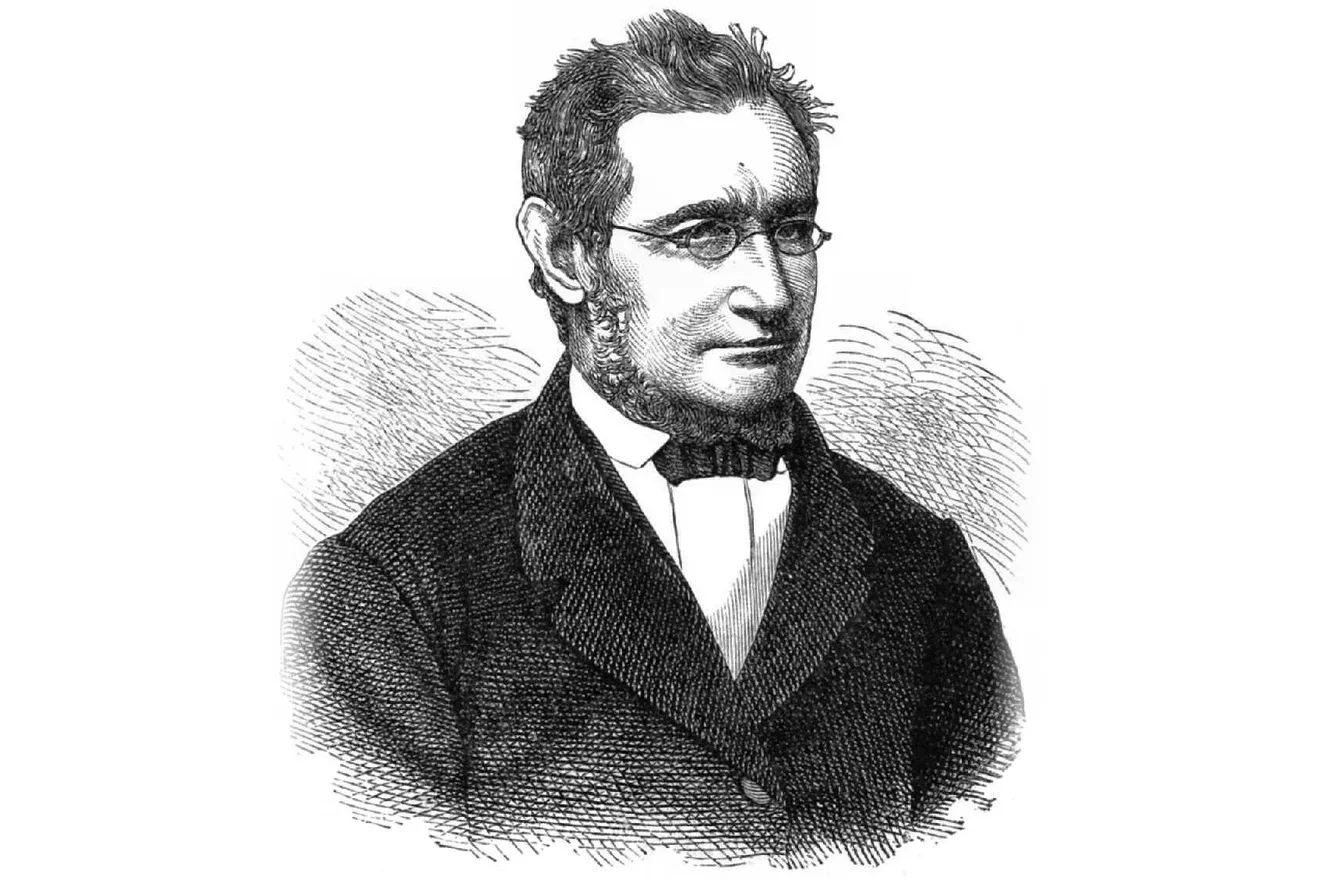
In the summer of 1840, a Dutch merchant ship called the Java lay at anchor in the waters of the East Indies, today’s Indonesia. On board was a 25-year-old German doctor named Julius Robert Mayer. Following the medical custom of the time, when sailors fell ill he drew blood from their veins. And he noticed something strange: the venous blood was bright red, almost like arterial blood. In Europe, venous blood was always much darker. At first he thought he had pierced an artery by mistake.
From those few drops of red blood, Mayer arrived at an idea every schoolchild learns today: the law of conservation of energy. Energy is not created and does not vanish; it only changes from one form to another. But the price he paid for that idea is one of the saddest stories in the history of science: a paper that was rejected, work that others were credited for, and a crisis that nearly cost him his life.
So who really discovered the law of conservation of energy? The answer is more interesting than a single name.
What is the law of conservation of energy?
Think of energy as a family’s money. Money can sit in a wallet, in a bank account, in a safe, or be exchanged into dollars. Moving it around changes its form, but total wealth stays the same, as long as nobody brings money into the house or takes it out.
Energy works the same way. It comes in many “currencies”:
- Kinetic energy, the energy of motion: a moving motorbike, a rolling marble.
- Potential energy, energy “saved up” by position: water held behind a hydroelectric dam, an apple on a branch.
- Thermal energy: a pot of hot water, brake pads after a hard stop.
- Chemical energy: the energy stored in petrol, in coal, in the bowl of noodle soup you had for breakfast.
- Electrical energy, light energy…
The law of conservation of energy says: in a closed system, energy is exchanged between these forms, but the total never changes. Water falling from a dam (potential energy) spins a turbine (kinetic energy), the turbine drives a generator (electrical energy), and the electricity reaches your home to boil a kettle (thermal energy). At every step some of it “leaks” as useless heat, but if you count the leaks too, not a single bit of energy is lost.
It sounds obvious. But in 1840 it was anything but. People then thought of heat as an invisible fluid called caloric, flowing from hot bodies to cold ones the way water flows downhill. Nobody imagined that a horse’s pulling power and the warmth of a stove were the same kind of money.
What did the bright red blood mean?
Mayer was a doctor, so he thought like one. It was already known that arterial blood is bright red because it is rich in oxygen; as it passes through the body, cells use oxygen to “burn” food and make heat, so the blood returning through the veins is oxygen-poor and darker.
The human body is like a charcoal stove that must always stay at 37 degrees. In cold Europe the stove burns plenty of fuel (food) and oxygen, and venous blood comes back nearly drained of oxygen. In the tropics the air is already warm, so the stove only needs to be turned down low. Burning less uses less oxygen, and the venous blood stays bright red[2][3].
Then Mayer asked a bigger question. Food burned in the body does not only produce heat; it also lets a sailor haul ropes and climb the mast, that is, produce mechanical work. If the same handful of rice can become either warmth or pulling power, then heat and work must be two forms of the same thing, and they must be exchangeable at a fixed rate.
The ship’s helmsman told him one more detail: the sea is warmer after a storm than before it. Wind and waves stir the water (work), and the water warms up (heat). To Mayer, that was further evidence.
The paper nobody answered
Back home in 1841, Mayer wrote his first paper and sent it to Germany’s most prestigious physics journal, Johann Poggendorff’s Annalen der Physik. It was clumsy, full of vague philosophical notions and even contained physics errors: Mayer had trained in medicine, not physics. Poggendorff never replied. The manuscript sat in his drawer and was only found many years after he passed away[3].
Mayer did not give up. He taught himself more physics, rewrote the paper, and in 1842 managed to publish a short eight-page article in a chemistry journal, Justus von Liebig’s Annalen der Chemie und Pharmacie[1]. It contained the most important number of his life.
A calculation with a balloon
Mayer wanted the “exchange rate” between work and heat: how much mechanical work equals a given amount of heat. He had no laboratory. He used existing data on gases and a very clever argument.
Heat the same amount of air in two ways:
- In a pot with a tightly screwed-on lid (constant volume). All the heat goes into warming the gas.
- In a balloon (constant pressure). The gas warms up and expands, pushing the surrounding air back. That pushing is work.
Experiments already showed that the second way takes more heat for the same rise in temperature. Mayer reasoned: that extra heat does not disappear, it has turned into the work of pushing the air. Measure the extra heat, calculate the pushing work, divide one by the other, and you have the exchange rate. Today the difference between those two heat capacities is written and is called Mayer’s relation, which every physics student meets.
Mayer’s result: the heat that warms 1 kg of water by 1 degree is equivalent to the work of lifting 1 kg to a height of 365 metres. The correct figure today is about 427 metres. Mayer was off by about 15% because the gas data of his time were imprecise, but the idea was entirely right.
Pause on that number for a moment, because it is surprising. Lift a 1 kg bag of rice from the ground to the roof of a 140-storey building, turn all of that effort into heat, and you warm 1 litre of water by just 1 degree. Heat is a very “expensive” form of energy. That is why you can rub your hands together for ages and they only get slightly warm, and why for thousands of years nobody noticed that work and heat are one and the same.
The brewer from Manchester
Around the same time in England, someone else reached the same idea by a completely different road: James Prescott Joule, son of a wealthy brewery owner near Manchester. Joule held no professorship, but he had money, time and a rare skill: measuring temperature extremely precisely, something he learned from brewing, where a few tenths of a degree can spoil a whole batch.
If Mayer was the thinker, Joule was the measurer. From 1843 he ran experiment after experiment: passing electric current through wires in water, forcing water through narrow tubes, compressing gases. The most famous is the paddle-wheel apparatus: two weights fall, pulling a string that turns a shaft with paddles immersed in an insulated vessel of water. The paddles churn the water and it warms up ever so slightly. Measure how far the weights fall and you know the work; measure the water’s temperature and you know the heat.
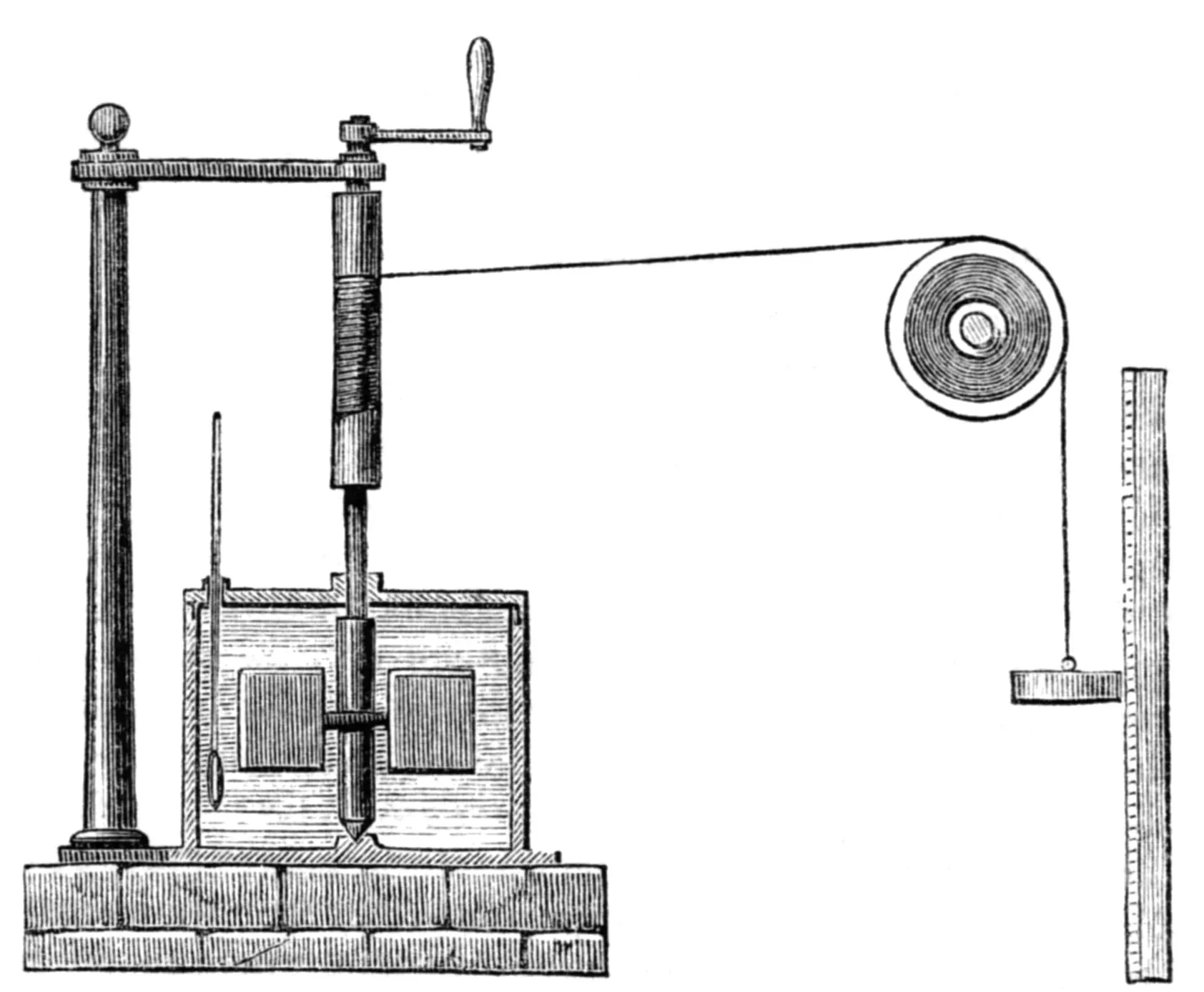
How small was the temperature rise? In the 1850 experiment, after the weights had been dropped 20 times, the water was only about a third of a degree warmer. Joule had to read his thermometer to one two-hundredth of a degree Fahrenheit. His final result is less than 1% away from today’s value[4][5].
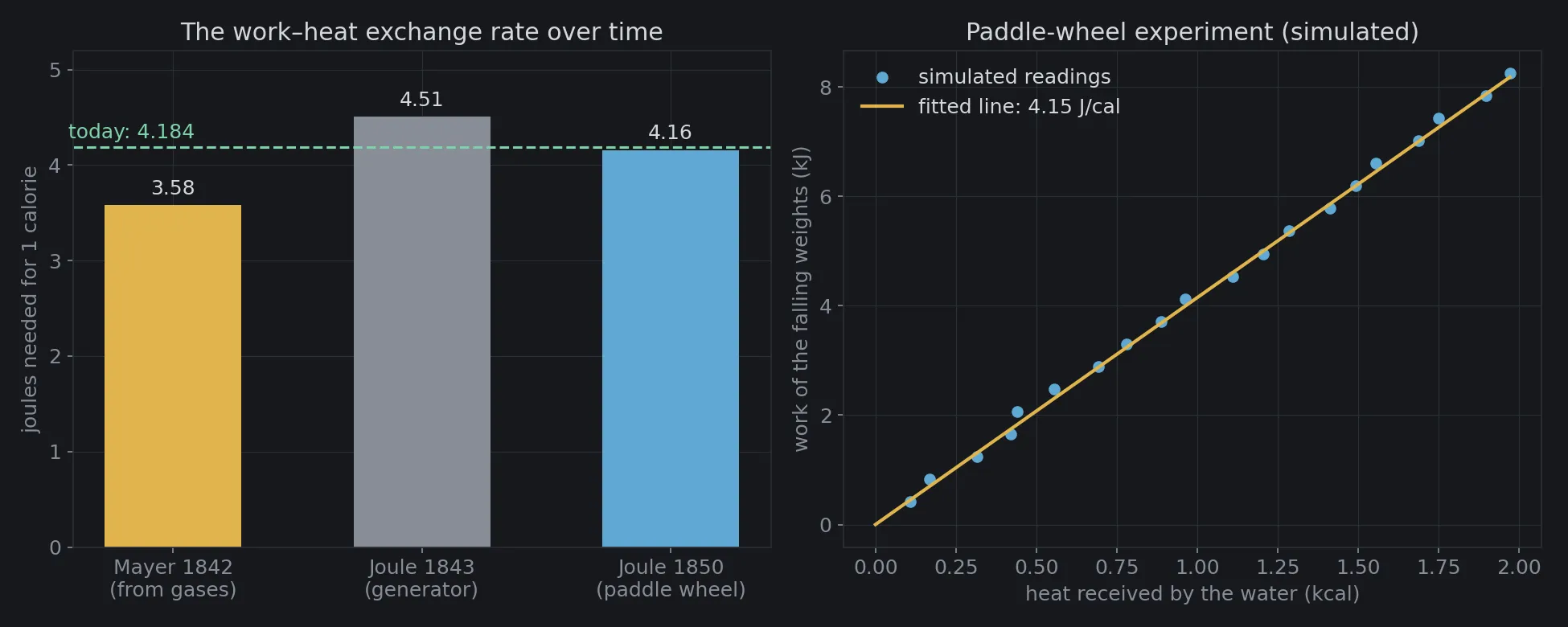
Figure 2 above puts those numbers side by side. Two things stand out. First, on the left: in 1843 Joule was still nearly 8% off, and it took him seven years of improving the experiment to get under 1%. Second, on the right is a simulated paddle-wheel experiment (illustrative numbers, method in the last section): even though every temperature reading has some error, the dots still lie on a straight line. Double the work and the heat doubles; ten times the work, ten times the heat. That straight line, not just the number 4.18, is the evidence that work and heat are the same money, exchanged at a fixed rate.
At first nobody believed him. In 1843 Joule presented his work at a meeting of the British Association and was met with silence. In 1847, at the Oxford meeting, the chairman asked him to be very brief and allowed no discussion. Just then, a 23-year-old stood up to ask a question: William Thomson, later Lord Kelvin. Thomson was sceptical at first, but went on to become Joule’s friend and his most important supporter.
Thomson himself later told an amusing story: a few weeks after the meeting, walking near Chamonix in France, he ran into Joule on his honeymoon, carrying a long thermometer and planning to check whether the water at the bottom of a waterfall was warmer than at the top. By Joule’s exchange rate, water falling 100 metres should warm by about degrees. The idea was right, but the waterfall threw up too much spray for the measurement to work.
The third man: Helmholtz
Also in 1847, in Berlin, a 25-year-old army surgeon named Hermann von Helmholtz read a long paper to the Berlin Physical Society titled Über die Erhaltung der Kraft, “On the conservation of force”[6]. Unlike Mayer and Joule, Helmholtz wrote in rigorous mathematics: he showed that if no perpetual motion machine can exist, then mechanics, electricity, magnetism and chemistry must all share a conserved quantity.
In a twist of fate, Poggendorff also refused to publish Helmholtz’s paper, finding it too philosophical. Helmholtz had to print it as a slim booklet. But unlike Mayer, he was an academic insider with good teachers and friends, and his work was quickly read and cited by German physicists.
The battle over who came first
In 1848 Mayer read that Joule’s work was being praised by French scientists. He wrote a letter asserting that he himself had published the work–heat exchange rate in 1842, before Joule. Joule replied that the idea might be Mayer’s, but the experimental proof was his. The dispute had begun.
For Mayer those were the worst years. In 1848 two of his young children passed away one after the other. In 1849 and 1850 a major newspaper in Augsburg ran articles mocking him as a conceited amateur. In May 1850, in a mental health crisis, he jumped from a second-floor window. He survived, but with badly injured legs, and in the following years he was treated in psychiatric institutions[3].
Recognition came late, and it came from England. In 1862 the physicist John Tyndall devoted an entire lecture at the Royal Institution in London to praising Mayer as the pioneer. That sparked a new war of words: Thomson and Peter Tait sided with Joule, accusing Tyndall of belittling the British. In 1871 the Royal Society of London awarded Mayer the Copley Medal, the most prestigious science prize of the time. He was ennobled, becoming “von Mayer”, and passed away in 1878 in his hometown of Heilbronn.
So who discovered it?
In 1959 the historian of science Thomas Kuhn counted at least twelve people who had arrived at the idea of energy conservation more or less independently between about 1830 and 1850[7]: besides Mayer, Joule and Helmholtz, there were the Danish engineer Ludvig Colding, the French engineer Sadi Carnot (in unpublished notes written before he passed away in 1832), and several others. Kuhn called it a textbook case of simultaneous discovery.
Why did so many people think of the same thing at the same time? Because 19th-century Europe was full of steam engines (heat turning into work in front of everyone every day), newly invented batteries and electric motors (chemical energy into electricity into work), and the question “how do these things convert into each other?” was in the air. It is like a whole class staring at the same maths problem long enough: sooner or later several people solve it at once.
If credit must be shared, one could say:
- Mayer was the first to state the idea clearly and calculate the work–heat exchange rate (1842).
- Joule proved it experimentally with precision, which made the scientific world believe it (1843 to 1850). The modern unit of energy, the joule (J), bears his name.
- Helmholtz turned it into a general mathematical principle for all of physics (1847).
The name “conservation of energy” came later: the word energy in its modern sense was popularised by William Rankine and Thomson in the 1850s. Before that, both Mayer and Helmholtz called it “force”.
Can a bowl of noodle soup get you up a mountain?
This law is everywhere around you; we are just so used to it that nobody notices.
Food labels. The “kcal” on a packet of instant noodles is a unit of heat: 1 kcal warms 1 litre of water by 1 degree. A bowl of Vietnamese phở of about 450 kcal (an illustrative figure) is about 1.9 million joules. If all of that energy went into climbing, a 60 kg person could climb about 3,200 metres, higher than Fansipan, Vietnam’s highest peak. In reality muscles turn only about a quarter of the energy into work and the rest into heat (which is why climbing makes you sweat), so you would need about four bowls. But that calculation is exactly Mayer’s calculation aboard the Java.
Your electricity bill. One unit of electricity (1 kWh) is 3.6 million joules, enough to bring about 10 litres of water from room temperature to the boil with no losses. Hydro, coal and solar power plants are just energy “currency exchanges”: none of them creates energy out of nothing.
Regenerative braking. When a petrol motorbike brakes, its kinetic energy turns into heat in the brake pads and is gone. An electric vehicle runs its motor backwards as a generator, turning part of the kinetic energy back into electricity in the battery. That is conservation of energy put to clever use.
Perpetual motion machines. As early as 1775, the French Academy of Sciences declared it would no longer examine any proposal for a perpetual motion machine. After Mayer, Joule and Helmholtz, people understood why: a machine that creates its own energy is like an investment fund promising returns with no money flowing in from anywhere. It sounds attractive, but the books never balance.
Why is energy conserved?
Mayer, Joule and Helmholtz showed that energy is conserved, but could not answer “why”. The answer came in 1918 from the German mathematician Emmy Noether[8]: energy is conserved because the laws of physics do not change over time. An experiment done today or tomorrow gives the same result.
Think of a game whose rules today are exactly the same as yesterday’s. When the rules never change, there is no way to “game the rules” to create money just by waiting, so the total money in the game must stay the same. Noether’s theorem is one of the most beautiful ideas in modern physics, and it shows that the law Mayer found in a few drops of blood actually reflects a very deep property of the universe.
Compute the work–heat exchange rate yourself
The code below produces exactly Figure 2. The first part converts three historical “exchange rates” into one unit, joules per calorie: Mayer’s 365 kgf·m/kcal from 1842, Joule’s 838 ft·lbf/BTU from 1843, and Joule’s 772.692 ft·lbf/BTU from 1850. The second part simulates a Joule-style paddle-wheel experiment with illustrative numbers: two weights totalling 26.3 kg falling 1.6 m, up to 20 times, stirring a vessel equivalent to 6.8 kg of water, with a thermometer that has a random error of about 0.004 degrees (fixed seed 42). From the readings we fit a straight line and read off the exchange rate. You only need numpy and matplotlib.
import matplotlib.pyplot as pltimport numpy as np
plt.rcParams.update({"figure.facecolor": "#16181c", "axes.facecolor": "#16181c", "text.color": "#d4d7dc",                     "axes.edgecolor": "#2a2e35", "axes.labelcolor": "#878d97",                     "xtick.color": "#878d97", "ytick.color": "#878d97", "font.size": 12})GOLD, BLUE, GREY = "#e0b44c", "#5fa8d3", "#878d97"rng = np.random.default_rng(42)G = 9.80665            # standard gravity, m/s²
# 1. Convert historical work–heat "exchange rates" into one unit: joules per calorie (J/cal).FT_LBF, BTU_CAL = 1.35582, 251.996          # 1 ft·lbf = 1.35582 J; 1 BTU = 251.996 calhistory = {    "Mayer 1842\n(from gases)": 365 * G / 1000,              # 365 kgf·m per kcal    "Joule 1843\n(generator)": 838 * FT_LBF / BTU_CAL,        # 838 ft·lbf per BTU    "Joule 1850\n(paddle wheel)": 772.692 * FT_LBF / BTU_CAL,}TODAY = 4.184for name, j in history.items():    print(f"{name.split(chr(10))[0]:11s}: {j:.3f} J/cal, off by {100 * (j / TODAY - 1):+.1f}% from 4.184")
# 2. Simulate a Joule-style paddle-wheel experiment (illustrative numbers):#    two weights totalling 26.3 kg fall 1.6 m, stirring a vessel equivalent to 6.8 kg of water.m_weights, h, m_water_g = 2 * 13.15, 1.6, 6800drops = np.arange(1, 21)work = m_weights * G * h * drops                          # mechanical work, JdT_true = work / (TODAY * m_water_g)                      # true temperature rise, KdT_read = dT_true + rng.normal(0, 0.004, drops.size)      # thermometer error ±0.004 Kheat = m_water_g * dT_read                                # measured heat, calslope = np.polyfit(heat, work, 1)[0]print(f"Simulated 20 drops: water warmed by {dT_read[-1]:.3f} K, estimate {slope:.3f} J/cal")
fig, (a1, a2) = plt.subplots(1, 2, figsize=(13, 5.2))names, values = zip(*history.items())bars = a1.bar(names, values, color=[GOLD, GREY, BLUE], width=0.55)a1.bar_label(bars, labels=[f"{v:.2f}" for v in values], color="#d4d7dc", padding=4)a1.axhline(TODAY, color="#7fd1a8", ls="--", lw=1.5)a1.text(-0.42, TODAY + 0.1, "today: 4.184", color="#7fd1a8", ha="left")a1.set(ylabel="joules needed for 1 calorie", title="The work–heat exchange rate over time", ylim=(0, 5.2))
a2.plot(heat / 1000, work / 1000, "o", color=BLUE, label="simulated readings")x = np.linspace(0, heat.max(), 50)a2.plot(x / 1000, slope * x / 1000, color=GOLD, lw=2, label=f"fitted line: {slope:.2f} J/cal")a2.set(xlabel="heat received by the water (kcal)", ylabel="work of the falling weights (kJ)",       title="Paddle-wheel experiment (simulated)")a2.legend(frameon=False, loc="upper left")for a in (a1, a2):    a.set_axisbelow(True)    a.grid(color="#2a2e35", lw=0.6)fig.tight_layout()fig.savefig("mayer-joule-ty-gia-en.png", dpi=150)
The output:
Mayer 1842 : 3.579 J/cal, off by -14.4% from 4.184Joule 1843 : 4.509 J/cal, off by +7.8% from 4.184Joule 1850 : 4.157 J/cal, off by -0.6% from 4.184Simulated 20 drops: water warmed by 0.290 K, estimate 4.148 J/calTry raising the thermometer error from 0.004 to 0.04 to see why Joule had to read his thermometer to one two-hundredth of a degree.
Back aboard the Java
In 1840, when Mayer bent over the bright red blood of a sailor in tropical waters, he had no laboratory, no physics degree and no one to ask. He had only the right question: why is the blood a different colour, and what does that difference say about the warmth inside the body?
The law of conservation of energy has no single author. It took a doctor who dared to think, a brewer who patiently measured, and a mathematician who wrote it down rigorously. But the first person to see it, in a few drops of blood, far from home, was Julius Robert Mayer.
Free geometry illustrations for students and teachers: EyeViz.
Tài liệu tham khảo
- [1]Julius Robert Mayer. Bemerkungen über die Kräfte der unbelebten Natur. Annalen der Chemie und Pharmacie 42, 1842.
- [2]Kenneth L. Caneva. Robert Mayer and the Conservation of Energy. Princeton University Press, 1993.
- [3]Julius von Mayer. Wikipedia.
- [4]James Prescott Joule. On the Mechanical Equivalent of Heat. Philosophical Transactions of the Royal Society of London 140, 1850.
- [5]Mechanical equivalent of heat. Wikipedia.
- [6]Hermann von Helmholtz. Über die Erhaltung der Kraft. G. Reimer, Berlin, 1847.
- [7]Thomas S. Kuhn. Energy Conservation as an Example of Simultaneous Discovery. Critical Problems in the History of Science (ed. M. Clagett), University of Wisconsin Press, 1959.
- [8]Emmy Noether. Invariante Variationsprobleme. Nachrichten von der Gesellschaft der Wissenschaften zu Göttingen, 1918.