The Turing test: can AI really think?
What is the Turing test, how did AI pass it in 2025, and does passing mean AI really thinks? From ELIZA and the Chinese room to ChatGPT, explained simply.
Mục lục
Every time you tick the “I’m not a robot” box before logging in, you are taking a Turing test, only with the roles reversed: this time the machine asks the questions and you have to prove you are human. The Turing test was proposed in 1950 around a very simple idea: if, after a conversation in text, we cannot tell which party is the machine and which is the person, we should accept that the machine thinks.
The short answer to “can AI think?”: AI has passed the Turing test, according to a controlled experiment published in 2025. But passing the test does not mean scientists agree that AI thinks. This article tells why Turing set the test, how machines have fooled people from 1966 until today, and why, at the very moment machines passed, the question “can machines think?” became harder to answer than ever.
You take a Turing test every day without knowing it
Before going back to 1950, look around. The question “human or machine?” has been part of everyday life for a long time.
The “I’m not a robot” box. CAPTCHA stands for “Completely Automated Public Turing test to tell Computers and Humans Apart”[5]. It was introduced in 2003 to stop programs that automatically registered thousands of junk accounts. It is like the guard at an apartment building asking a stranger “which flat are you visiting?”: not to make life hard, but to filter out anyone with no reason to be there. Warped letters and image grids that ask you to “select all traffic lights” all rely on one fact: things people find easy, machines find hard.
Customer-service chatbots. You message your bank at midnight and get an instant, polite, on-point answer. Are you sure there is a person on the other side? Many companies do not say, and many customers do not ask. Only when an answer goes off-topic do we start to suspect “it must be a machine”.
Calls that fake a relative’s voice. Scammers can now use AI to imitate the voice of a victim’s child or parent and ask for an urgent loan. This is the Turing test at its most dangerous: the listener has a few dozen seconds and a lot of pressure to decide “is this a real person?”.
Students’ essays. A teacher reads an unusually smooth essay and wonders: did the student write it, or a machine? “AI detectors” were built to answer that question, and they get it wrong fairly often.
All four situations share one structure: we can only see behaviour, not what is inside, and we have to guess who is on the other side. That is exactly the structure Turing proposed 76 years ago.
What is the Turing test?
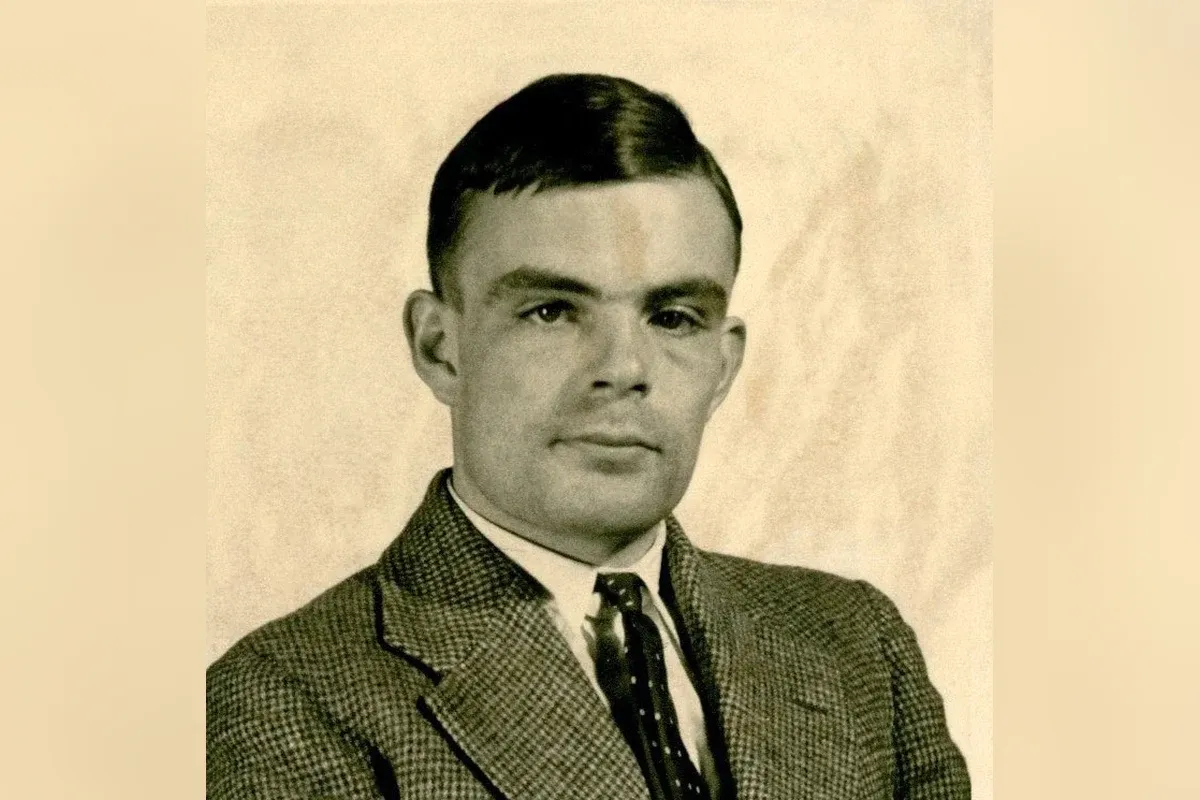
In 1950, Alan Turing was working at the University of Manchester, home to one of Britain’s first electronic computers. Fourteen years earlier he had written the paper that laid the foundations of the computer, with the abstract “Turing machine”, and proved that some problems cannot be solved by any program (that story is in the article on Cantor’s diagonal argument). During the war he worked at Bletchley Park, where German military messages were decrypted.
His 1950 paper, Computing Machinery and Intelligence, opens with one sentence: “I propose to consider the question, ‘Can machines think?’”[1]. Then he immediately sets that question aside. To Turing, the words “machine” and “think” were too vague. Defining them by surveying how people normally use them would turn the answer into an opinion poll, which helps nobody. Instead, he proposed a game.
The imitation game
The original version has no machine. There are three people: a man (A), a woman (B) and an interrogator (C) in a separate room. C communicates with A and B only through typed text and must guess which is the man and which is the woman. A tries to mislead C, while B tries to help C guess correctly.
Then Turing asks: what happens if we replace A with a machine? Will the interrogator guess wrong as often as when the game is played between people? This question, he argued, can stand in for “can machines think?”.
Picture a job interview by text message: you do not see the candidate’s face or hear their voice, you only read their answers. If, after a whole session, you cannot say whether the candidate is a person or a program, what grounds do you have, as far as the job is concerned, to say it “cannot think”? That is Turing’s point: we never look inside other people’s heads, we judge each other by words and actions. So let us use the same yardstick for machines.
Typed text is deliberate. Turing did not want a machine to fail just because it lacks a human voice or face. As he put it, we do not wish to penalise the machine for its inability to shine in beauty competitions, nor to penalise a man for losing in a race against an aeroplane. The test measures one thing only: the ability to hold a conversation.
The prediction for the year 2000
Turing did not just pose the question. He dared to predict: in about fifty years, around the year 2000, there would be machines with a storage capacity of about (a billion) bits that play the imitation game so well that an average interrogator would have no more than a 70% chance of making the right identification after five minutes of questioning[1].
Notice how modest that number is. He did not say machines would fool everyone forever. He only said: within five minutes, the interrogator would be wrong at least three times in ten. The year 2000 came and went without any machine doing it. It took another 25 years for the prediction to come true, and by then machines went well past the bar he had set.
Nine objections
The longest part of Turing’s paper is a list of objections he raises against himself and answers one by one. There are nine, and some read as if they were written yesterday.
- “A machine can only do what we tell it to do.” Turing calls this Lady Lovelace’s objection, after Ada Lovelace, who wrote programs for Charles Babbage’s Analytical Engine in the 19th century. She wrote that the engine “has no pretensions to originate anything”. Turing replies that machines take him by surprise quite often, and who is to say that surprising someone is not a kind of originality? Today, when an AI model writes a poem nobody has written before, the debate is exactly the same.
- “A machine has no consciousness.” If a machine wrote a sonnet, would it feel that sonnet? Turing points out that by this argument we could not know whether other people are conscious either, since we only know our own consciousness for certain. In daily life we simply assume others are conscious like us, a “polite convention”, as he called it.
- “A machine will never be able to do X.” Never tell a joke, fall in love, make mistakes, enjoy strawberries and cream. Turing notes that such claims are usually generalisations from the machines we happen to have seen, not arguments.
At the end of the paper, Turing offers a suggestion that came true only much later: instead of programming an adult mind, build a “child machine” and teach it, as one teaches a child at school. That is the idea behind machine learning today.
1966: ELIZA and the secretary
The Turing test sounds hard, but people turn out to be easier to fool than we think.
In 1966, Joseph Weizenbaum at MIT wrote a program called ELIZA[2]. Its most famous script, DOCTOR, played a psychotherapist of the school that mostly reflects the patient’s words back. ELIZA understood nothing. It looked for keywords in your sentence and slotted them into a ready-made template:
Person: I’ve been very sad lately. ELIZA: Why are you sad? Person: My mother doesn’t understand me. ELIZA: Tell me more about your family.
See the word “mother”, ask about family. Find no keyword at all, say “Please go on”. The whole program was a few hundred lines, like a shop assistant who has memorised a handful of greetings: they can answer anything a customer says without really listening.
Yet users opened up to ELIZA. Weizenbaum recounts that his secretary, who had watched him write the program for months and knew perfectly well it was just a program, asked him after a few exchanges to leave the room so she could talk to it in private[3]. The episode led him to spend much of the rest of his career warning against people placing their trust in machines.
This phenomenon is now called the ELIZA effect: we attribute understanding to anything that responds to us at the right moment. It is like talking to a cat and feeling it “understands” you, just because it meows whenever you pause. Keep this effect in mind, as it will come back later.
Competitions and a 13-year-old boy
From 1991, the Loebner Prize ran a Turing test every year, with prize money for any program that fooled the judges. For almost thirty years, the winning programs mostly learned ELIZA’s tricks: making deliberate typos, changing the subject when a question got hard, telling stories about themselves. They won by acting, not by understanding.
In 2014, at the Royal Society in London, a chatbot called Eugene Goostman convinced 33% of the judges that it was human[6]. The press reported that “a machine has passed the Turing test”. But Eugene played a 13-year-old Ukrainian boy who did not yet speak fluent English. Every silly answer was forgiven because “he’s young, and a foreigner”. That was a trick, like a student who has not studied but claims to have just changed schools. Researchers rejected the claim almost unanimously.
The lesson from ELIZA to Eugene: the Turing test measures the ability to make people believe, and there are many shortcuts to that.
2025: AI passes the Turing test
Everything changed when large language models (LLMs) such as ChatGPT arrived. Two researchers at the University of California, San Diego, Cameron Jones and Benjamin Bergen, decided to run the Turing test properly: with control conditions, a pre-registered design and hundreds of participants.
In 2024, in a two-party version (the interrogator chats with one partner and guesses whether it is a person or a machine), GPT-4 was judged to be human 54% of the time. ELIZA got only 22%. Notably, real humans were correctly judged human only 67% of the time[7].
In 2025 they ran exactly the three-party design Turing described: the interrogator chats at the same time with a real person and a machine, five minutes each conversation, then picks which one is human[8]. If the machine is as good as a person, interrogators will pick it about 50% of the time, like tossing a coin.
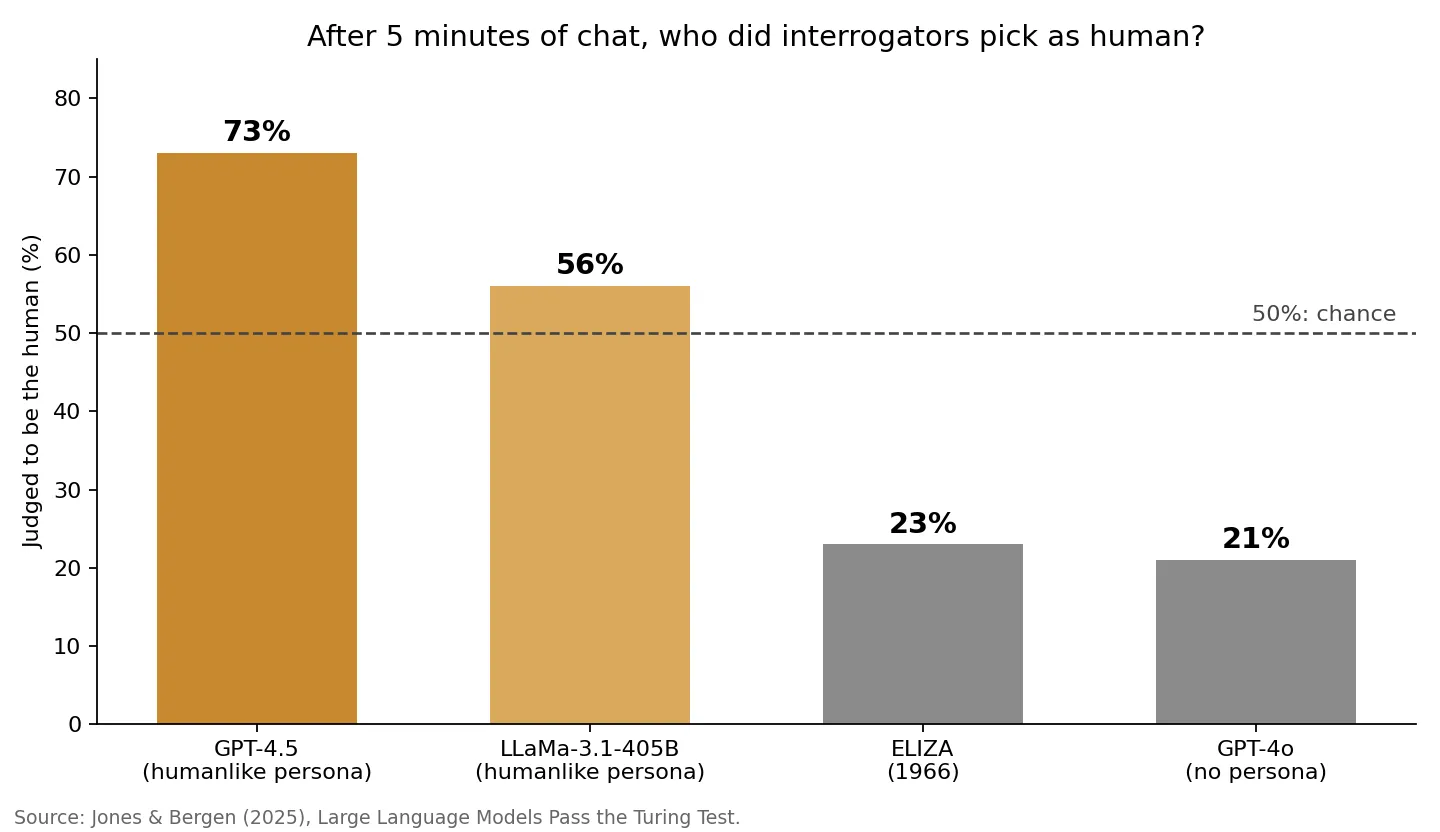
The result: when told to play a young, somewhat terse person who uses slang, GPT-4.5 was picked as the real human 73% of the time. In other words, interrogators chose the machine more often than they chose the actual person. LLaMa-3.1 scored 56%, on par with humans. ELIZA and GPT-4o without a persona prompt managed only about 20%.
By Turing’s own criterion, this is the first empirical evidence that an artificial system passes the standard three-party test. His prediction of “no more than a 70% chance of a right identification” has been surpassed by a wide margin: interrogators now do worse than a coin toss.
How were people fooled?
The most interesting detail is how interrogators made their judgements. They rarely asked knowledge questions or maths puzzles. They made small talk, asked about feelings and how the day was going, and then guessed based on style[7]. An answer that was too polished, too polite, too complete was taken for a machine. A curt reply with typos and a hint of impatience was taken for a person.
This is like spotting a scam message: not because the content is wrong, but because “that’s not how my mum writes”. Once machines learn the style, that feeling is no longer reliable. It is also why the same GPT-4.5 scored 73% with a persona but far lower without one: what decided the outcome was the performance, exactly the lesson of ELIZA.
AI passed the Turing test, so does AI think?
If Turing were alive, he might say: by my definition, yes. But most scientists today are not so quick to agree. There are three main ways of looking at it.
The Chinese room: getting it right is not understanding
In 1980, the philosopher John Searle proposed a thought experiment[4]. Imagine a person who knows no Chinese at all, sitting in a closed room with a thick rule book written in English. People outside slip sheets of paper with questions in Chinese under the door. The person inside looks up the book: “when you see this string of symbols, write that string of symbols”, and slips the answer back out.
If the book is good enough, the people outside will believe there is a fluent Chinese speaker in the room. The room passes the Turing test in Chinese. But the person inside understands nothing.
Searle concluded: a program that only manipulates symbols according to rules does not understand, however much it behaves like someone who does. Like a student who memorises the answer key: top marks, but change the questions and they are lost.
The best-known reply is the “systems reply”: the person in the room does not understand Chinese, but the whole room, person plus rule book plus paper and pencil, might. A single neuron in your head does not understand English either, and yet you do. The debate has gone on for more than forty years without a verdict.
“Stochastic parrots” and the evidence against
To understand the second view, you need a rough idea of what a large language model does. At its simplest, it does one thing: predict the next word. You type “The weather today is”, it works out which word most often comes next (“nice”, “rainy”, “sunny”), picks one, and repeats. Just like the word suggestions on your phone keyboard, except that it has read as much text as millions of books and has hundreds of billions of parameters to remember the patterns.
In 2021, the linguist Emily Bender and her co-authors called such models “stochastic parrots”[9]: they stitch together pieces of language they have seen according to probability, sounding fluent but with no connection to meaning or the real world. A parrot says “good morning” at the right time without knowing what morning is.
But “just predicting the next word” can demand more than it seems. To correctly finish “The capital of the state containing Dallas is…”, a model must know that Dallas is in Texas, and then that the capital of Texas is Austin. In 2025, researchers at Anthropic looked inside a language model and found exactly those two intermediate steps: a group of components representing “Texas” lights up first, and only then “Austin”[10]. They also found that when writing rhyming poetry, the model picks the rhyming word at the end of a line before writing that line, meaning it plans ahead instead of going word by word.
Think of someone at a market: from the outside, they just take one step at a time. But the fact that they head to the vegetable stall first and then to the butcher shows they have a list in their head. These findings do not prove the model “understands” the way people do, but they show that inside it there are structures that resemble reasoning, not just random word stitching.
Turing’s own answer
The third view goes back to Turing. He anticipated this debate in his objection about consciousness. We never know for certain whether other people “really” think. We infer it from their behaviour and accept it as a convention. If we demand that machines prove something people cannot prove to each other, we are applying a double standard.
From this angle, “does AI really think?” may be like asking “does a submarine really swim?”. Submarines move underwater very well, just not the way fish swim. Whether to call that “swimming” is a choice of words, not a scientific question.
These three views are not mutually exclusive. What they all agree on is that the Turing test measures behaviour, not what is inside. And 2025 showed that behaviour can be human enough to fool humans, while what goes on inside remains an open question.
Where AI still differs from people
Getting through five minutes of conversation does not mean AI matches people at everything. Here are a few differences users should know about.
Making up facts that sound convincing. Ask a language model about a paper that does not exist and it will sometimes still give you authors, a year and even page numbers. Researchers call this “hallucination”. The reason lies in the next-word mechanism itself: a citation that sounds like a real one is still highly probable, even when it is false. Like a lost tourist who is too shy to ask for directions and confidently gives directions to others.
Seeing text differently from us. In 2024, many well-known models miscounted the letter “r” in “strawberry”. The reason: a model does not read letter by letter but in chunks, much as we read a word by its syllables rather than spelling it out. Asking it about letters is like asking a skim reader “how many a’s were in that sentence?”. Newer models have fixed most errors of this kind, but it is a reminder that the way AI “sees” the world is not the way we do.
Puzzles that are obvious to people. In 2012, Hector Levesque and colleagues proposed another test to replace Turing’s, the Winograd schema[11]. Example: “The trophy doesn’t fit in the brown suitcase because it is too big. What is too big?” A person answers instantly: the trophy. Change “too big” to “too small” and the answer becomes the suitcase. There is no keyword for an ELIZA trick to latch onto; to answer correctly you have to understand trophies and suitcases in the real world. For a long time machines did poorly on this kind of question. Today’s large language models get most of them right, and researchers have had to invent new, harder puzzles. The chase shows one thing: every time a machine passes a test, we discover the test measured less than we thought.
How to use AI when you can’t tell human from machine
Whichever side of the philosophical debate you are on, the 2025 result has some very practical consequences.
- Don’t rely on “it sounds human”. The experiment shows that this feeling is now wrong more often than right. For an urgent call asking for money, call your relative back on their usual number, or ask a question only family would know. That is your family’s own Turing test.
- Fluent is not the same as correct. A coherent AI answer can still be wrong. For numbers, citations, health or legal advice, check the source. Treat AI like a well-read friend with a patchy memory: useful for suggestions, not good enough as a witness.
- Ask AI the way you would brief a capable person. Give enough context, break big tasks into small steps, ask for reasons. These habits help whether or not it “thinks” inside, just as clear instructions help anyone do a better job.
- Remember the ELIZA effect. When you catch yourself believing a chatbot “understands you”, think of Weizenbaum’s secretary. The feeling of being understood is real, but it says more about us than about the machine.
If you want to know why these models run on special chips, the article CPU vs GPU explains the hardware behind them. And for a very different kind of AI, one that cannot chat but only makes decisions, read the article on Jev, the AI model that doesn’t chat.
The man who asked the question
Alan Turing did not live to see his prediction come true. In 1952 he was convicted for a same-sex relationship, then a criminal offence in Britain, and was made to undergo hormone treatment. Two years later, in 1954, he passed away at the age of 41. Alan Turing: Enigma and a conviction for being gay tells this part of the story in more detail. In 2013 he received a posthumous royal pardon. Since 2021 his portrait has appeared on the Bank of England’s £50 note. Who is the father of the computer? covers his 1936 paper and the other people who made the computer.
The 1950 paper closes with a sentence that still holds: “We can only see a short distance ahead, but we can see plenty there that needs to be done”[1]. Turing did not answer the question “can machines think?”. He turned it into a question that could be tested. Seventy-five years later, machines have answered that test, and handed us back the original question, harder than ever: what is thinking, really?
Free geometry illustrations for students and teachers: EyeViz.
Tài liệu tham khảo
- [1]Alan Turing. Computing Machinery and Intelligence. Mind, 59(236), 433–460, 1950.
- [2]Joseph Weizenbaum. ELIZA: a computer program for the study of natural language communication between man and machine. Communications of the ACM, 9(1), 36–45, 1966.
- [3]Joseph Weizenbaum. Computer Power and Human Reason: From Judgment to Calculation. W. H. Freeman, 1976. The story of the secretary who asked Weizenbaum to leave the room so she could talk to ELIZA in private.
- [4]John Searle. Minds, brains, and programs. Behavioral and Brain Sciences, 3(3), 417–424, 1980.
- [5]Luis von Ahn, Manuel Blum, Nicholas Hopper, John Langford. CAPTCHA: Using Hard AI Problems for Security. EUROCRYPT 2003, 2003.
- [6]Computer AI passes Turing test in "world first". BBC News, 2014. Eugene Goostman convinced 33% of the judges at the Royal Society, London.
- [7]Cameron Jones, Benjamin Bergen. People cannot distinguish GPT-4 from a human in a Turing test. arXiv:2405.08007, 2024.
- [8]Cameron Jones, Benjamin Bergen. Large Language Models Pass the Turing Test. arXiv:2503.23674, 2025.
- [9]Emily Bender, Timnit Gebru, Angelina McMillan-Major, Shmargaret Shmitchell. On the Dangers of Stochastic Parrots: Can Language Models Be Too Big?. FAccT 2021, 2021.
- [10]Tracing the thoughts of a large language model. Anthropic, 2025.
- [11]Hector Levesque, Ernest Davis, Leora Morgenstern. The Winograd Schema Challenge. KR 2012, 2012.