Can AI think? From AlphaGo to ChatGPT
Can AI really think, or is it a statistical machine? Four tests, from AlphaGo and Lee Sedol to ChatGPT, show how far AI understands and where it breaks.
Mục lục
Move 37
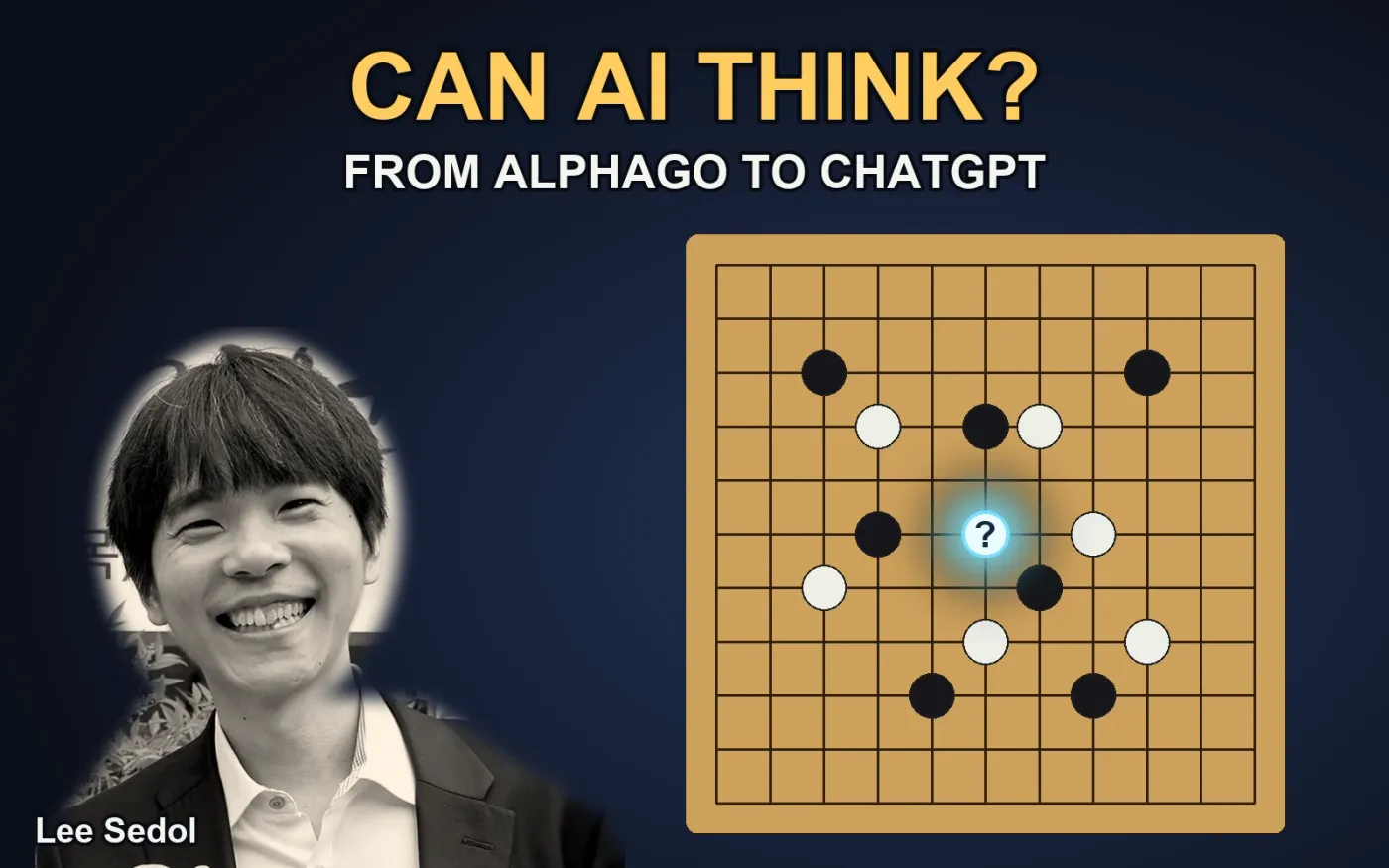
On 10 March 2016, in a hotel in Seoul, Lee Sedol stepped out of the match room for a while. When he came back, the program AlphaGo had placed its stone for move 37 on the right side of the board. Two professional commentators stopped short. One called it a very strange move. The other thought the machine had made a mistake. Lee Sedol took nearly 15 minutes to respond [1].
It was no mistake. The move turned the game, and AlphaGo won. Afterward Lee Sedol said: “Yesterday, I was surprised. But today I am speechless” [1].
Ten years later, the question from that room has reached everyone’s phone. Can AI really think, or is it just a statistical machine that is good at what it was trained to do? The short answer of this article: today’s AI really is a statistical machine, but saying so does not end the argument. It tells us what AI is made of, not what AI can do. So instead of arguing over words, we will put AI through four tests that can actually be checked: creativity, understanding a concept, knowing what it is doing, and handling a slightly altered problem.
The results do not lean firmly either way, and that lack of a clean lean says more about AI than a yes or no would.
What does “thinking” mean?
To answer, we need a definition we can test. The article on the Turing test tells how Alan Turing replaced the question “can machines think?” with a conversation test in 1950, and how John Searle objected with his Chinese room. That debate is unsettled, and AI passed the conversation test in 2025. So this article picks a different, narrower standard.
Picture two drivers in the same city. The first has memorized a thousand routes. The second carries a map in their head. On familiar routes the two drive identically, and the memorizer may even be faster. The difference appears only on the day a road is closed. The driver with the map finds another way. The memorizer is stuck.
That is the standard here: thinking shows up as the ability to carry understanding into new situations, not just performing well in the area one has trained on. This is not the only possible definition, and it says nothing about consciousness, the inner feeling of thinking. There is no reliable measure of consciousness yet, so this article does not rule on it. But the map can be tested: close a road and see what happens.
How did AlphaGo learn the game?
Go has simple rules: two players take turns placing black and white stones on a 19 × 19 board, surrounding territory and enemy stones. Yet the number of positions is so vast that no machine can go through them all. Looking a few moves ahead in the style of chess is not enough, because each turn has too many options and it is very hard to tell who is ahead. Strong players rely heavily on a feel for the position.
AlphaGo was built to imitate exactly those two abilities [2]. The first part is a neural network, a huge function with millions of adjustable knobs that are tuned gradually by data. Like someone learning to judge pho by tasting thousands of bowls, the network learned to suggest a few moves worth considering and to estimate who has the advantage. It first learned from games by strong players, then played itself millions of times [1] [2].
The second part is search: starting from the suggested moves, the program plays out many branches in its head and picks the one with the best result. The neural network is intuition, and search is calculation. A strong player likewise feels the position and also reads a few moves ahead.
In 2017, AlphaGo Zero dropped human games entirely. It knew only the rules, started from random moves, played against itself, and then beat the version that had defeated Lee Sedol by 100–0 [3]. Everything it knew about Go came from the statistics of its own games.
Keep one point in mind: AlphaGo has an absolute referee. When a game ends, you know who won, so the board punishes every mistake. This will matter later.
What does an LLM learn?
An LLM (large language model) is the kind of model behind ChatGPT, Claude and Gemini. Its core task sounds very modest: read some text and predict the next word. It is like a fill-in-the-blank game: “Paris is the capital of …”. Repeat that word by word, and it writes sentences and whole articles.
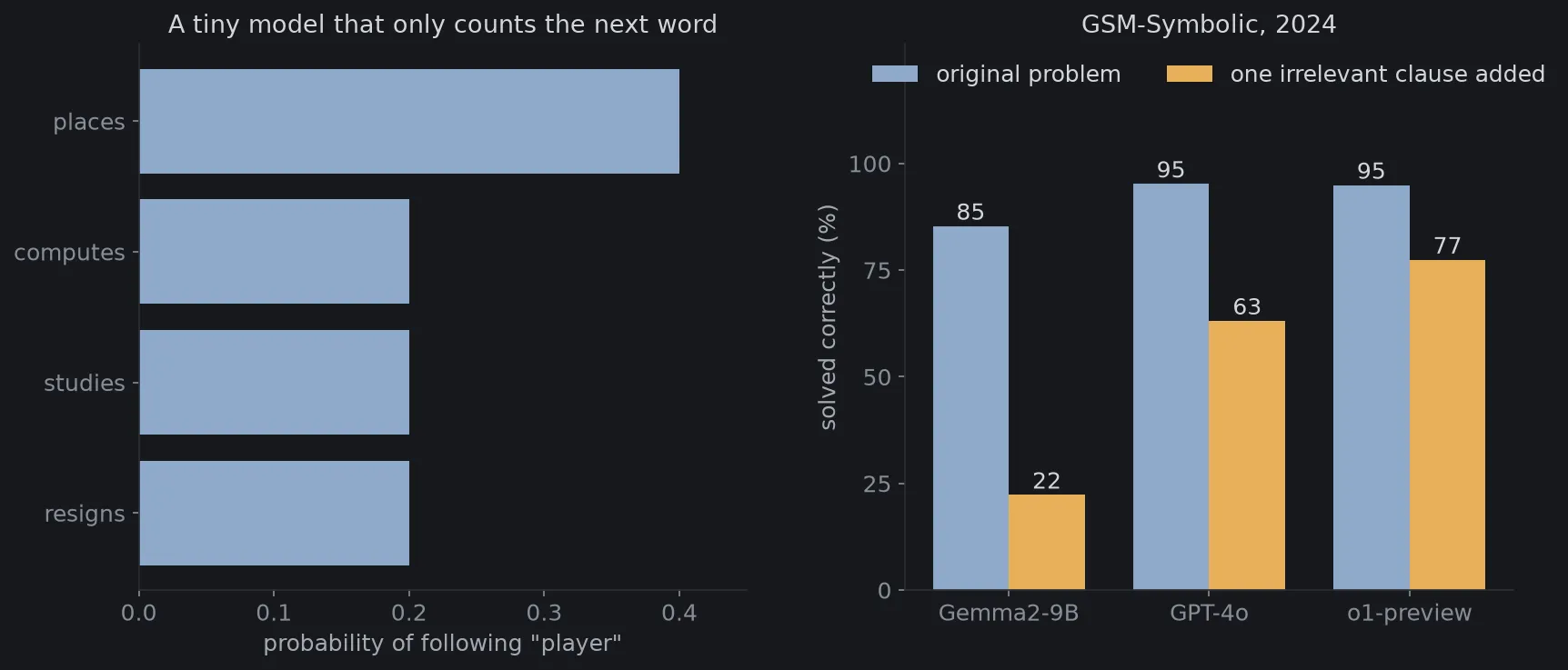
To predict well, the model tunes billions of parameters over an enormous amount of text. Each word becomes an arrow in a many-dimensional space, as the article on cosine similarity describes, and the model learns relationships among arrows across long passages. The left of Figure 1 is a crude miniature that I ran myself: a model that only counts which word tends to follow which. Real LLMs are far apart from it in scale and in how they learn, but they share one goal: predict what comes next.
My tiny model read ten sentences about Go, then wrote: “white stone surrounds black stone”. That reads fine, yet the model has no idea what a stone is and no way to check whether the sentence is true. In 2021, Emily Bender and colleagues called LLMs “stochastic parrots”: they stitch together patterns they have seen according to probability, without being tied to meaning [10].
The board has a referee, words do not
When AlphaGo loses, it knows. An LLM has no such referee. In training, it is scored on whether the predicted word matches the original text, meaning what people once wrote, not what is true. A false sentence written smoothly is still a very predictable sentence. It is like a student learning from model essays: the essay scores well for resembling the model, not because the student has checked each claim.
This explains something every chatbot user has met: a model can be wrong in a very confident voice. On a board, a confident wrong move is punished at once. In words, nothing punishes it.
So research labs are trying to bring AlphaGo’s “reading ahead” into LLMs. Reasoning models write out intermediate steps before settling on an answer, like someone working on scrap paper before handing in a test. According to Google, Gemini Deep Think explores and combines several possible solutions simultaneously rather than following one linear chain of thought, and it was further trained with reinforcement learning on theorem-proving data [9].
In 2025, that model reached gold-medal standard at the International Mathematical Olympiad: it solved five of six problems for 35 of 42 points, graded by the organizers, written in natural language within the 4.5-hour limit [9]. That is hard to dismiss as copying. “Parrot” is not the whole story.
In my view it is no accident that one of the clearest achievements of LLMs is in mathematics. A proof can be checked as right or wrong, so mathematics sits closer to a board game than any other use of language. Ask about an obscure detail of history and no board stands ready to punish a wrong answer. So to see how far AI understands, we cannot only watch it win. We need tests that move it out of familiar territory.
Test 1: Is AI creative?
Back to move 37. David Silver, the lead researcher, said AlphaGo itself calculated about a one-in-ten-thousand chance that a human would play that move. It played it anyway, because what it had learned through self-play and look-ahead pointed to a good move [1]. In other words, the part imitating humans said “nobody plays that”, and the rest said “play it”.
Fan Hui, the European champion who had lost to AlphaGo, reacted with disbelief at first, then looked again and kept saying: “So beautiful. So beautiful” [1]. Michael Redmond called the move creative and unique [4]. In later years Go itself changed: Lee Sedol says AI overturned centuries of tradition, such as early invasions of the corner, which players now use routinely [5].
Test result: pass, in a narrow sense. Move 37 was not copied from any game, and it was useful. But “new” does not mean “understood”. Natural selection also produces new designs without any thought. To find out whether AlphaGo has a map, we must close a road.
Test 2: Does AI understand concepts?
Game 4, 13 March 2016. Lee Sedol had already lost the match and stood in a difficult position. He thought for about 30 minutes and then played move 78, a wedge in the middle of the board. Demis Hassabis said AlphaGo did not foresee it because it estimated a human had only about a one-in-ten-thousand chance of playing it [1]. Another report gives 0.007%, so treat this as an order of magnitude, not an exact number [5]. AlphaGo’s reply was very poor, and from move 87 it played a series of clearly weak moves before resigning [4]. The player Gu Li called move 78 a “divine move” [4].
In a 2025 memoir, Lee Sedol tells it differently from the legend. He says the decisive move was 68, one he would never play against a human, and that “every move from 68 to 78 was a trick” [5]. He had not found a truth of Go. He had found a place AlphaGo could not see. You could say he had closed a road.
Seven years later, the story repeated much more clearly. In 2023, Tony Wang, Adam Gleave and colleagues trained an AI whose only job was to attack KataGo, a strong Go program available to everyone. The attacker won more than 97% of games against KataGo at superhuman settings [6]. The strange part is that it did not play good Go. It lured KataGo into a cyclic encirclement: a group of stones gets surrounded while appearing safe. KataGo did not defend, as if it could not see that its group was in danger.
The next detail is the one to think about. This attacker loses even to amateur players. Amateurs beat the attacker, the attacker beats KataGo, and KataGo beats professionals, like a round of rock-paper-scissors. And once human experts understood the cyclic trick, they used it themselves, with no help from a machine, to beat superhuman AIs consistently [6]. People picked up the idea and carried it elsewhere, while KataGo, even after training against the attack, could still be exploited by new variants [6].
Test result: not passed, at least by this generation of Go AI. A beginner knows that a fully surrounded group is in danger, whatever its shape. A program stronger than professionals could miss that for an unusual shape. This is the driver who has memorized a million routes and still gets stuck at one closed road.
Test 3: Does AI know what it is doing?
Ask an LLM “what is 36 + 59?” and it answers 95. Ask how, and it describes the familiar column method: 6 plus 9 is 15, write the 5 and carry the 1.
In 2025, researchers at Anthropic looked inside the Claude model as it did this sum, and found something else. The model uses several parallel paths: one estimates the rough size of the answer, another works out the last digit, and the two combine. It does not work the way it says it does, and according to the study it seems unaware of its own method [7]. The same study shows that the model sometimes gives plausible-sounding calculation steps it never carried out [7].
It is like a skilled mental calculator who, asked for the secret, recites the textbook rule while their mind works another way. In fairness, people do not always know how they think either: you recognize a close friend’s face instantly, yet could hardly explain the steps. Our own explanations are often built after the fact.
Test result: not passed, and humans do not fully pass either. The difference is that an LLM’s explanation is so fluent that it invites belief. When AI “shows its thinking”, that may be real thinking, or just text that sounds like thinking.
Test 4: Change the problem slightly
This is the most direct test of the map standard. In October 2024, a research group at Apple built GSM-Symbolic from school math problems, then changed names, changed numbers, or added a clause that sounds relevant but does not affect the answer [8]. Here is the example they give:
Oliver picks 44 kiwis on Friday. Then he picks 58 kiwis on Saturday. On Sunday, he picks double the number of kiwis he did on Friday, but five of them were a bit smaller than average. How many kiwis does Oliver have?
Fruit size does not change the count, so the answer is . Many models subtracted 5 and got 185. A student might stumble too, but would not lose half their marks across a whole test because of it.
The right of Figure 1 gives the numbers: with such extra clauses, GPT-4o falls from 95% correct to 63%, the open model Gemma2-9B from 85% to 22%, and o1-preview, a step-by-step reasoning model, from 95% to 77% [8]. The authors conclude that the reasoning of these models is fragile and “may be more akin to sophisticated pattern matching” than true logical reasoning [8].
Read the third column of the chart together with the 2025 milestone above. o1-preview falls much less, and just a year later a model reached gold-medal standard in mathematics. The 2024 figures are a snapshot, not a permanent limit. Still, the study shows a kind of failure worth testing on the model you use today.
Test result: partial pass, and improving.
What do the four tests say?
| Test | Evidence | Result |
|---|---|---|
| Creativity | Move 37, new Go strategies | Pass, in a narrow sense |
| Understanding concepts | Move 78, the cyclic trick against KataGo | Not passed |
| Knowing what it is doing | The sum 36 + 59 | Not passed, humans not fully either |
| Slightly altered problems | GSM-Symbolic, IMO 2025 | Partial pass, improving |
The table shows that “statistics” and “thinking” do not exclude each other. The human brain is also cells passing signals, and nobody can read meaning from one neuron, so the fact that AI is built from matrix multiplication does not prove it cannot think. Equally, fluent speech does not prove that it understands.
The clearest difference is the shape of the ability. Human ability is fairly smooth: being good at one level usually means not failing at easier levels. Today’s AI ability is jagged: it can outdo the best in the world, then fail at something a child would not. That jaggedness is evidence that it does not work like us inside, even when it gives the same answers on the outside.
Why do people still need to supervise AI?
The four tests lead to a very practical conclusion: with today’s AI, people still need to sit in the referee’s chair, for three reasons.
AI cannot reliably tell when it is wrong. On a board, the rules do the scoring. In a report, a contract or a diagnosis, no such board exists. Test 3 shows that a model’s smooth explanation does not guarantee the steps really happened, so someone must compare the output with reality.
AI’s errors fall in hard-to-predict places. A new employee usually makes mistakes on hard tasks. AI may finish a hard task and trip on an easy one, like KataGo against the cyclic trick. It was people who understood that blind spot and learned to exploit it [6].
Responsibility still rests with people. In 2022, after a passenger’s grandmother passed away, an Air Canada chatbot gave wrong information about the bereavement fare policy. In the dispute, the airline argued that it should not be liable for information given by the chatbot. In 2024, a tribunal in British Columbia rejected that argument and ordered compensation [12]. A machine can draft the answer, but the person or organization using it has to put their name to it.
None of this means AI is useless, and it does not prove that AI could never replace people. Nobody can measure the future yet. It only says that while AI’s abilities remain jagged, handing everything to the machine in places with consequences is a risky decision. Lee Sedol, who sat across from the machine, reached a similar conclusion: humans need to work with AI to create something new [5]. Supervision here has to mean real checking, not a quick glance and a click on approve.
Three common misunderstandings about AI
“It’s only statistics, so it doesn’t matter.” Statistics at scale produced move 37 and Olympiad-level solutions. The label “statistics” describes a method, not the limits of the result. Underestimating AI is exactly the mistake Lee Sedol warns of in his memoir: people are repeating his failure to anticipate how fast AI improves [5].
“Fluent speech means understanding.” Language is the signal we use to judge each other. Someone who speaks coherently usually understands. With LLMs that inference is no longer safe, as Test 3 shows. The article on the Turing test tells how people were fooled as far back as 1966 by a very simple program.
“Good at one thing means good at everything.” KataGo is stronger than professionals, yet lost to a trick experts could learn. A model that solves Olympiad problems can still invent a citation. Doing well on a test does not say it can be trusted with your work. You would not hand your car to a driver who has only memorized routes and never met a closed road.
Build a word-prediction model yourself
The Python below builds the tiny model described above: it reads ten sentences, counts which word follows which, then writes on by drawing words at random according to probability. It also puts the GSM-Symbolic figures on a chart and draws Figure 1. The seed is fixed at 42. You need numpy and matplotlib. This illustrates the idea of next-word prediction, not how a real LLM is built.
from collections import Counter, defaultdict
import matplotlib.pyplot as pltimport numpy as np
plt.rcParams.update({"figure.facecolor": "#16181c", "axes.facecolor": "#16181c", "text.color": "#d4d7dc",                     "axes.edgecolor": "#2a2e35", "axes.labelcolor": "#a4a9b2",                     "xtick.color": "#878d97", "ytick.color": "#878d97", "font.size": 12})rng = np.random.default_rng(42)
# Part 1: a tiny language model that only counts which word tends to follow whichTEXT = """player places black stone on board .player places white stone on board .machine places white stone on board .machine computes next move very fast .player computes next move very slowly .black stone surrounds white stone .white stone surrounds black stone .player studies board very slowly .machine studies board very fast .game ends when player resigns .""".split()
counts = defaultdict(Counter)for word, next_word in zip(TEXT, TEXT[1:]):    counts[word][next_word] += 1

def predict(word):    """Probability of each word that can follow `word`, based only on the counts."""    total = sum(counts[word].values())    return {w: c / total for w, c in counts[word].most_common()}

def write_on(word, length=12):    """Generate a sentence: each step draws a word at random by probability. No notion of true or false."""    sentence = [word]    while len(sentence) < length and sentence[-1] != "." and counts[sentence[-1]]:        options = predict(sentence[-1])        sentence.append(rng.choice(list(options), p=list(options.values())))    return " ".join(sentence)

print("after 'player':", {w: round(p, 2) for w, p in predict("player").items()})for start in ("player", "machine", "black", "white", "black", "white"):    print("machine wrote:", write_on(start))print("after 'cat':", predict("cat") if counts["cat"] else "never seen, nothing to predict")
# Part 2: accuracy (%) in the GSM-Symbolic study, before and after adding one irrelevant clauseGSM = {"Gemma2-9B": (85.3, 22.3), "GPT-4o": (95.2, 63.1), "o1-preview": (94.9, 77.4)}for name, (original, added) in GSM.items():    print(f"{name}: {original}% down to {added}%, a fall of {original - added:.1f} percentage points")
# Plotfig, (ax, ax2) = plt.subplots(1, 2, figsize=(13, 5.2), gridspec_kw={"wspace": 0.26})options = predict("player")ax.barh(list(options)[::-1], list(options.values())[::-1], color="#8fa9c9")ax.set_xlabel("probability of following \"player\"")ax.set_title("A tiny model that only counts the next word", color="#d4d7dc", fontsize=13)ax.set_xlim(0, 0.45)positions = np.arange(len(GSM))ax2.bar(positions - 0.19, [v[0] for v in GSM.values()], 0.38, color="#8fa9c9", label="original problem")ax2.bar(positions + 0.19, [v[1] for v in GSM.values()], 0.38, color="#e8b05a", label="one irrelevant clause added")for x, (a, b) in zip(positions, GSM.values()):    ax2.text(x - 0.19, a + 1.5, f"{a:.0f}", ha="center", color="#d4d7dc")    ax2.text(x + 0.19, b + 1.5, f"{b:.0f}", ha="center", color="#d4d7dc")ax2.set_xticks(positions, list(GSM))ax2.set_ylim(0, 128)ax2.set_yticks(range(0, 101, 25))ax2.set_ylabel("solved correctly (%)")ax2.set_title("GSM-Symbolic, 2024", color="#d4d7dc", fontsize=13)ax2.legend(frameon=False, loc="upper center", ncol=2)for a_ in (ax, ax2):    for sp in ("top", "right"):        a_.spines[sp].set_visible(False)fig.savefig("doan-tu-tiep-theo-en.png", dpi=150, bbox_inches="tight")
Output:
after 'player': {'places': 0.4, 'computes': 0.2, 'studies': 0.2, 'resigns': 0.2}machine wrote: player studies board very slowly .machine wrote: machine studies board very fast .machine wrote: black stone .machine wrote: white stone .machine wrote: black stone on board .machine wrote: white stone surrounds black stone .after 'cat': never seen, nothing to predictGemma2-9B: 85.3% down to 22.3%, a fall of 63.0 percentage pointsGPT-4o: 95.2% down to 63.1%, a fall of 32.1 percentage pointso1-preview: 94.9% down to 77.4%, a fall of 17.5 percentage pointsThe line about “cat” is the one to look at. Faced with that word, this model has nothing to say, because it only has the roads it has already traveled. Real LLMs have moved far beyond that limit by representing words as arrows, so they can generalize to sentences they have never seen. The question of this article is how far that generalizing goes.
Back to Lee Sedol
In November 2019, Lee Sedol retired, saying that even if he became number one, “there is an entity that cannot be defeated” [11]. That is what he said in public, and it should not be read as the sole cause behind a whole career’s end. In his memoir, he says the loss he regrets most is Game 5, because he felt bad about winning Game 4 with a trick [5].
A machine does not regret like that, or at least nobody has measured it doing so. AI can find move 37. It has not yet shown that it knows what it just did. The rest of the question may not lie on the board at all: if AI one day passes all four of these tests, we will have to decide what the word “thinking” means, rather than wait for a machine to answer for us.
Free geometry illustrations for students and teachers: EyeViz.
Tài liệu tham khảo
- [1]Cade Metz. In Two Moves, AlphaGo and Lee Sedol Redefined the Future. WIRED, 2016.
- [2]D. Silver et al.. Mastering the game of Go with deep neural networks and tree search. Nature 529, 484–489, 2016.
- [3]D. Silver et al.. Mastering the game of Go without human knowledge. Nature 550, 354–359, 2017.
- [4]AlphaGo versus Lee Sedol. Wikipedia.
- [5]Grandmaster Lee Se-dol reveals how he beat AlphaGo: 'Every move was a trick'. Korea JoongAng Daily, 2025.
- [6]T. T. Wang, A. Gleave et al.. Adversarial Policies Beat Superhuman Go AIs. ICML 2023, 2023.
- [7]Tracing the thoughts of a large language model. Anthropic, 2025.
- [8]S. Mirzadeh et al.. GSM-Symbolic: Understanding the Limitations of Mathematical Reasoning in Large Language Models. arXiv, 2024.
- [9]Advanced version of Gemini with Deep Think officially achieves gold-medal standard at the International Mathematical Olympiad. Google DeepMind, 2025.
- [10]E. M. Bender, T. Gebru, A. McMillan-Major, M. Mitchell. On the Dangers of Stochastic Parrots: Can Language Models Be Too Big?. FAccT 2021, 2021.
- [11]South Korean Go master retires, says AI cannot be defeated. Global News, 2019.
- [12]Moffatt v. Air Canada, 2024 BCCRT 149. Civil Resolution Tribunal, British Columbia, 2024.