What is Jev? The AI model that decides instead of chatting
What TypeSafe AI’s Jev is, why not chatting makes it far faster and cheaper than LLMs, how it compares with larger models, and how to use Jev effectively.

Mục lục
Jev is an AI model released by TypeSafe AI (San Francisco) on 15 September 2026. Unlike ChatGPT or Claude, Jev does not write text. You give it a situation and a few questions with predefined answers, and it returns a choice with probabilities, for example “good news: 82%, neutral: 15%, bad news: 3%”. Because it skips writing entirely, Jev answers in under half a second, at a price tens to hundreds of times lower than leading large language models (LLMs)[1].
This article explains why “not being able to chat” is an advantage, how Jev compares with larger models, and most importantly: how to use Jev effectively, including if you are an investor who wants it to filter the news.
An AI that can’t talk
Imagine you follow 50 stocks, and every day there are a few hundred news items about them. For each item, you only need to know three things:
- Is this news good, neutral or bad for the company?
- How big is the impact?
- Do you need to be alerted right away?
You could use ChatGPT for this, but it is wasteful. It will write a polite explanatory paragraph, take a few seconds each time, charge you for every word it writes, and occasionally answer in the wrong format and break your program. You don’t need a paragraph. You need three short answers.
Jev was built for exactly this kind of job. You pass in a state, here the text of the news item, and some typed questions. Jev has three question types[2]:
| Question type | Use it when | Jev returns |
|---|---|---|
| Choice | Picking one of several options | The chosen option, the probability of each option |
| Score | Placing the situation on an ordered scale | A score on the scale, the probability of each level |
| Noul | Asking a yes/no question | The probability the answer is “yes”, from 0 to 1 |
For a news item like “Company X reports a sharp rise in Q3 profit, beating its full-year target”, Jev returns: Choice “good” with high probability, Score high on the impact scale, and Noul “alert now” close to 1. Not a single wasted word. Your program reads those answers directly and decides what to do next.
Why is Jev faster and cheaper than larger models?
LLMs spend money on “writing”, not “reading”
Every time you call an LLM such as GPT, Claude or Gemini, it does two things:
- Reads your question. This runs in parallel: the whole question is processed at once, so it is fast and cheap.
- Writes the answer. This runs sequentially: the model writes one token at a time (a token is a piece of text, roughly part of a word), and it must finish one token before writing the next. Every token is a full run of the model.
So most of the waiting time and the money go into writing. That is also why providers charge several times more for output tokens than for input tokens. Reasoning models even “think” through thousands of hidden tokens before answering, so a simple question can take tens of seconds.
Jev only reads, then scores
Jev drops writing altogether. TypeSafe has not published its architecture, but independent analyses suggest Jev reads the situation once, then scores every option at the same time, and turns those scores into probabilities[4]. TypeSafe’s CEO has said strings are “not allowed at all” as outputs, so that every answer can be computed in parallel.
An easy picture to remember: asking an LLM is like asking an analyst to write a full report just to conclude “good news”. Asking Jev is like asking the same analyst to read it and hold up a card.
That single change gives Jev four advantages:
- Fast and predictable: response time is roughly just reading time, regardless of how long the answer would have been.
- Cheap: Jev only charges for input; output is free[2]. Classifying a million news items costs a few tens of dollars.
- Many questions, one read: all questions share a single read of the situation, instead of each one being a separate paragraph to write.
- Never the wrong format: the answer is always one of the options you provided. No JSON validation, no retries because the model drifted off-format, a hidden cost anyone using LLMs in software knows well.
There is one more advantage few people notice: probabilities come for free. To find out how “sure” an LLM is, you have to ask it many times and count, or let it say “I’m 80% sure”, a number that is often unreliable. Jev reads the probabilities straight from inside the model in the same single run.
Compared with other large models
| Leading LLMs (GPT, Claude, Gemini) | Jev | Small open-source LLMs | |
|---|---|---|---|
| Speed | Seconds to tens of seconds | Under half a second | Fast, depending on hardware |
| Cost per decision | High | Very low | Low |
| Accuracy on hard tasks | Highest | On par with mid-tier models | On par with or slightly above Jev |
| Explains its reasoning | Yes | No | Yes |
| Open-ended work, writing, arithmetic | Yes | No | Moderately |
The table shows two things. First, Jev’s advantage is largest against frontier models: in one comparison compiled by DataCamp, Jev matched the accuracy of a large OpenAI model while being about 76 times cheaper and about 25 times faster[3]. Second, that advantage shrinks a lot against small open-source models. The “read, then score” technique is not proprietary; anyone running an open model can do it, and independent tests found a few open models in the same price range slightly more accurate than Jev[6]. What Jev really sells is convenience: a clean API, three ready-made question types, and fairly good probabilities out of the box.
The price of not chatting
Dropping the writing step also drops what writing provides:
- No chain of reasoning. LLMs are good at hard problems because they get to “think on paper” step by step. Jev has to answer after a single read, like fast, intuitive thinking. TypeSafe calls Jev a “System One model”, borrowing from Daniel Kahneman’s Thinking, Fast and Slow. That is why Jev trails frontier models on hard tasks and is clearly weak at arithmetic, dates and exact literal reading.
- No explanation of why it chose what it chose, which makes it hard to audit.
- Options must be known in advance. Jev can’t answer open questions.
- Questions can’t depend on each other. If one question needs the answer to another, you have to make two calls.
The name “Jev” comes from the economist William Stanley Jevons[1], who noticed that more coal-efficient steam engines did not make Britain burn less coal. Quite the opposite: because engines became cheaper to run, they were used everywhere. TypeSafe is betting on the same effect: when each AI decision becomes hundreds of times cheaper, people will use AI for every small decision that used to be not worth paying for. The article AI and the electricity behind it (article in Vietnamese) touches on this paradox from the energy side.
How good is Jev?
TypeSafe says Jev is tens to hundreds of times faster and cheaper than leading LLMs, never produces the wrong format, and gives “calibrated” probabilities[3]. But the company has not published a technical paper or public benchmark, and it acknowledges its tests were designed by its own team[1].
Independent tests in the first three weeks paint a more balanced picture[6]:
- Accuracy on par with mid-tier LLMs, behind frontier models on hard tasks.
- Very strong on simple, high-volume tasks, such as spam filtering or ticket classification.
- Sensitive to how questions are asked: just reordering the options changed quite a few answers.
- Weaker in languages other than English. There is no public test in Vietnamese yet.
- Can be confidently wrong when the answer is not in the data you provide.
On probabilities, an audit on GitHub found Jev ranks very well (comments it scored higher really were more toxic), but the percentages themselves were far off: where Jev said about 75%, human annotators flagged only about 10%[7]. The good news is that a simple recalibration, learned from a small amount of labelled data, removed almost all of that error.
In short: Jev knows what is “more” than what, but its percentages are not necessarily real percentages.
How to use Jev effectively
This is a practical guide for anyone planning to put Jev to work, from filtering investment news to sorting email.
1. Pick the right job for Jev
Before you start, check whether your task meets three conditions:
- Known answers: you can list every possible option (good/bad, yes/no, levels 1 to 5).
- High volume: hundreds or thousands of times a day. If it is only a few times a day, just use a large LLM for accuracy.
- Speed or cost matters: it runs in the background of your software, with no one waiting to read the answer.
Don’t give Jev: financial ratio calculations, summaries, report writing, open questions, or forecasts of things that are not in the data (like tomorrow’s stock price).
2. Split big questions into small ones
Jev answers best when each question asks about one thing. Instead of asking “Is this news good and important?”, split it into two: a Choice “good/neutral/bad” and a Score for importance. All questions are answered at once in a single call, so splitting them barely adds time or cost.
Pick the right question type:
- Noul for yes/no: “Does this news mention business results?”
- Choice for unordered categories: “Which group does this news belong to: business results, personnel, legal, dividends, other?”
- Score for ordered levels: “Impact on the share price: negligible, small, moderate, large.”
3. Write clear, non-overlapping options
Because Jev only chooses from what you give it, answer quality depends heavily on how you describe the options:
- Describe each option in a concrete sentence, not a single word. “Bad: news that lowers profits, raises legal risk or damages trust in management” is much better than “bad”.
- Keep options from overlapping. If an item could be both “legal” and “personnel”, use two separate Noul questions instead of one Choice.
- Always include an “other” option. Otherwise Jev is forced to pick a wrong option confidently.
- For Score, describe every level, not just “1 to 5”. What each level means should be clear enough that two people reading the same item would pick the same level.
4. Give it the right information, nothing extra
Jev struggles with long texts full of irrelevant information. So:
- Pass only what is needed: the headline and the first few paragraphs, not the whole web page.
- Split the information into clear fields (ticker, headline, body, publication date), and refer to those field names in your questions.
- If the answer depends on a computed number (such as profit growth), compute it yourself in code and pass it in, rather than asking Jev to calculate.
5. Test how robust your questions are
Since Jev is sensitive to wording, run two quick tests before going live:
- Reorder the options and run again on the same data.
- Rephrase the question in a different way with the same meaning.
If the answers change a lot, your question isn’t clear enough. Go back to step 3.
6. Measure on your own data
This is the most important step, especially for languages other than English, such as Vietnamese, where no public test exists yet. Take a few hundred real samples (say, 300 news items), label the correct answers yourself, and compare them with Jev’s answers. You will learn three things: how often Jev is right, which kinds of items it gets wrong, and whether its probabilities match reality.
Redo this measurement whenever you change your questions or the model version. In production, pin the model version (TypeSafe lets you choose a specific version instead of always using the latest), so results don’t change without warning.
7. Trust the ranking, be careful with the percentages
With the data from step 6, you can:
- Use the probabilities to rank, for example to sort news from most to least worth reading. Jev does this well.
- Choose thresholds from data, not from round numbers. Don’t assume “above 90% means certain”. Check at which threshold Jev is actually right often enough for your needs.
- Recalibrate the probabilities if you need to use the numbers in further calculations (see the last section).
8. Combine Jev with large LLMs and humans
The most effective setup is usually not “Jev replaces the LLM”, but each doing what it does best:
- Jev filters: it runs on all the data and discards most of what doesn’t matter, for a few cents.
- A large LLM thinks: cases where Jev is unsure (middling probabilities) or that are very important go to a large LLM for careful analysis, with explanations.
- A human decides: reading only the few cases left at the end.
Finance projects built on Jev on GitHub follow the same idea: Jev judges, code executes. Jev answers narrow questions, while the decision to place an order belongs to a fixed set of rules with clear risk limits[10].
Jev from an investor’s point of view
A valuation story full of expectations
TypeSafe launched Jev together with a funding round valuing the company at about US10 billion[9], and Bloomberg described Jev as an “AI model that can’t chat” taking on bigger rivals[8].
The question a careful investor should ask is where the moat is. As noted above, the core technique is not proprietary. Less than ten days after Jev, the community already had similar models such as Laya, with weights published on Hugging Face[11]. The big labs could also easily launch a cheap “probabilities only” mode. For now, most of Jev’s value lies in expectations.
Don’t use the raw percentage to decide how much money to put in
In investing, probabilities are used not only to decide whether to buy, but also how much to buy. Many position-sizing rules, such as the Kelly criterion, say the higher the probability of winning, the bigger the bet. If a model is overconfident, you will bet far more than your real edge justifies.
The figure below simulates this with a synthetic model: it ranks bets perfectly, but its probabilities are exaggerated, just like what the independent audit found in Jev.
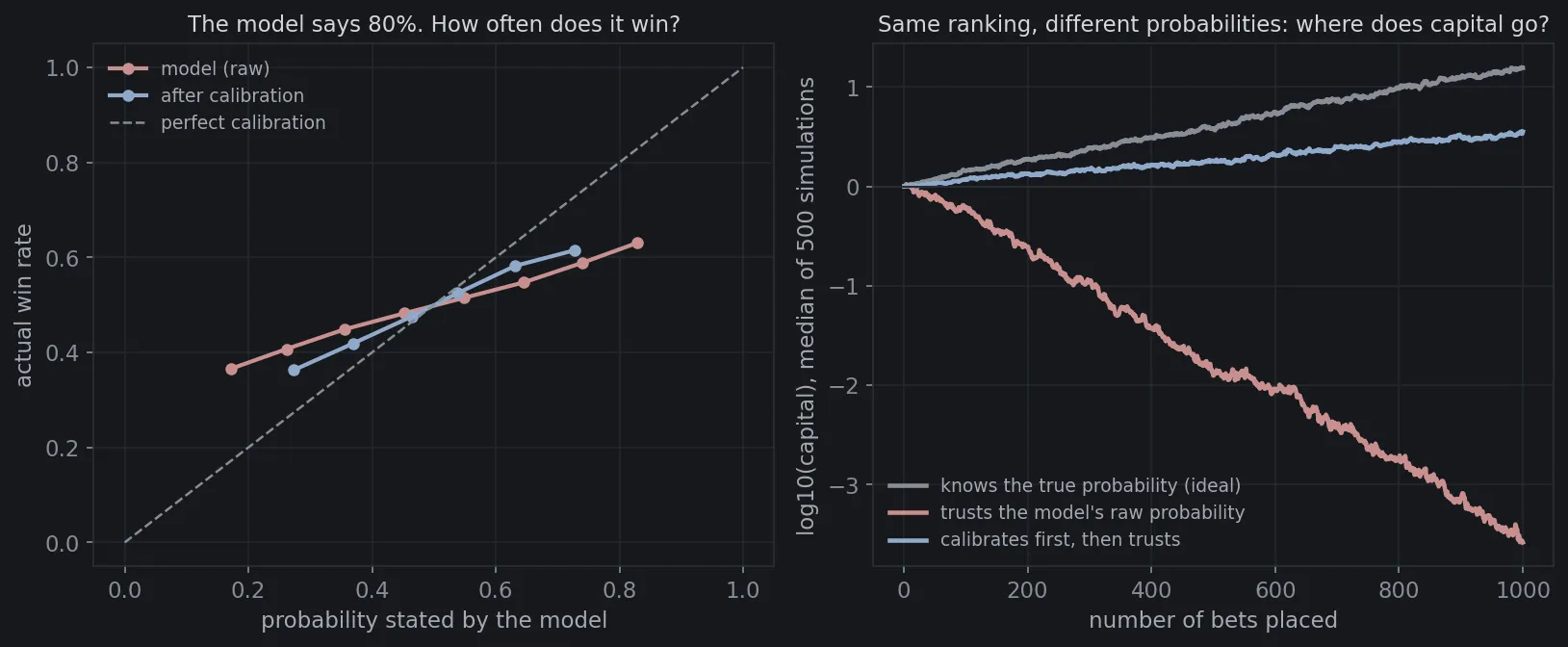
Same model, same ability to pick bets. Those who trust the raw numbers lose almost everything, because the real edge is small while the bets are too large. Those who calibrate first (using part of the data to learn what “the model says 70%” really means) still make money, though less than the ideal, because calibration learned from limited data still has errors. This is another form of regression to the mean (article in Vietnamese): extreme estimates from little data are usually more extreme than the truth.
Three rules follow:
- Use the ranking first, the numbers second.
- Recalibrate on your own data, and recheck regularly.
- Bet smaller than the formula suggests. Many professional investors use only half the Kelly amount, precisely because they know their probabilities are never perfectly accurate.
Conclusion
Jev is not fast and cheap by magic. It drops writing, the slowest and most expensive part of an LLM, and keeps only reading and choosing. In exchange, it gives up long reasoning, explanations and open-ended answers.
That is why Jev does not replace large models; it works as a fast filtering layer in front of them: classifying, scoring and routing millions of small decisions at a very low price. Using it well means picking the right job, asking clear questions, measuring on your own data, and always remembering one thing: when a model says “80%”, ask 80% of what, measured on which data?
Tài liệu tham khảo
- [1]Jev (AI model). Wikipedia, 2026.
- [2]Flavio Copes. How to use Jev with Python, 2026. API usage, pricing and rate limits as of September 2026.
- [3]Jev: TypeSafe’s System One Model Explained. DataCamp, 2026.
- [4]Victor Dibia. How Jev works: calibrated decision models, 2026.
- [5]What is Jev?. Browserbase, 2026.
- [6]xbill. Jev After Eight Days of Independent Tests: Level With Mid-Price LLMs, Behind the Frontier. DEV Community, 2026. A review of 14 arXiv preprints, 104 GitHub repositories and 33 articles evaluating Jev.
- [7]Adilmp. Does Jev confidence mean anything? A calibration audit of TypeSafe’s Jev. GitHub, 2026.
- [8]Jev, an AI Model That Can’t Chat, Takes On Bigger Rivals. Bloomberg, 2026.
- [9]TypeSafe AI’s Jev Model Attracts $10 Billion Valuation Amidst AI Cost Concerns. GuruFocus, 2026.
- [10]drillan. Jev (TypeSafe System One) finance & trading projects — surveyed 2026-09-20. GitHub Gist, 2026.
- [11]Jev, Laya Go Viral: New Class of AI Models Sweeps Silicon Valley. x-cmd, 2026.