Collatz conjecture: why does 27 take so long to reach 1?
The Collatz conjecture has just two rules, yet no general proof. Follow 27 through 111 steps to see why checking examples is not the same as proving a claim.

Mục lục
Take the number 27. If it is even, divide it by 2. If it is odd, multiply it by 3 and add 1. Repeat with the number you get, until you reach 1.
The Collatz conjecture says that every positive integer will reach 1 this way. What we do not have is a proof covering every possible starting number [1]. For 27 alone, the computed answer is 111 steps, and at one point the number on your paper climbs to 9,232.
That is quite a detour for a two-digit number. We know how to carry out each step, but not how to guarantee that every journey ends at 1. The results for 27 come from the Python code near the end of this article.
Before looking at why this is hard, try a smaller number. No programming is needed, and neither are any formulas beyond multiplication, addition and division.
What is the Collatz conjecture? Start with 6
Write down 6. It is even, so halving it gives 3. The number 3 is odd, so multiplying by 3 and adding 1 gives 10. Keep going:
6 → 3 → 10 → 5 → 16 → 8 → 4 → 2 → 1.
Eight arrows, or eight steps. Throughout this article, applying either rule counts as one step. Multiplying by 3 and adding 1 is counted separately from the division by 2 that follows.
If you continue after 1, you get 4, then 2, then 1 again. These three numbers form a cycle: like driving around a roundabout, you return to the same place and repeat the whole route. So “reaching 1” does not mean the calculation stops working. It is the point where we choose to stop.
The problem is usually associated with the German mathematician Lothar Collatz. It is also called the 3x + 1 problem, the Syracuse problem and the Ulam problem. Different names, the same question: does every positive integer eventually enter the loop 4 → 2 → 1? [1][2]
Here, conjecture means a claim that has not been proved, not an unclear set of calculation rules. Think of having perfectly precise directions, without knowing whether every route following them leads to the same town square.
Why does starting with 27 mean such a long wait?
Start with 27, and the first stretch does not look too troubling:
27 → 82 → 41 → 124 → 62 → 31 → 94 → 47 → 142 → 71…
After one division by 2, the number is odd again. Multiply by 3 and add 1, and it climbs higher than before. Looking at just the first ten steps, you might think you are heading the wrong way.
The number keeps rising and falling. At one point it reaches 1,822, drops, then climbs even higher. At step 77 it hits 9,232. Not until step 96 does it first fall below its starting value of 27. Finally, at step 111, it reaches 1.
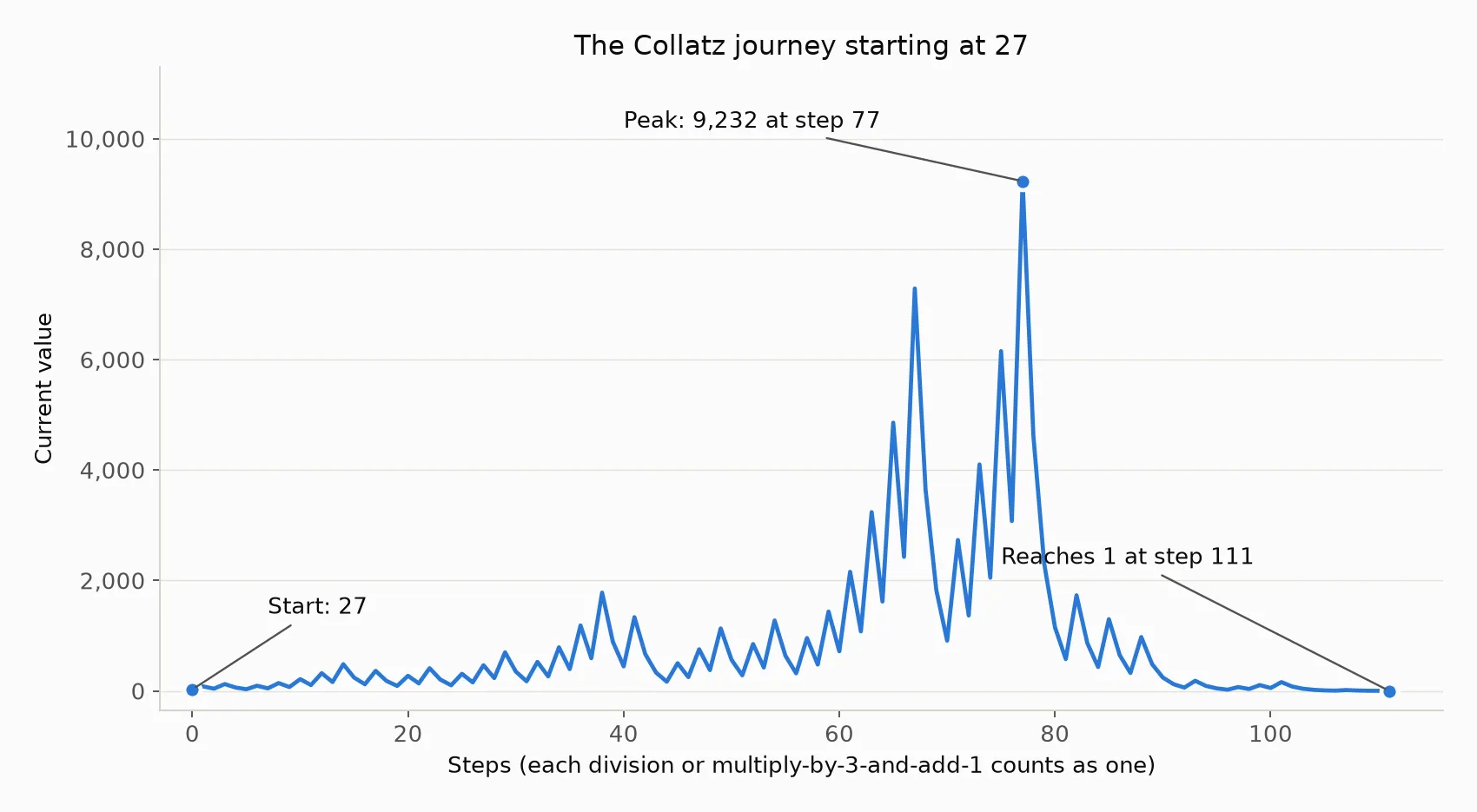
Imagine a staircase with a button to move down and another to launch you upward. Sometimes you descend several steps in a row. But at certain steps, the launch button sends you much higher. Knowing there is a way down is not enough to conclude that you will eventually reach the ground floor.
The unpredictability also shows up in neighboring starting numbers. I ran the same rules for a few starting points and got this table:
| Starting number | Steps to first reach 1 | Largest value reached |
|---|---|---|
| 6 | 8 | 16 |
| 7 | 16 | 52 |
| 26 | 10 | 40 |
| 27 | 111 | 9,232 |
| 28 | 18 | 52 |
| 97 | 118 | 9,232 |
From 26 to 27, the starting number increases by just 1, but the journey takes 101 more steps. From 27 to 28, the journey gets shorter again. A larger starting number does not necessarily take longer to reach 1.
This is not a dice game. A fixed starting number always produces the same result. It feels unpredictable because we do not have a simple way to read the arrival time from the size of the starting number alone.
Where different roads merge
There is a way to save effort when testing Collatz. You do not have to recalculate a stretch you already know.
For example, starting at 3 gives:
3 → 10 → 5 → 16 → 8 → 4 → 2 → 1.
Starting at 6 takes you to 3 in the first step. From there, the rest of the route is already known. It is like two people coming out of different side streets, meeting on the main road and continuing to the same bus station.
This is always true: once two journeys reach the same number, their remaining routes are identical. Every number has exactly one next step, with no choice of turning left or right. Paths can merge, but they cannot split when followed forward.
We can draw these relationships as a directed graph: each number is a dot, and each calculation is an arrow. It is a road map whose “addresses” happen to be integers. If you have read about Euler and the seven bridges of Königsberg, you will recognize the same idea of stripping away detail to keep the connections between points.
Look backward from 16. Which numbers can reach it in one step? There is 32, because halving it gives 16. There is also 5, because 3 × 5 + 1 = 16. One address can receive visitors from several roads, even though it has only one road onward.
This picture makes it tempting to believe every branch connects to 1. But a finite drawing contains only the numbers we have put into it. Drawing many branches that reach 1 does not prove there is no other branch outside the map. That is the first gap between a suggestive picture and a proof.
How can multiplying by 3 and dividing by 2 make things smaller?
An obvious argument goes like this: multiplying an odd number by 3 and adding 1 makes it even, so we can immediately halve it. There is an increase and a decrease; surely it will eventually get small.
But try 7:
7 → 22 → 11.
After multiplying by 3, adding 1 and halving once, we have gone from 7 to 11. If we divide by 2 only once, the two steps together act roughly like multiplying by 1.5. That is an increase, not a decrease.
The important point is that sometimes we can divide by 2 several times in a row. For 5:
5 → 16 → 8 → 4 → 2 → 1.
One jump up, followed by four steps down. For 3, the corresponding stretch is only 3 → 10 → 5. Both start with an odd number, but the “bonus halvings” are very different.
To see this more clearly, group a round together: start from an odd number, multiply by 3 and add 1, then keep halving until you reach the next odd number. This is just a faster way to read the same journey, not a change to the rules. In this reading, 7 goes straight to 11, while 5 goes straight to 1.
A calculation that suggests an answer, but does not prove it
For now, imagine the number of halvings has this distribution: about half the rounds allow just one halving, a quarter allow two, an eighth allow three, and so on. These proportions have an arithmetic basis when odd numbers are sampled uniformly from increasingly large intervals. They are also a starting point for probabilistic models of Collatz [3].
In that model, the average number of halvings is 2. Ignoring the added 1 when the number is large enough, each round multiplies by 3 and divides by roughly two factors of 2. The trend on a multiplicative scale is 3/4, which is less than 1.
“Multiplicative” means we combine ratios rather than add changes. For example, multiplying by 1.5 and then by 0.375 gives an overall factor of 0.5625. We rise first but finish below where we started. The factor 3/4 corresponds to the average logarithmic change in the model; it is not a promise that every round reduces the number by 25%.
This is one reason the conjecture seems plausible. The path may leap upward, but repeated halvings seem to pull it down over time.
The missing piece is that a real journey does not draw a fresh random choice at every round. The next number is determined entirely by the previous one. We cannot treat the rises and falls as independent coin tosses and conclude that there are no exceptions.
It is like knowing a noodle shop sells an average of 100 bowls of phở a day. That does not guarantee there will be a bowl left when you arrive. An average-based model suggests a trend; a claim about every case requires another step of reasoning. For Collatz, that step is precisely what is missing.
Would falling below the starting number be enough?
There is a stronger idea than “it seems to decrease on average.” We do not need every step to go downward. We only need to prove that every number greater than 1 eventually falls below its own starting value.
Why would that be enough? Suppose every number smaller than 27 is already known to reach 1. If the journey from 27 reaches 23, it joins a route we already know. We no longer need to track it separately.
This is strong induction: settling a new case using all the smaller cases already settled. Imagine building an address book from smaller numbers to larger ones. A new address only needs to lead to an old address with a known route home. We do not have to reopen the entire map.
If “eventually falls below itself” holds for every number greater than 1, we can keep building that address book indefinitely. The difficulty is that this rule itself has not been proved for every number. We have reformulated the problem, not solved it [2].
A part we really can prove
For even numbers, it is easy: one division by 2 already gives a smaller number.
We can also do it for odd numbers that leave remainder 1 when divided by 4. For example:
13 → 40 → 20 → 10.
After three steps, we have fallen from 13 to 10. Try 9: 9 → 28 → 14 → 7, again smaller than the starting point.
In general, such a number has the form . For a positive integer :
Since , after three steps we are guaranteed to be lower. We set 1 aside because it is already the destination.
So far, we have dealt with even numbers and half the odd numbers. The remaining group consists of odd numbers that leave remainder 3 when divided by 4, such as 7, 11, 15 and 27. But “remaining” does not mean every number in the group is difficult: 3 reaches 1 quickly, while 27 takes a long wait.
You can keep dividing the cases by their remainders modulo 8, modulo 16, and so on, handling more cases along the way. It feels like tidying a room where every cupboard opens onto smaller compartments. More statements have been proved, but no single step closes every compartment.
This viewpoint gives another concrete conclusion. If there is a smallest number that fails to reach 1, it must leave remainder 3 when divided by 4. It cannot be even, because it would immediately fall to a smaller number. Nor can it leave remainder 1, because the three steps above would take it into the already settled territory. We know something about what a hypothetical exception must look like, but we have not ruled it out.
If Collatz is false, where could the number go?
A counterexample is a case that breaks a general claim. If someone says “every motorbike in the parking lot is black,” one red motorbike is enough. For Collatz, we need a positive integer that never reaches 1.
There are two ways it could escape, and a complete proof must block both [1][2].
The first is another loop. The journey repeats a number it has already visited without ever reaching 1. Since each next step is fixed, it circles through that loop forever. Finding such a cycle among positive integers would refute the conjecture.
The second is to continue forever without repeating. The number could rise and fall many times; each new step need not be larger than the last. But it would never revisit an old address or reach 1.
If it never repeated but also could not exceed a fixed ceiling, it would eventually run out of numbers to visit. There are only finitely many integers between 1 and any finite ceiling. A nonrepeating path must therefore eventually leave every finite region. That is the precise sense of heading to infinity, not a claim that the graph always slopes upward.
The number 27 does not illustrate this second kind of escape. It climbs very high, but then returns to 1. Reaching a very large number is not evidence that the journey will never return. Likewise, running for a long time without reaching 1 is not enough to conclude that it never will.
How many successful computer checks would be enough?
Computers are very good at the work that 27 just made us do by hand. They run the rules, store known routes and test more starting points. Computational projects checking Collatz have gone far beyond the six numbers in this article [1].
Yet however large the checked bound, infinitely many numbers remain beyond it. A million correctly printed tickets do not guarantee that the next ticket is free of errors. In mathematics, a single exception can defeat a statement containing the word “every.”
That does not make computation useless. It helps find counterexamples, refute smaller guesses and expose flaws in intuitive arguments. The table above immediately disproves “larger numbers take more steps.” The graph for 27 also disproves “the value decreases every two steps.”
The issue is the question we give the machine. “Does this number reach 1?” can be answered by running it until it reaches 1. “Do all numbers reach 1?” requires reasoning that also covers numbers we have not run.
In programming, this is also a question about termination: does a loop finish for every valid input? Think of a paperwork process where every action is precisely specified, but we are not sure every file will leave the process. Do not confuse this with saying “Collatz has been proved impossible to solve.” No such conclusion has been established for the original problem.
A useful comparison is binary search. Each round eliminates roughly half the search range. The range size is a nonnegative integer that decreases whenever the search continues, so it cannot keep decreasing forever. We have a clear measure of progress.
For Collatz, the value in hand is not such a measure, because it can increase. That is the difference between knowing how to write a loop and knowing how to prove it will stop.
Has anyone made progress toward a proof?
Yes. But we need to read exactly what each result proves, rather than stop at the word “Collatz” in the title.
In 2019, Terence Tao announced a result showing that almost every trajectory reaches small values in a precise sense. The paper was subsequently published in 2022 [3][4].
Broadly speaking, choose a threshold depending on the starting number that tends to infinity, however slowly. Tao proved that almost every starting number has a trajectory that drops below that threshold. Here, “almost every” uses a weighted way of counting called logarithmic density, not simply the usual unweighted proportion.
Imagine each number holding a voting token with weight . Larger numbers hold lighter tokens. The result says that the exceptions account for a proportion of the total weight that tends to zero as the counting range expands. This illustrates the counting method, not the entire proof technique.
Two gaps remain. A threshold that increases very slowly is still not the constant 1, so dropping below it does not mean reaching 1. And a set of exceptions with density zero can still contain numbers. For example, perfect squares become increasingly sparse among the integers, but they do not disappear.
So the result should not be described as “Tao proved that every number reaches 1, with just a few details left.” The work settles a deep part of the problem, but almost every is not every, and reaching low values is not reaching 1.
A related lesson appears in the story of Fermat and the note in the margin: a short statement may require tools far removed from what first meets the reader’s eye. With Collatz, two elementary calculations still leave a gap of that kind.
Plot the journey from 27 yourself
The Python below generates Figure 1 exactly and computes the table above. It requires matplotlib; the sequence calculation uses only Python integers. There is no randomness, so rerunning it gives the same results.
The function has a limit of 10,000 steps to prevent it from waiting indefinitely when you try another input. Reaching the limit means only that the calculation has not finished, not that you have found a counterexample. The // operator keeps division in integers, avoiding floating-point rounding errors.
from pathlib import Pathimport matplotlibmatplotlib.use("Agg")import matplotlib.pyplot as pltfrom matplotlib.ticker import FuncFormatter

def collatz(n, max_steps=10_000):    if not isinstance(n, int) or n < 1:        raise ValueError("A positive integer is required")    values = [n]    for _ in range(max_steps):        if n == 1:            return values        n = n // 2 if n % 2 == 0 else 3 * n + 1        values.append(n)    raise RuntimeError("Step limit reached; no conclusion yet")

for start in [6, 7, 26, 27, 28, 97]:    seq = collatz(start)    print(f"{start}: {len(seq) - 1} steps; maximum {max(seq)}")
seq = collatz(27)peak = seq.index(max(seq))print(f"27: peak at step {peak}; first below 27 at step "      f"{next(i for i, n in enumerate(seq) if n < 27)}")
plt.rcParams.update({    "font.family": "DejaVu Sans", "font.size": 11,    "figure.facecolor": "#fcfcfb", "axes.facecolor": "#fcfcfb",    "text.color": "#0b0b0b", "axes.labelcolor": "#0b0b0b",    "xtick.color": "#525252", "ytick.color": "#525252",    "axes.edgecolor": "#d1d1ca",})fig, ax = plt.subplots(figsize=(10, 5.5), dpi=170)ax.plot(range(len(seq)), seq, color="#2a78d6", lw=2)for step in [0, peak, len(seq) - 1]:    ax.plot(step, seq[step], "o", ms=8, color="#2a78d6",            markeredgecolor="#fcfcfb", markeredgewidth=2)ax.annotate("Start: 27", (0, 27), xytext=(7, 1400),            arrowprops={"arrowstyle": "-", "color": "#525252"})ax.annotate(f"Peak: 9,232 at step {peak}", (peak, seq[peak]),            xytext=(40, 10_200),            arrowprops={"arrowstyle": "-", "color": "#525252"})ax.annotate("Reaches 1 at step 111", (111, 1), xytext=(75, 2300),            arrowprops={"arrowstyle": "-", "color": "#525252"})ax.set(xlim=(-3, 116), ylim=(-350, 11_300),       xlabel="Steps (each division or multiply-by-3-and-add-1 counts as one)",       ylabel="Current value", title="The Collatz journey starting at 27")ax.yaxis.set_major_formatter(FuncFormatter(lambda x, _: f"{x:,.0f}"))ax.grid(axis="y", color="#e1e0d9", lw=0.6)ax.set_axisbelow(True)ax.spines[["top", "right"]].set_visible(False)fig.tight_layout(pad=1.5)output = Path("images/gia-thuyet-collatz/hanh-trinh-so-27-en.png")output.parent.mkdir(parents=True, exist_ok=True)fig.savefig(output)plt.close(fig)
Output:
6: 8 steps; maximum 167: 16 steps; maximum 5226: 10 steps; maximum 4027: 111 steps; maximum 923228: 18 steps; maximum 5297: 118 steps; maximum 923227: peak at step 77; first below 27 at step 96Try replacing 27 with 31 or 97 and comparing the paths. If you change the plotted starting number, also update the annotations that are written specifically for 27. Two journeys may begin very differently and then merge into the same final stretch. This lets you inspect the idea that “the same address means the same road home.”
Back to the sheet of paper marked 27
At the start, we only wanted to know how long 27 would take to reach 1. That question has an answer: 111 steps. After the journey, the question worth keeping is why we still cannot guarantee the same outcome for every positive integer.
We have seen that a small number can take a long detour. We have also proved that some classes of numbers must fall below their starting values. Those are genuine pieces of understanding, but they do not replace the missing part. A map showing many roads to one bus station still does not guarantee that every side street connects to it.
Collatz does not need a practical application attached to it to be worth thinking about. It puts us right on the boundary between knowing how to calculate each step and understanding what must happen after all the steps. The number 27 has made it home. A proof for every number has not.
Cover adapted from the 1984 portrait of Lothar Collatz by Wikipeter-HH. Cropped, desaturated, shaded and overlaid with text; the composite is licensed under CC BY-SA 3.0.
Free geometry illustrations for students and teachers: EyeViz.
Tài liệu tham khảo
- [1]Eric W. Weisstein. Collatz Conjecture. MathWorld, Wolfram Research.
- [2]Jeffrey C. Lagarias. The 3x + 1 Problem and its Generalizations. The American Mathematical Monthly, 92(1), 3–23, 1985.
- [3]Terence Tao. Almost all Collatz orbits attain almost bounded values. What's new, 2019.
- [4]Terence Tao. Almost all orbits of the Collatz map attain almost bounded values. Forum of Mathematics, Pi, 10, e12, 2022.