Euclid and the axiomatic method: Why does mathematics need unproved assumptions?
Why does Euclid start with assumptions? An equilateral triangle reveals the axiomatic method, the power of proof, and what a diagram can silently assume.
Mục lục
One segment, two circles, one question
Alexandria, around 300 BCE. In the collection of books associated with Euclid, the first construction asks for one thing: given a segment, construct an equilateral triangle on it. There is no need to measure angles or read a length from a ruler. What matters is a sequence of constructions and reasons.[1][3]
But if every reason needs another reason, where does the chain begin? The axiomatic method answers by stating starting assumptions, then deriving conclusions from them. Think of chess: before deciding whether a move is legal, we must agree on the rules. Axioms are not proved within the system that uses them as starting points. That does not mean we must believe them in every setting.
Euclid’s construction is short enough to follow by eye. It also contains a step that the eye accepts more readily than the argument justifies. By the end, you will see why the three sides must be equal, what is missing from the classical argument, and why a subject devoted to proof needs unproved starting points.
This is part 1 of a three-part series on the parallel postulate and non-Euclidean geometry. Part 2 follows János Bolyai and whether there is only one parallel; part 3 follows Nikolai Lobachevsky and the triangle angle sum.
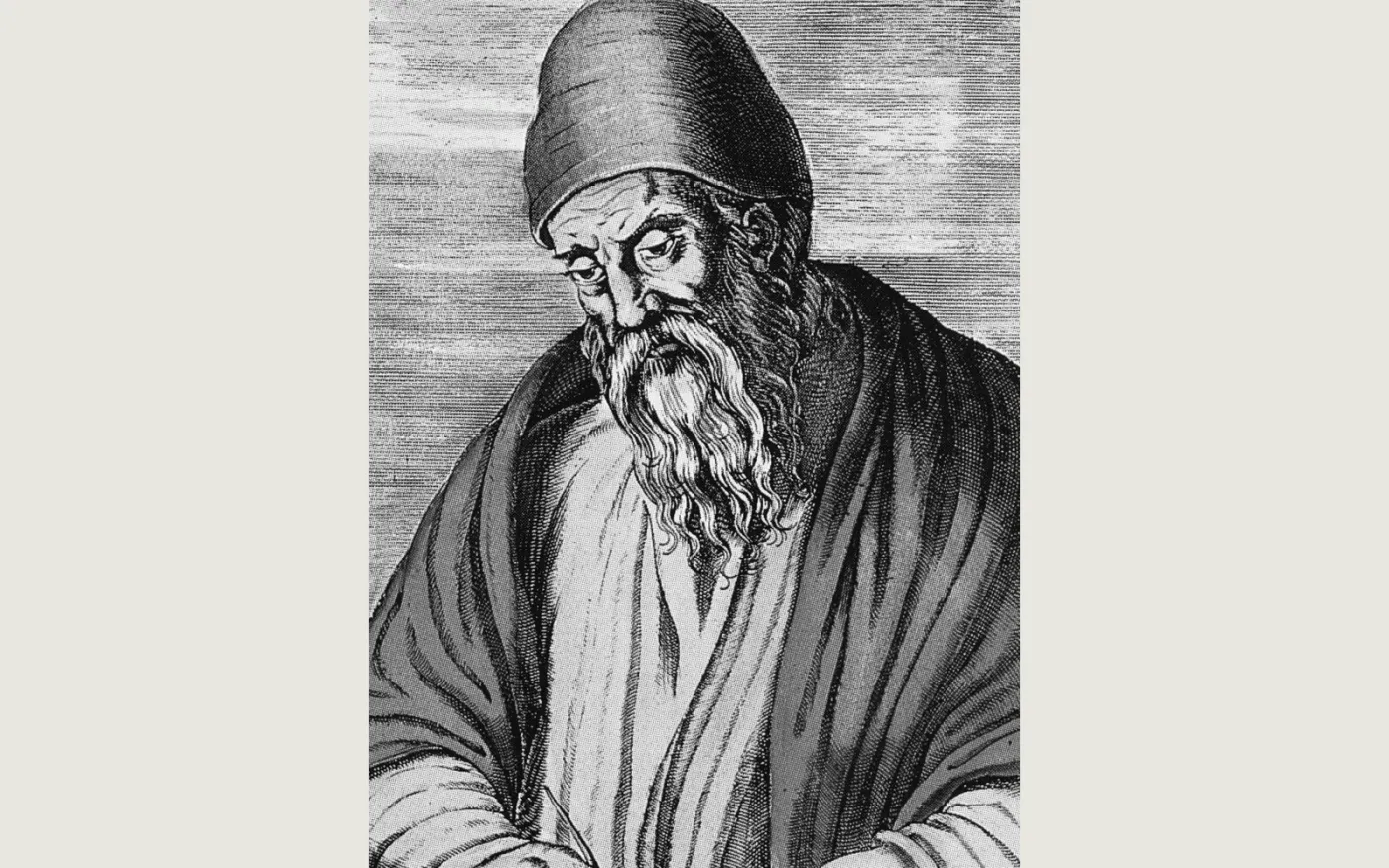
Euclid left books, but few traces of a life
We know more about the contents of the Elements than about the person who compiled them. Euclid is associated with Alexandria in Egypt. The dates of his birth and passing, and many details of his life, are uncertain. Some familiar stories were recorded centuries later, so we should not read them as eyewitness accounts.[1]
This story therefore does not recreate a lesson or a conversation in a palace. The moment we can examine is on the page: how does Euclid move from the opening assumptions to the first result?
The Elements consists of 13 books covering plane and solid geometry, proportion, and arithmetic. Many results draw on earlier work, including that of Eudoxus and Theaetetus. Euclid did not invent all this knowledge himself, nor was he the first person to use proof.[1]
What matters here is the organization. A result does not stand alone as a useful trick. It belongs to a chain: this depends on that, and that depends on stated starting points. You can trace an argument backward, much as you check each item on a receipt rather than looking only at the total.
Why is measuring a thousand triangles still not enough?
Draw a triangle on paper, measure its three angles, and add them. The result is approximately 180°. Change the triangle and repeat. The result is much the same. Small discrepancies might come from a thick pencil line or an inaccurate protractor.
Repeated measurements give us reason to believe a pattern. But the number of triangles measured is always finite. The statement “every triangle in the Euclidean plane has angle sum 180°” covers triangles never drawn, extremely small ones, and extremely large ones. A list of measurements does not by itself explain all of them.
Proof does something different: it takes assumptions to a conclusion through permitted steps of reasoning. Think of checking whether a billing formula works for every valid receipt, rather than trying a few sample receipts. A valid proof does not depend on the straightness of a pencil line or the accuracy of a ruler.
The distinction also appears in the Collatz conjecture: testing many cases can provide strong evidence, but it does not replace an argument covering every case. Proof is not repeated measurement with the word “probably” removed.
Still, a proof needs input. If we use the angle sum of a triangle to prove something else, we must know how that angle sum was established. Following the reasons backward brings us to the title’s question: do the starting points need proofs too?
Why not demand that everything be proved from nothing?
Suppose you ask a shopkeeper to explain a bill. They point to quantities, unit prices, and delivery charges. You then ask why those numbers are correct. The checking can go deeper, but to calculate anything, both sides must eventually agree on the input and the permitted operations.
A mathematical proof does not begin in a vacuum either. A deductive system has objects, assumptions, and rules of reasoning. An axiom is a statement accepted as a starting point within that system. In chess, the knight’s movement is a rule, not a move that a player must justify from previous moves.
If we prove an axiom using a new assumption, we have moved the starting point to that assumption. If we use the desired conclusion as its own reason, we argue in a circle. And in the familiar setting of finite proofs, retreating forever without accepting any input leaves us unable to begin.
This does not make every choice of axioms equally useful. We still ask whether a system contradicts itself, whether it describes the objects we want to study, and whether an assumption is needed. Writing arbitrary rules for a game does not guarantee that the game works or is worth studying.
Unproved within a system does not mean beyond questioning. We can compare sets of axioms, examine their consequences, or study them using another theory. We must simply say which ground we are standing on.
What comes before a theorem in Euclid?
Book I of the Elements opens with definitions, five geometrical postulates, and five statements called “common notions.” Propositions with proofs follow. These ancient categories do not exactly match the way modern books use the word “axiom.”[2]
A definition specifies what a name means. An equilateral triangle is a triangle with three equal sides. Think of a menu defining a “double portion” as two servings: that tells us what the label means, but does not put such a portion on the table.
The distinction matters. Defining an equilateral triangle does not construct one. We must still show that an object meeting the description exists.
A theorem is a conclusion to derive, not simply accept. A legal chess move must obey the agreed rules. The Elements includes both assertions of properties and construction problems. For a construction, the proof must show that the resulting figure meets the requirement.
What exactly do Euclid’s five postulates say?
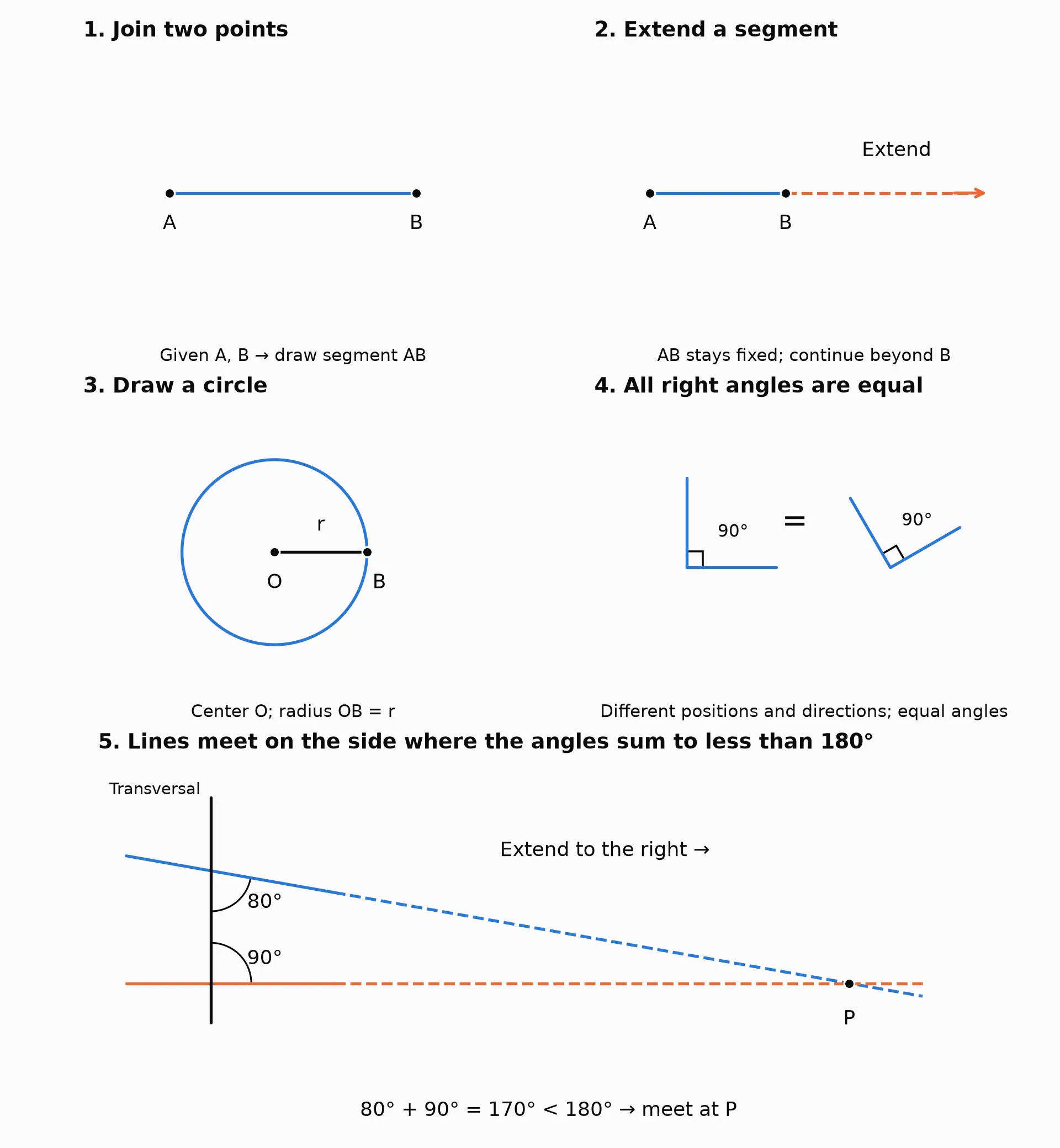
Here are the five statements, paraphrased in modern English, with explanations of their use. The first three permit constructions; the last two establish relationships between geometrical objects.[2]
Postulate 1: Join two points with a straight segment
A straight segment can be drawn from any point to any other distinct point. Mark A and B on paper, place a straightedge through them, and join them. The postulate permits segment AB without requiring us to know its length first.
In the equilateral-triangle construction, this lets us join C to A and B. Notice that the original does not explicitly say “only one” joining segment. Euclid uses that uniqueness, but the statement does not spell it out as a separate assumption.
Postulate 2: Extend a segment along the same straight line
A finite straight segment can be extended continuously in a straight line. Given AB, we may continue the line beyond B without changing direction. Think of aligning another ruler with the first to continue a drawn line.
This does not stretch AB: A and B stay where they are. We add a portion beyond the existing segment. The edge of the paper is not a boundary of the mathematical object; when an argument requires further extension, this postulate permits it.
Postulate 3: Draw a circle with a given center and radius
A circle can be drawn with any given center and radius. Place the compass point at A, open it to B, and turn: the result is a circle centered at A through B. Think of fixing one end of a string and moving the other around while keeping it taut: the distance to the center stays fixed.
The postulate authorizes the construction of the circle. The definition of a circle says that all segments from its center to its circumference equal the radius. But this postulate does not say that any two circles must intersect. That distinction will matter when we read the first construction.
Postulate 4: All right angles are equal
All right angles equal one another. A corner of a sheet of paper and a corner of a rectangular tile both open through 90°, despite their different sizes. Side length does not determine angle size.
In Euclid’s definition, when a line standing on another makes two equal adjacent angles, each is a right angle. Postulate 4 goes further: a right angle in one construction equals a right angle in another. A right angle is therefore a shared standard of comparison, independent of where it is drawn.[2]
Postulate 5: Through a point outside a line, exactly one parallel exists
The familiar classroom formulation is: In the same plane, through a point outside a straight line, there is one and only one straight line parallel to the given line. This is an equivalent formulation in the usual geometrical framework, not Euclid’s original wording.[5]
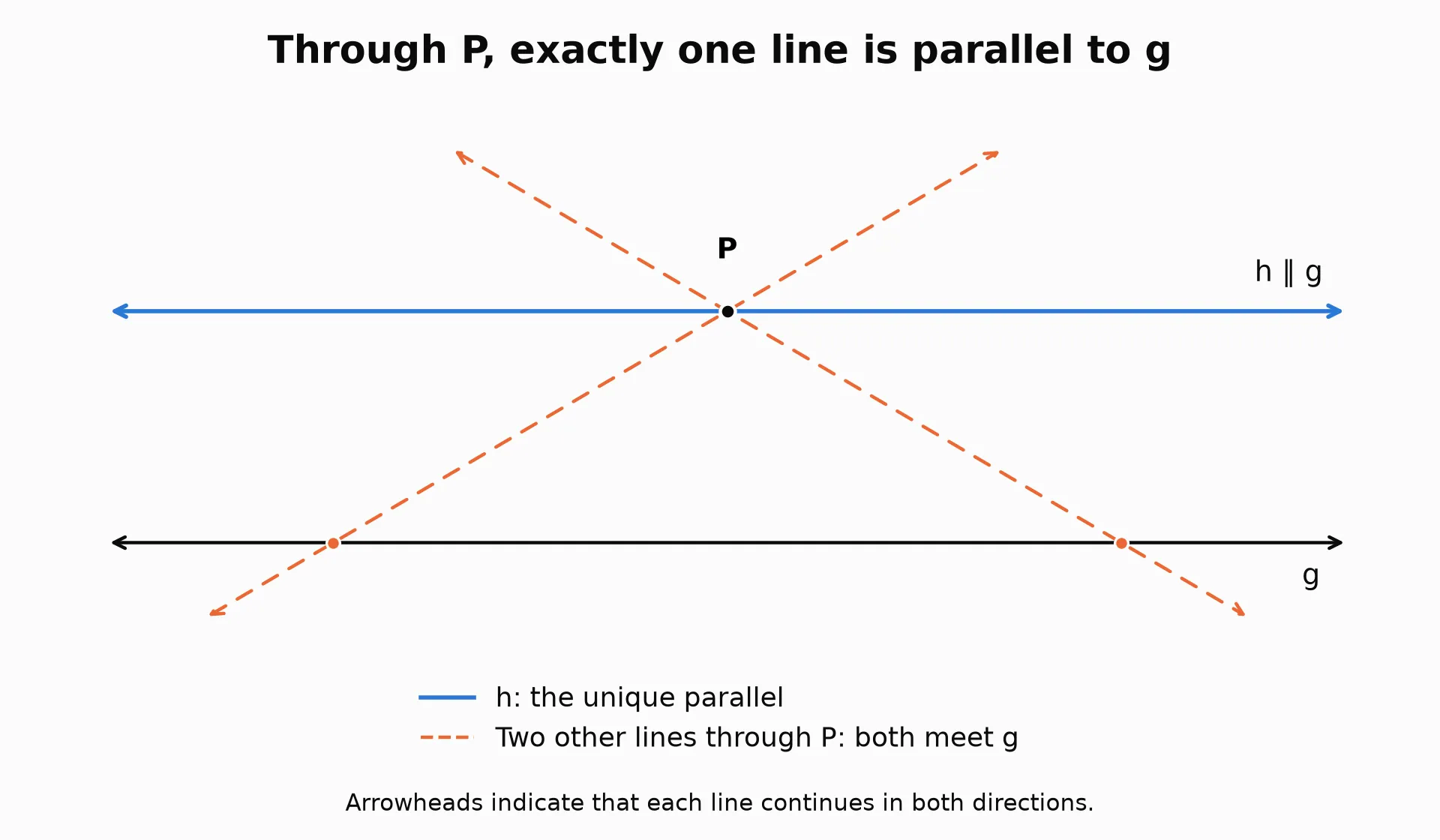
Draw a straight line on paper, then mark a point P outside it. You can draw many lines through P in different directions. The postulate says just one never meets the given line, however far both are extended in either direction. “One and only one” makes two claims: such a line exists, and there is no second one.
Euclid used an angle condition: in one plane, if a line crossing two straight lines makes the interior angles on the same side sum to less than two right angles, the two lines, when extended, meet on that side. “Interior” means in the region between the two lines. “On the same side” means both to the left or both to the right of the crossing line. Panel 5 of Figure 1 illustrates this original formulation.[5]
For example, suppose the same-side interior angles are 80° and 90°, totaling 170°. The two lines meet on that side, even if the intersection lies beyond the page. The original wording does not specify how far away they meet; the case of a 180° sum requires further reasoning.
How do the five common notions support reasoning?
These statements concern magnitudes of the same kind: lengths compared with lengths, areas with areas. We do not add a segment to an angle. They are also often called axioms, but Euclid lists them separately from the five geometrical postulates above.[2]
1. Things equal to the same thing equal one another
Things which equal the same thing also equal one another. If two pieces of string each match a reference string, they match each other. This is the step that connects “AC equals AB” and “BC equals AB” to “AC equals BC” in the coming construction.
2. Adding equals to equals gives equal totals
If equals are added to equals, the wholes are equal. Take two strings of equal length and attach a 10 cm piece to each: the new strings still have equal lengths. In geometry, this lets us compare whole segments after joining equal corresponding parts.
3. Subtracting equals from equals leaves equal remainders
If equals are subtracted from equals, the remainders are equal. Cut 20 cm from each of two 1 m fabric strips: both remainders measure 80 cm. If equal segments contain parts already known to be equal, their remaining parts are equal too.
4. Things that coincide are equal
Things which coincide with one another equal one another. Place one cardboard triangle over another so that all their vertices and sides match exactly: that supports saying they are equal. Matching just one side or looking similar is not enough. This is the traditional interpretation in terms of superposition; a modern system must also clarify which movements preserve size.
5. The whole is greater than its part
The whole is greater than a proper part of it. A 1 m wooden rod is longer than its 60 cm portion because another 40 cm remains. Here we mean finite geometrical magnitudes with a positive remainder, not an unrestricted rule about the number of elements in infinite sets.
What can two circles do that a measuring ruler cannot?
Given segment AB, Euclid asks us to construct an equilateral triangle on it. The first proposition, numbered I.1, proceeds as follows:[3]
- Draw a circle centered at A with radius AB.
- Draw a circle centered at B with radius BA.
- Choose an intersection C of the circles and join CA and CB.
On paper, place the compass point at A, open it to B, and draw a circle. Move the point to B, open to A, and draw the second circle. Join the segment’s endpoints to the upper intersection. No number needs to be read from a ruler.
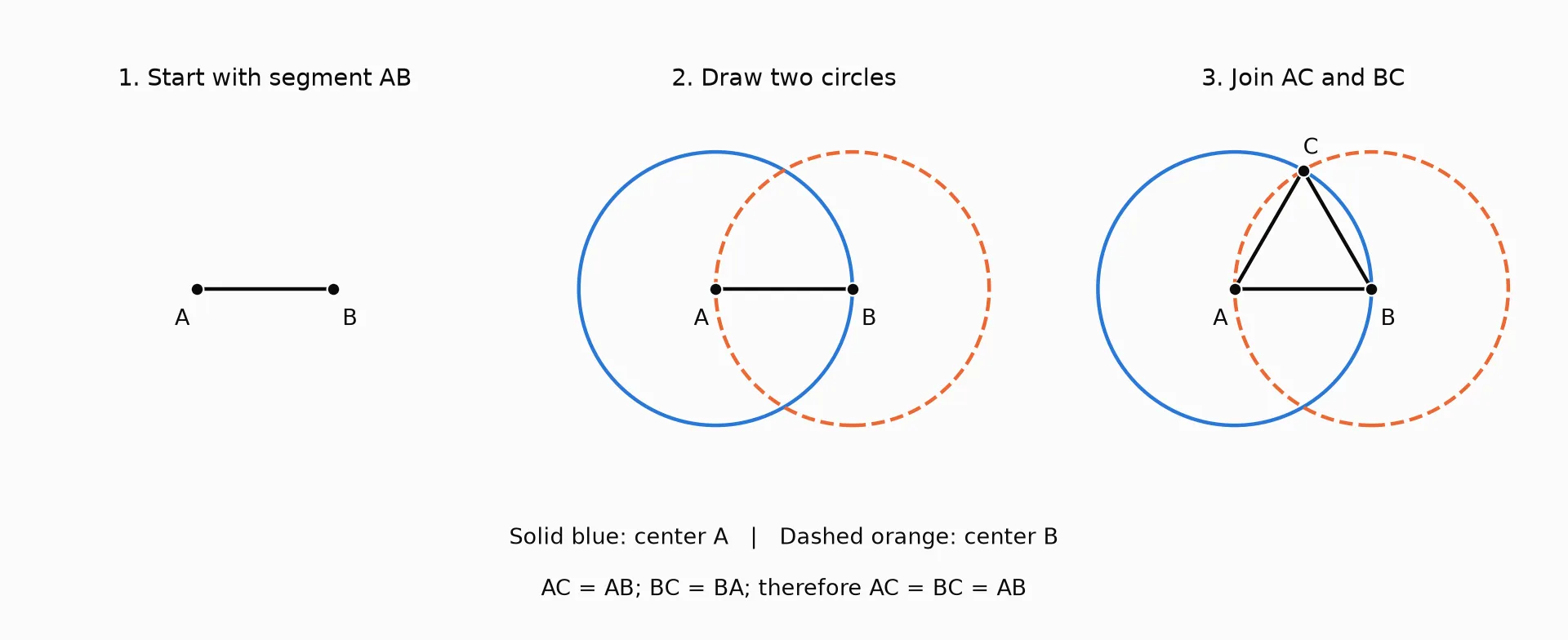
Why is the triangle equilateral? C lies on the circle centered at A, so AC equals AB. C also lies on the circle centered at B, so BC equals BA. BA is simply segment AB named in reverse order. Both AC and BC therefore equal AB, and hence equal each other.
Each step has a reason we can locate. Drawing the circles uses the third postulate. Joining points uses the first. Comparing radii uses the definition of a circle. Moving from “both equal AB” to “equal each other” uses the common notion about equality.
The triangle is not equilateral because it looks balanced. It is equilateral because of how it was constructed. A ruler gives an approximate check of a drawing. The argument applies to any nonzero segment AB satisfying the geometrical assumptions in use.
For Figure 3, I set AB to one unit. The computer reports all three sides as 1.000000 to six decimal places. That is a numerical check of one figure, not a replacement for Euclid’s proof. Changing the unit would not change the reason the sides are equal.
But what guarantees that the circles intersect?
Read the third step again: “Choose an intersection C.” The point is plainly visible in the diagram. Is its appearance enough to justify its existence?
In his commentary on the Elements, David Joyce notes that I.1 does not state enough assumptions to guarantee this intersection. Permission to draw two circles does not automatically include permission to assert that they meet. A rigorous modern system needs suitable additional assumptions about relationships, order, and continuity.[3]
Think of a map showing two routes. Crossing ink lines do not guarantee a transfer point: one route might run on a bridge. This is only an analogy for the relations a picture may leave unspecified, not a replacement model for two circles.
A hidden assumption is something used without being stated, like silently treating a listed price as tax-inclusive. Two people may perform the same correct addition yet reach a total that does not mean what each thought they were calculating.
One gap does not mean Euclidean geometry collapses. The equilateral-triangle construction can be justified in more fully specified axiom systems for the Euclidean plane. What needs repair is the list of assumptions, not the equality of the three sides once the intersection exists.
A plane keeping only points with rational coordinates
You can skip this coordinate discussion without losing the main idea. It makes concrete why “we can draw two circles” and “they have an intersection” are different requirements.
Suppose we keep only points whose coordinates are fractions of integers. These are rational coordinates, like an address system accepting only numbers expressible as fractions. This illustrates a restricted set of points; it is not a claim that the resulting example satisfies every other geometrical assumption used by Euclid.
Place A at and B at . The two unit circles have equations:
Subtracting the equations gives . Substituting back gives:
But is not rational. To check this, suppose it equals a reduced fraction . From , we infer that is divisible by 3. Write and substitute to obtain , so is also divisible by 3. This contradicts the fraction being reduced.
Neither intersection therefore belongs to the chosen set of rational-coordinate points. Yet each circle still contains points of that set: B lies on the circle centered at A, and A lies on the circle centered at B.
Drawing both circles as continuous curves on a screen represents them in the real-coordinate plane, including points we just excluded. That is why “you can see it” needs care. An illustration can carry more structure than the assumptions under discussion.
Did later mathematicians merely correct Euclid?
In 1899, David Hilbert published Grundlagen der Geometrie, placing geometry in a more formal axiomatic framework. His work made explicit relationships that intuition and diagrams had partly supplied.[4]
Formalization resembles turning a game’s spoken conventions into written rules covering each case. In geometry, this means specifying assumptions about points lying on lines, one point lying between others, equal segments, and continuity. The rules need not describe pencil marks; they need to support checking arguments.
This is more than finding faults in an older author. The habit of asking “what justifies this step?” helped later mathematicians identify what needed clarification. Standards of rigor have a history, and Hilbert’s work does not erase the Elements from that history.
The same habit appears when checking programs: what inputs are allowed, what is guaranteed before execution, and what must hold afterward? Trying a few inputs is useful, but differs from an argument covering all valid inputs. This is a similarity in organizing reasons, not a claim that modern software follows directly from Euclid’s books.
In Abel’s story about fifth-degree equations, the permitted operations determine what can be achieved. Euclid’s straightedge-and-compass setting likewise reminds us to examine the rules before judging a solution.
Must every axiom be an obvious truth?
Axioms are often introduced as statements so obviously true that they need no proof. That is memorable, but incomplete. Choosing a statement as an assumption does not make it a mandatory description of every object or of physical space.
Within a system, we ask whether conclusions follow from assumptions. When applying it to the world, we also ask whether those assumptions suit the objects and precision required. A house’s floor plan may be enough for arranging furniture, but it does not replace all information about a three-dimensional building.
Euclid states the fifth postulate at the beginning, but first uses it at Proposition I.29 in Book I’s chain of proofs. It concerns where extended lines meet, not just a local construction. Many later mathematicians tried to prove it from the remaining assumptions.[5]
In the familiar formulation introduced above, through a point outside a line, there is one and only one straight line parallel to the given line. The question lies in “only”: does that uniqueness follow from the remaining assumptions?
Independence means that an axiom does not follow from the system’s remaining assumptions. Think of a rule that genuinely adds a restriction rather than restating a consequence of earlier rules. “People tried for a long time without proving it” does not establish independence.
That question leads toward Bolyai and Lobachevsky: could an assumption thought to need one more proof actually be a choice we can change? Each person’s story deserves a separate article. Here, the important point is that Euclid’s method makes the question explicit: first state what you are assuming.
Construct Euclid’s first triangle yourself
This Python script produces Figure 3 in the article’s image directory. It needs matplotlib; run it from the eyeblogs root. There is no randomness, so no seed is needed. C’s coordinates are calculated in advance for drawing in the real-coordinate plane. The program is not a formal proof from the axioms.
from pathlib import Pathfrom math import sqrt, distimport matplotlibmatplotlib.use("Agg")import matplotlib.pyplot as pltfrom matplotlib.patches import Circle
# Run from the eyeblogs root. No randomness is used.out = Path("images/euclid-phuong-phap-tien-de")out.mkdir(parents=True, exist_ok=True)A, B, C = (0, 0), (1, 0), (0.5, sqrt(3) / 2)ink, blue, orange, surface = "#0b0b0b", "#2a78d6", "#eb6834", "#fcfcfb"plt.rcParams.update({"font.family": "DejaVu Sans", "font.size": 12})fig, axes = plt.subplots(1, 3, figsize=(12, 4.9), facecolor=surface)titles = ["1. Start with segment AB", "2. Draw two circles", "3. Join AC and BC"]for step, ax in enumerate(axes):    ax.set(aspect="equal", xlim=(-1.15, 2.15), ylim=(-1.15, 1.3))    ax.set_facecolor(surface)    ax.axis("off")    ax.set_title(titles[step], color=ink, fontsize=13, pad=14)    if step >= 1:        ax.add_patch(Circle(A, 1, fill=False, color=blue, lw=2))        ax.add_patch(Circle(B, 1, fill=False, color=orange, lw=2, ls="--"))    ax.plot([0, 1], [0, 0], color=ink, lw=2)    points = [("A", A, (-12, -20)), ("B", B, (5, -20))]    if step == 2:        ax.plot([0, C[0], 1], [0, C[1], 0], color=ink, lw=2)        points.append(("C", C, (0, 9)))    for label, point, offset in points:        ax.scatter(*point, s=50, color=ink, edgecolors=surface, zorder=5)        ax.annotate(label, point, xytext=offset, textcoords="offset points", color=ink)fig.text(0.5, 0.15, "Solid blue: center A   |   Dashed orange: center B", ha="center", color=ink)fig.text(0.5, 0.07, "AC = AB; BC = BA; therefore AC = BC = AB", ha="center", color=ink)fig.subplots_adjust(left=0.025, right=0.975, top=0.9, bottom=0.23, wspace=0.15)fig.savefig(out / "dung-tam-giac-deu-en.png", dpi=160, facecolor=surface)plt.close(fig)for name, value in [("AB", dist(A, B)), ("AC", dist(A, C)), ("BC", dist(B, C))]:    print(f"{name} = {value:.6f}")
My run produced:
AB = 1.000000AC = 1.000000BC = 1.000000The numbers agree at the displayed precision. But the reason was available before the computer was switched on: C belongs to both circles of radius AB. You can change the drawing or the unit; the reasoning remains the same.
Back to the intersection on the page
In the first construction, the compasses do more than make a balanced picture. They force segments joining the circumference to the center to have the same length. Following the reasons shows how an equilateral triangle emerges from accepted assumptions. Asking one more question reveals that C’s existence must be guaranteed, not merely seen.
Euclid’s legacy is not that every line of an ancient text meets modern formal standards. It is a way of organizing knowledge so that readers can ask for the grounds of each step. As in Euler’s seven bridges, changing how we view a picture can reveal structure the original drawing left unstated.
Mathematics needs unproved starting points within the system under consideration, not to avoid reasoning, but to begin it transparently. On Euclid’s first page, three equal sides are the answer. The continuing question is: what did we use to reach that answer?
Next in the series: János Bolyai: Is there really only one parallel?
Free geometry illustrations for students and teachers: EyeViz.
Tài liệu tham khảo
- [1]J. J. O’Connor and E. F. Robertson. Euclid of Alexandria. MacTutor History of Mathematics, University of St Andrews.
- [2]Euclid; online edition and commentary by David E. Joyce. Elements, Book I: definitions, postulates, common notions and guide. Clark University.
- [3]Euclid; online edition and commentary by David E. Joyce. Elements, Book I, Proposition 1: construction and critiques of the proof. Clark University.
- [4]J. J. O’Connor and E. F. Robertson. David Hilbert. MacTutor History of Mathematics, University of St Andrews.
- [5]Euclid; online edition and commentary by David E. Joyce. Elements, Book I, Postulate 5 and guide. Clark University.
- [6]Portrait of Euclid, André Thevet. Wikimedia Commons.