János Bolyai: Is there really only one parallel?
Through a point outside a line, is there only one parallel? Follow János Bolyai from an 1823 letter to a geometry with a different answer.
Mục lục
A letter before the work was finished
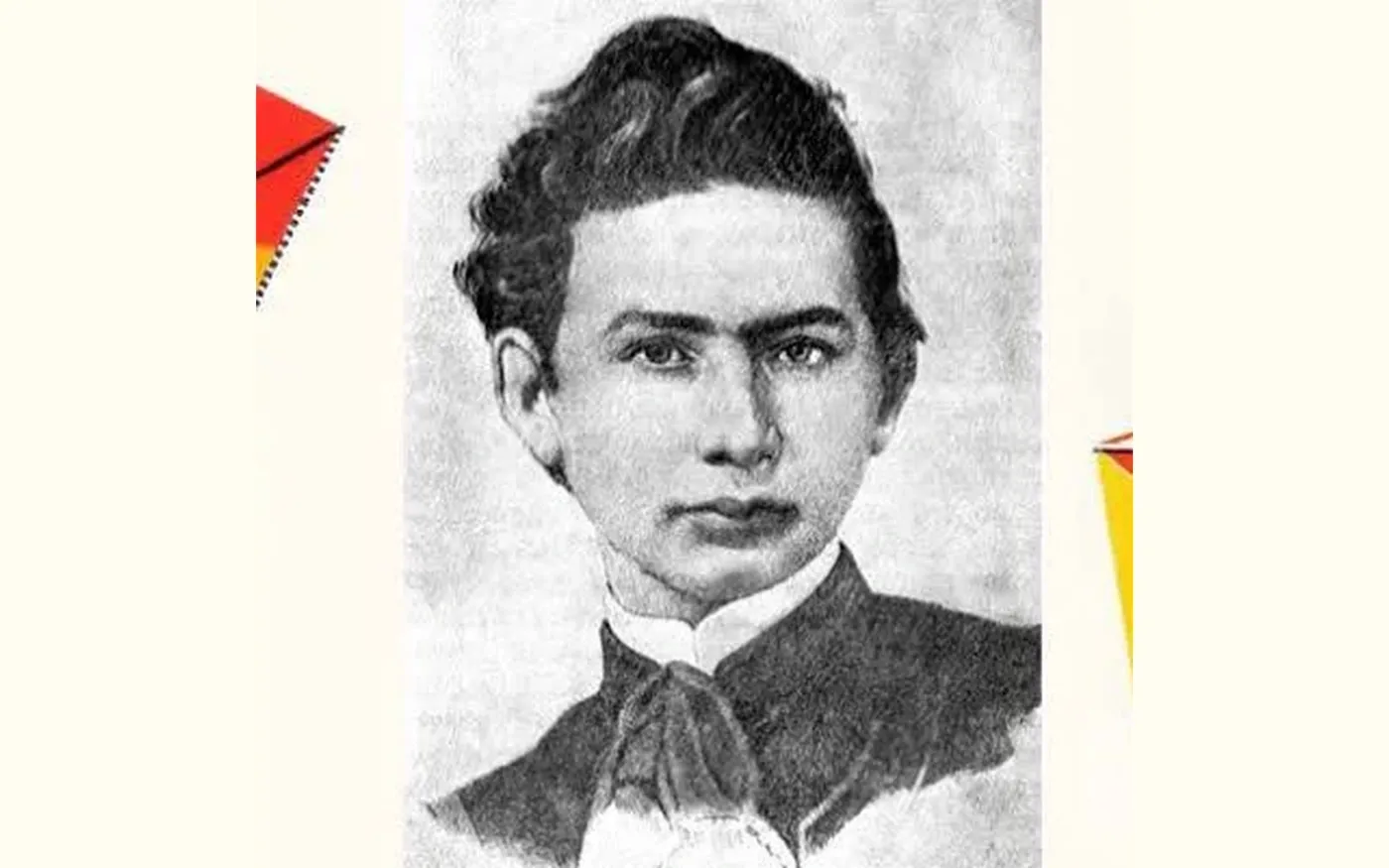
On November 3, 1823, in Temesvár, now Timișoara in Romania, an army engineering officer wrote to his father. The opening discussed the binomial expansion. Near the bottom of the page, János Bolyai turned to the problem occupying him: parallel lines. His father had warned him not to spend time on it. [1] [2]
Through a point outside a line, is there really only one parallel? In the Euclidean plane, yes. But in the geometry Bolyai studied, several lines through that point never meet the given line. Here, “parallel” has the broad meaning of coplanar and non-intersecting. What Bolyai found was not a more ingenious proof of the familiar rule, but a geometry with different assumptions. [3]
In the letter, Bolyai wrote that from nothing he had created “a new different world,” in Péter Körtesi’s English translation. But just before those words, he also said the work was unfinished. The letter records a promising direction, not an announcement that every proof was complete. [1]
To understand that “world,” we can begin with one line, one point, and a familiar classroom question: why should there be exactly one parallel?
This is part 2 of a three-part series on the parallel postulate and non-Euclidean geometry. Part 1 covers Euclid and the axiomatic method; part 3 follows Nikolai Lobachevsky and the triangle angle sum.
Why did his father want him to stop?
Farkas Bolyai had taught his son mathematics from childhood. He had also tried to prove the parallel postulate and discussed the problem with Gauss. His warning did not come from someone unfamiliar with the subject. It came from someone who had invested effort in the same problem. [2] [3]
A simple example reveals the trap. You want to show that two lines never meet. You extend them a little, then a little more. They remain apart. But “they have not met on the page” does not prove “they will not meet however far they are extended.” A finite drawing and a statement about entire lines are different things.
Another approach can quietly assume something equivalent to the conclusion. Suppose you take it for granted that a triangle can be enlarged arbitrarily while all its angles stay fixed. In Euclidean geometry this feels as ordinary as enlarging a drawing before printing. Yet the existence of similar triangles at every size is tied to the parallel postulate. Using it to prove the postulate brings the argument back to its starting point. [3]
Circular reasoning is like verifying an invoice against a copy made from that same invoice. Two sheets do not provide two independent checks. Attempts to prove the fifth postulate often concealed the extra assumption inside something that seemed obvious.
Farkas did not remain an obstacle. Once he understood the significance of his son’s work, he urged János to write it up for publication with his own book, the Tentamen. Their story is therefore not a straight path from parental opposition to failure. The person who had asked his son to stop also helped bring the work into print. [2]
Where did Bolyai change the question?
The article on Euclid and the axiomatic method explains why proof needs a starting point. A postulate is an assumption accepted within the system being studied. Think of it as a rule of a game: moves must obey the rules, while choosing the rules is a separate question.
The parallel postulate has a familiar classroom formulation: In the same plane, through a point outside a straight line, there is one and only one straight line parallel to the given line. This is equivalent to the fifth postulate in the usual geometrical framework, not Euclid’s original wording. [3]
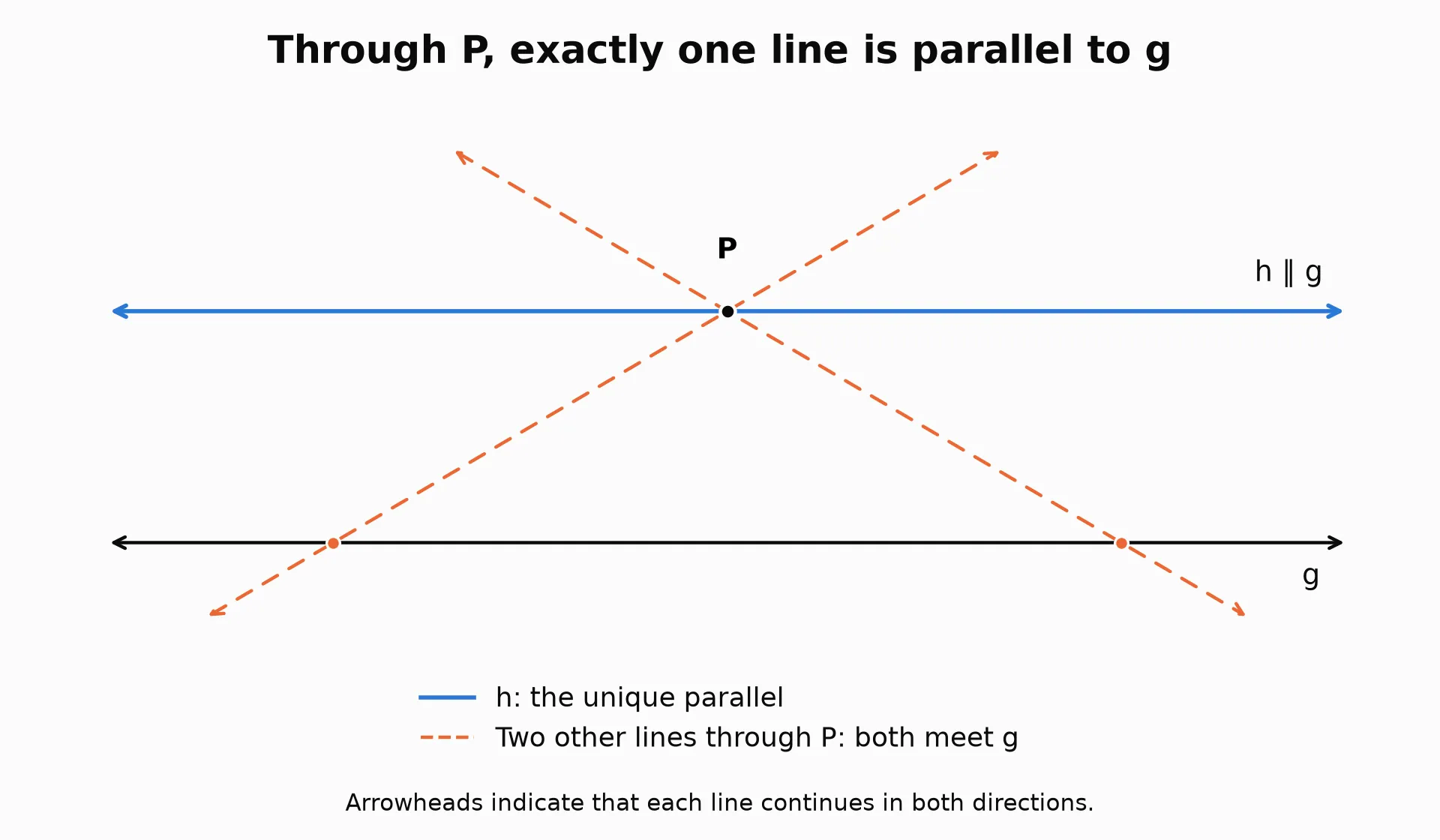
Draw a straight line on paper, then mark a point outside it. You can draw many lines through in different directions. The postulate says just one never meets , however far both are extended in either direction. “One and only one” means that such a line exists and that there is no second one.
Instead of continuing to demand a proof of “exactly one,” Bolyai investigated what happens without accepting it. In what we now call hyperbolic geometry, many lines through do not intersect . Changing the rule is like removing a constraint from a construction puzzle: the task is not to declare every arrangement acceptable, but to check which new arrangements obey the remaining rules. [2] [3]
This does not permit changing answers at will. Once the assumptions are chosen, conclusions still require proof. One cannot use the Euclidean postulate where it is convenient and discard it where it is not.
An important part of Bolyai’s work separated results that depend on the parallel postulate from those that do not. He called results independent of that choice “absolute.” Today, absolute geometry, or neutral geometry, can be understood as the shared rules before choosing the Euclidean or hyperbolic branch. Some triangle-congruence results, for example, do not depend on deciding how many parallels exist. [2]
What do several non-intersecting lines look like?
Look at the left half of the figure. The black line runs through the center. Point is above it. All three blue curves pass through , but none touches the black line inside the circle.
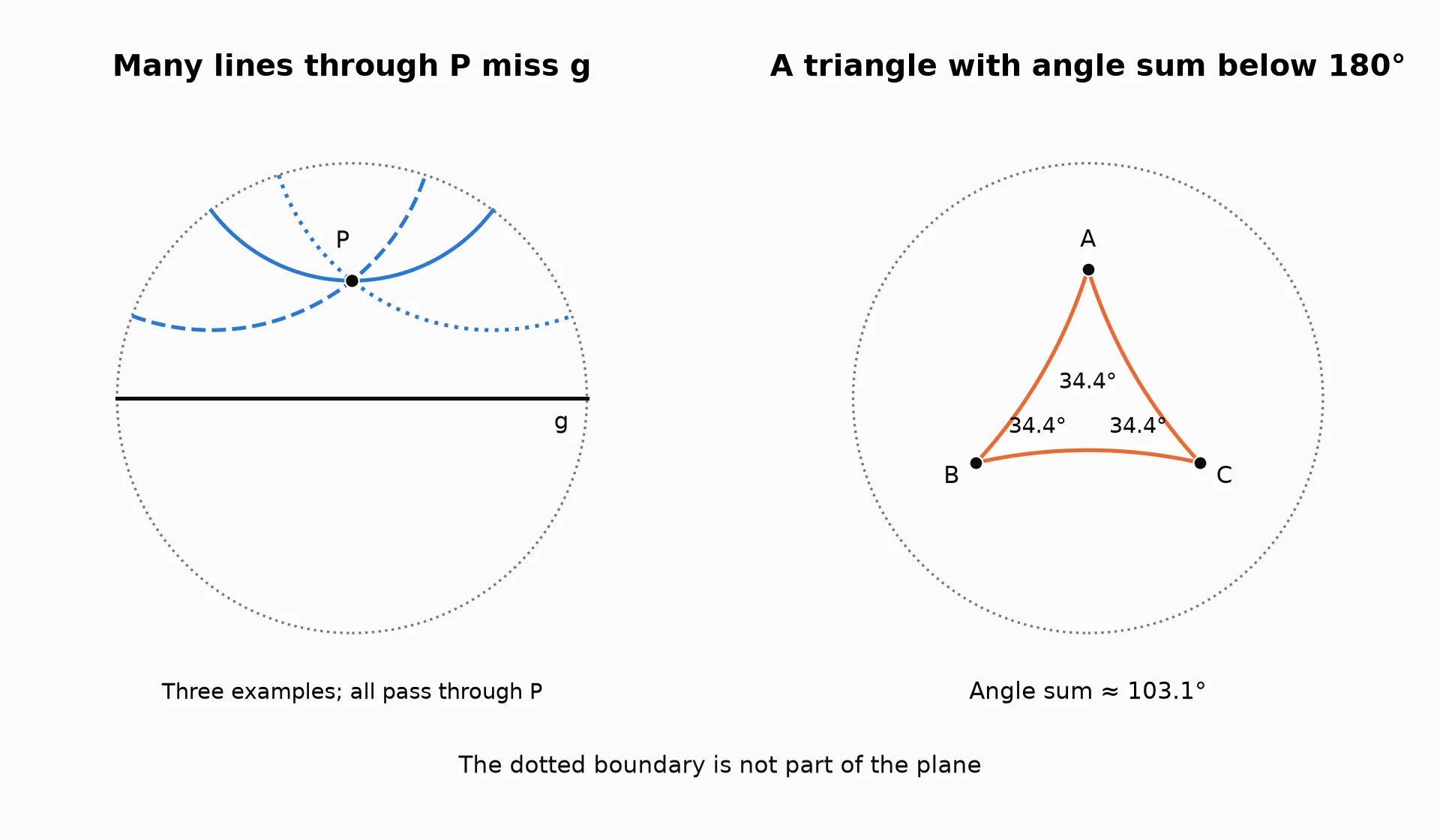
Your first reaction may be: “But they are curved!” They are, according to the Euclidean geometry of the screen. The picture uses the Poincaré disk model, a representation of the entire hyperbolic plane inside a disk. It resembles a map in one respect: the image on paper and the space it represents do not use the same measuring rules. [5]
The points of this plane lie strictly inside the disk. A “hyperbolic straight line” appears as a diameter or an arc of a circle orthogonal to the boundary circle. Orthogonal means that where those circles meet, their tangents form a 90° angle. An arbitrary curved arc will not do. [5]
All three blue lines are extended fully according to this rule. Their portions inside the disk remain above . They have not merely failed to meet because we drew too little of them. The structure of the arcs shows that they never intersect anywhere in the model’s domain.
What about the boundary? It does not belong to the hyperbolic plane. A point just inside it belongs to the plane; a point on it does not. Measuring the remaining distance with a Euclidean ruler and concluding that the plane runs out of room would use the wrong ruler.
As on a map that compresses distances, a short-looking segment near the boundary can represent a long hyperbolic journey. The boundary is not a wall that a traveler in this plane can reach and touch. An infinite space is being represented by a finite picture. [5]
Why do triangles no longer add up to 180°?
In the right half of Figure 2, each side is a segment of a valid hyperbolic line. Replacing the sides with straight chords on the screen would produce a different, Euclidean triangle. Measuring that chord triangle and assigning its angles to the original would change the object halfway through.
The disk model has a useful property: it preserves angles. The angle between two hyperbolic lines equals the angle between the tangents to their arcs at the intersection. Think of roads meeting at a junction: the immediate direction of travel determines the turning angle, not a straight line connecting distant destinations on a map. [5]
For the three vertices chosen here, the program calculates approximately 34.361° at each corner. The sum is 103.082°, below 180°. These are the results of a coordinate example I constructed and ran, not measurements Bolyai made with an instrument.
The triangle still has three vertices, three sides, and three angles. What changes is the angle-sum theorem, because the assumptions have changed. Every nondegenerate hyperbolic triangle whose vertices lie inside the plane has an angle sum below 180°. [6]
The missing amount is called the angular defect. If 180° is an expected budget, our triangle contains only about 103.1°, leaving a shortfall of about 76.9°. That is not an error caused by imprecise drawing. In this geometry, the defect is directly related to area. [6]
Enlargement changes too. A Euclidean triangle can be enlarged while preserving all three angles. In a hyperbolic plane of fixed curvature, the angles determine the area. Keeping them fixed does not allow arbitrary scaling. What initially looked like an innocent printing operation is a mathematical property with real content. [3] [6]
What came back from Gauss?
Bolyai developed his work during his years as an army engineer. He did not begin with the disk model shown here. That is a modern explanatory tool, not something we should place retrospectively on his desk in 1823. [2] [5]
His work appeared in what is usually called the Appendix, associated with Farkas Bolyai’s Tentamen. The book bears the date 1832, while separate copies of the Appendix already existed in 1831. These dates describe different publication stages; choosing one does not make the other wrong. [2] [4]
Farkas sent a copy to Gauss in June 1831, but it did not arrive. Gauss received a replacement early the following year and replied on March 6, 1832. He wrote that praising the work would almost mean praising himself, because its content coincided with thoughts he had pursued for years. [4]
Keep only that sentence and a neat story emerges: a young researcher publishes, and an established authority claims the credit. But the letter also says Gauss was pleased that his old friend’s son had preceded him. Correspondence shows that Gauss really had investigated non-Euclidean geometry; he did not simply claim prior knowledge after reading Bolyai. [2] [4]
Bolyai’s problem remained: the work had been sent for evaluation, but the reply did not bring the public recognition he hoped for. His biography records the response as a severe blow. Yet concluding that Gauss stole the work or deliberately organized its suppression goes beyond the evidence. [2]
In the same period, Nikolai Lobachevsky independently published work on the new geometry, including a publication in 1829. Bolyai was therefore not its sole founder. This story recognizes his independent contribution; Lobachevsky’s path deserves a separate account. [2] [3]
Is failing to find a contradiction enough?
We need to distinguish Bolyai’s achievement from how later mathematics came to understand it. Producing many compatible theorems does not automatically prove that no contradiction will ever appear. A spreadsheet may process many rows without an error, but that alone does not establish that every formula is safe for every input.
A contradiction means deriving both a statement and its negation from the same assumptions. A system might require two objects to be equal and also require those very objects not to be equal. Such a system can no longer distinguish valid conclusions.
An additional nineteenth-century step was the construction of models, including Beltrami’s work in 1868 and subsequent representations. If hyperbolic points, lines, and measurements can be interpreted using objects in familiar mathematics, a contradiction in the new system would imply a contradiction in the mathematics used to build the model. [3]
This is relative consistency, like an adapter with a conditional guarantee: if the underlying system is consistent, the interpreted system is too. It is not a claim that every mathematical foundation has been proved absolutely free of errors.
Models also answer the question about the parallel postulate. If the background assumptions hold in a model where “exactly one line” fails, that statement cannot follow from those assumptions alone. The failed proof attempts were not merely awaiting a cleverer trick. The requested conclusion does not follow from the permitted starting points. [3]
This is more accurate than saying “Bolyai proved Euclid wrong.” Euclid developed geometry from his assumptions. Bolyai opened another possibility; later models clarified the logical relationship between the choices.
Which geometry describes our world?
A valid hyperbolic plane does not force your kitchen table to obey its rules. A mathematical model and a physical description answer different questions: is a system of rules consistent, and does it agree with measurement? A subway map can accurately show which stations connect without accurately showing walking distances.
The triangle in this article is therefore not evidence that every triangle drawn with a ruler in your notebook must total less than 180°. It was constructed under the rules of a hyperbolic model, not measured on a sheet of paper.
Nor should a sphere be substituted without explanation. Triangles formed by great-circle arcs on a sphere have angle sums above 180°, a different kind of geometry. They help illustrate that geometry can change, but they are not the hyperbolic geometry of this story. [3]
A useful habit today is to separate assumptions from conclusions. When a result looks wrong, ask under which rules it is wrong. Euler’s seven bridges also begins with a separation: keep the relationships relevant to the problem and discard shapes that do not decide the answer. With Bolyai, the object of scrutiny is a rule that seemed impossible to change.
The story of Abel and the late letter points to another gap: obtaining a result does not immediately bring readers or recognition. Those gaps belong to the lives of mathematicians, but they do not replace the need to check proofs.
Draw a triangle below 180° yourself
The Python script below produces Figure 2. The triangle’s vertices are evenly spaced on a Euclidean circle of radius 0.55 centered in the unit disk. These coordinates are an illustrative choice. Angles are calculated from the tangents to the two arcs at each vertex, not measured from the exported image.
You need numpy and matplotlib. Replace 0.55 with another positive number below 1 to explore another example. This script constructs a modern model; it does not reconstruct Bolyai’s historical proof method.
from pathlib import Pathimport numpy as npimport matplotlibmatplotlib.use('Agg')import matplotlib.pyplot as pltfrom matplotlib.patches import Circle
OUT = Path('images/bolyai-the-gioi-moi')OUT.mkdir(parents=True, exist_ok=True)BLUE, ORANGE, INK, BG = '#2a78d6', '#eb6834', '#0b0b0b', '#fcfcfb'plt.rcParams.update({'font.family': 'DejaVu Sans', 'font.size': 14})
# A circle orthogonal to the boundary has |c|² = R² + 1.def center(p, q):    return np.linalg.solve(2*np.array([p, q]),                           [1+np.dot(p, p), 1+np.dot(q, q)])
def side(p, q):    c = center(p, q)    a, b = np.arctan2(*(p-c)[::-1]), np.arctan2(*(q-c)[::-1])    d = (b-a+np.pi) % (2*np.pi)-np.pi    t = np.linspace(a, a+d, 300)    return c + np.linalg.norm(p-c)*np.c_[np.cos(t), np.sin(t)]
def tangent(p, q):    r = p-center(p, q)    v = np.array([-r[1], r[0]])    return v*np.sign(np.dot(v, q-p))/np.linalg.norm(v)
v = .55*np.c_[np.cos(np.deg2rad([90, 210, 330])),               np.sin(np.deg2rad([90, 210, 330]))]angles = []for i in range(3):    a, b = tangent(v[i], v[(i+1)%3]), tangent(v[i], v[(i+2)%3])    angles.append(np.degrees(np.arccos(np.clip(np.dot(a, b), -1, 1))))print('Angles:', ', '.join(f'{x:.3f}' for x in angles))print(f'Sum: {sum(angles):.3f} degrees')assert sum(angles) < 180
lang = 'en'vi = lang == 'vi'fig, axes = plt.subplots(1, 2, figsize=(12, 7), facecolor=BG)for ax in axes:    ax.set(aspect='equal', xlim=(-1.13, 1.13), ylim=(-1.13, 1.23))    ax.axis('off')    ax.add_patch(Circle((0, 0), 1, fill=False, ec='#777777', lw=1.5, ls=':'))ax = axes[0]ax.set_title('Nhiều đường qua P không cắt g' if vi else 'Many lines through P miss g',             fontsize=18, weight='bold', pad=20)ax.plot([-1, 1], [0, 0], color=INK, lw=2.3, label='g')ax.text(.86, -.13, 'g', color=INK)t = np.linspace(0, 2*np.pi, 4000)for cx, style in [(-.6, '--'), (0, '-'), (.6, ':')]:    c = np.array([cx, 1.25])    radius = np.sqrt(np.dot(c, c)-1)    pts = c + radius*np.c_[np.cos(t), np.sin(t)]    pts[np.linalg.norm(pts, axis=1) >= 1] = np.nan    assert c[1]-radius > 0    ax.plot(*pts.T, color=BLUE, ls=style, lw=2.3)ax.scatter(0, .5, color=INK, s=70, edgecolors=BG, zorder=5)ax.text(-.07, .64, 'P', color=INK)ax.text(0, -1.28, 'Ba đường mẫu; tất cả đều đi qua P' if vi        else 'Three examples; all pass through P', ha='center', fontsize=13)ax = axes[1]ax.set_title('Tam giác có tổng góc nhỏ hơn 180°' if vi else 'A triangle with angle sum below 180°',             fontsize=18, weight='bold', pad=20)for i in range(3):    pts = side(v[i], v[(i+1)%3])    ax.plot(*pts.T, color=ORANGE, lw=2.3)    ax.scatter(*v[i], color=INK, s=65, edgecolors=BG, zorder=5)    label = v[i]*1.22    ax.text(*label, 'ABC'[i], ha='center', va='center', color=INK)    a = v[i]*(.12 if i == 0 else .45)    ax.text(*a, f'{angles[i]:.1f}°', ha='center', va='center', color=INK, fontsize=13)ax.text(0, -1.28, ('Tổng góc' if vi else 'Angle sum')+f' ≈ {sum(angles):.1f}°',        ha='center', fontsize=14)fig.text(.5, .08, 'Vòng biên nét chấm không thuộc mặt phẳng' if vi         else 'The dotted boundary is not part of the plane', ha='center', color=INK)fig.subplots_adjust(left=.04, right=.96, top=.87, bottom=.21, wspace=.25)suffix = '' if vi else '-en'fig.savefig(OUT/f'dia-poincare{suffix}.png', dpi=160, facecolor=BG)plt.close(fig)
Output for the chosen radius:
Angles: 34.361, 34.361, 34.361Sum: 103.082 degreesEach angle rounds to 34.4°, but the sum is calculated before rounding, giving about 103.1°, not the sum of the rounded labels. The program also checks that the three blue lines remain strictly above in the disk.
Back to the final lines of the letter
The 1823 letter contains more than the phrase about a “new world.” Most of it is still a mathematical exchange between a son and a father: a proof concerning the binomial expansion, questions to discuss, a work to write once its contents are organized. The frequently quoted sentence sits amid unfinished work. [1]
Bolyai did not discover a stroke of the pen that made every earlier solution meaningless. He changed the question: without requiring one postulate to hold, how far can rigorous reasoning go? Non-intersecting lines and triangles below 180° provide concrete answers, not just a slogan about thinking differently.
The father who had warned him away from the problem later helped print the work. The “new world” entered mathematics through more than a sentence in a letter. It needed pages of proof, copies sent to readers, and models that later mathematicians continued to build. [2] [3]
Previous in the series: Euclid and the axiomatic method. Next: Nikolai Lobachevsky and non-Euclidean geometry: Do triangle angles always add up to 180°?
Free geometry illustrations for students and teachers: EyeViz.
Tài liệu tham khảo
- [1]János Bolyai; transcribed and translated by Péter Körtesi. Temesvár letter from János to Farkas Bolyai. MacTutor, University of St Andrews, 1823.
- [2]J. J. O’Connor and E. F. Robertson. János Bolyai. MacTutor, University of St Andrews, 2004.
- [3]J. J. O’Connor and E. F. Robertson. Non-Euclidean geometry. MacTutor, University of St Andrews.
- [4]György Alexits. The Life and Work of János Bolyai. Translation hosted by MacTutor, University of St Andrews, 1953.
- [5]Eric W. Weisstein. Poincaré Hyperbolic Disk. Wolfram MathWorld.
- [6]Eric W. Weisstein. Hyperbolic Triangle. Wolfram MathWorld.