Prisoner's Dilemma: Why Both Reason Well and Still Lose
The prisoner's dilemma shows how self-interest can defeat cooperation. From discount wars to long partnerships, learn the model and its limits for investors.
Mục lục
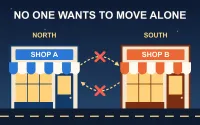
Two coffee shops across the street from each other are both thinking about running a discount. Whichever shop cuts prices alone pulls customers from the other. But if both cut, few new customers appear, and each shop earns less on every cup. You hold the stock of a chain in this business, and you are reading a plan to “grow market share through promotions”.
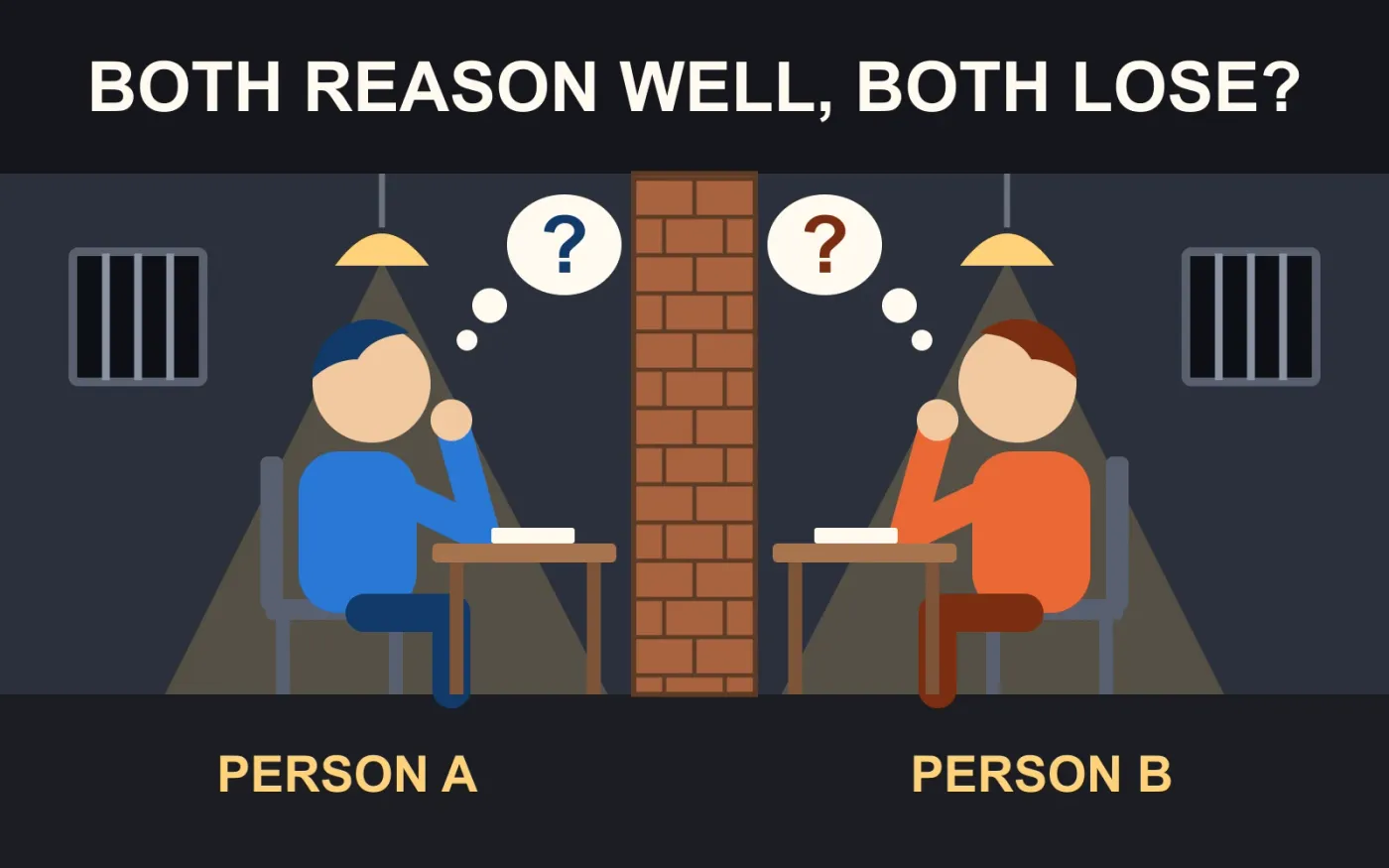
The prisoner’s dilemma is a situation where each side gains by not cooperating, whatever the other side does, yet both end up worse off when both do so than when both cooperate. Nobody has to miscalculate for the shared loss to happen. The difficulty lies in the structure of the payoffs: one side changing alone does not solve the problem for both.
What is the prisoner’s dilemma, without the prison story?
The name comes from a story about two people questioned separately, each choosing whether to cooperate with the other. But the story is not a condition of the problem. Two coffee shops, two neighbors cleaning a shared yard or two sides of a transaction can all illustrate the same structure.
According to the Stanford Encyclopedia of Philosophy, Merrill Flood and Melvin Dresher studied a game with this structure in early 1950. Albert Tucker later used the prisoner story to explain it to an audience.[1] We do not need that setting to do the calculation.
Let’s use the two coffee shops, with one note: this is a model of one round of competition, not a description of every promotion. The shops choose at the same time, without seeing each other’s choice. Each has two actions: hold the price or discount. For now we ignore changes in quality, differences in cost and new customers.
| A chooses / B chooses | Hold price | Discount |
|---|---|---|
| Hold price | 3; 3 | 0; 5 |
| Discount | 5; 0 | 1; 1 |
These are illustrative payoff points, not the profit of a real shop and not investment returns. The first number belongs to A, the second to B. A score of 0 is just the bottom of this scale. It does not mean a company loses all its revenue.
If both hold, each gets 3. If one discounts while the other holds, the discounter gets 5 and the holder gets 0. If both discount, each gets only 1. The table spells out everything we assume before drawing any conclusion.
Why is discounting the privately better choice?
Put yourself in A’s position. If B holds, A gets 5 by discounting instead of 3. If B discounts, A gets 1 by discounting instead of 0. In both cases, discounting is better for A.
We call this a strictly dominant strategy: a choice that is always better than the alternative, whatever the opponent does. Imagine a commute table in which bus route 1 beats route 2 in rain or sunshine. You do not need a weather forecast to pick route 1 from that table.
B faces the same calculation. Both discount and both get 1. From this cell, if one shop goes back to holding its price alone, its score falls from 1 to 0. Nobody gains by changing alone. This is the only Nash equilibrium of this one-round game, even if random choices between the two actions are allowed.[1]
Yet if both hold, each gets 3, which is more than 1. So why not do the better thing together? Because if one side trusts the other to hold, it gains by discounting alone and taking 5. A good shared result cannot protect itself against the private motive to switch.
This is not proof that the players lack intelligence or ethics. We have not assigned anyone a personality. The table alone shows that a privately sensible choice can lead to a result both sides would rather avoid.
“Both lose” for whom?
In the discount example, “both lose” describes the two shops compared with both holding their prices. Customers may get cheaper coffee. People outside the table do not automatically share the conclusion of the people inside it.
So the lesson should not become “companies must hold prices together so everyone wins”. Agreements that restrict competition raise legal questions. The Nobel source on game theory also notes that contracts restricting trade can be illegal.[2] This article analyzes motives. It does not teach companies to coordinate on prices.
A promotion can also create real demand, clear inventory or lower the cost per unit. Then the cell where both discount is not necessarily worse than the cell where both hold. If the order of the payoffs changes, it may no longer be a prisoner’s dilemma.
For an investor, the point to check is where the growth comes from. Is revenue rising because the company sells more, or because it spends more to pull customers from rivals? After rivals respond, how much margin is left? The game helps organize these questions. It does not replace reading the numbers.
Not every conflict is a prisoner’s dilemma
Two people paying to repair a shared alley may face a similar problem. Each wants a good alley but would like the other person to pay. Still, you have to know the specific benefits and costs before calling it a true prisoner’s dilemma.
For example, if one person only wants to contribute when they believe the other will too, that is a different problem, one of coordination. It is like two people carrying a table: lifting one end alone achieves nothing, but lifting together does. “What should I do?” depends on your belief about the other person, rather than on one action that is always better.
Shareholders who rarely monitor a company are another case to separate out. A shareholder who spends effort reading reports, asking questions and pushing for change can create benefits for those who spent no effort. That is the free-rider problem, like enjoying a clean shared yard without ever sweeping it. It is not automatically a two-player game with exactly the four cells above.
Nor can you call every sell-off a prisoner’s dilemma. Who needs cash now, who faces a margin call, who has different information and who simply changed their valuation? Until you know the options and the payoffs, you have a label, not a tested model.
Why can people who know each other cooperate for years?
Change the setting to a relationship where cooperation can create value: a small workshop ordering materials from a regular supplier. The two sides deal with each other many times. Goods of the right quality and payment on time bring repeated benefits. Exploiting a loophole once may pay off immediately, but it can lose future orders.
In this example, “cooperate” means carrying out a beneficial, lawful business relationship. It does not mean rivals negotiating to hold prices. We keep using the 5, 3, 1, 0 scale to make the calculation easy to follow, without claiming every contract has these payoffs.
A repeated game is one where the same players meet over many rounds. A strategy is then more than today’s action. It is a rule of behavior based on what has happened. Think of a corner grocery that lets a regular customer buy on credit because of their payment history, rather than deciding as if each visit came from a stranger.
The Stanford entry sets out the difference between games with a fixed number of rounds and games where the end is unknown.[1] While a relationship can continue, future benefits change the price of an action taken today.
A harsh rule that keeps the math clear
Consider this rule: start by cooperating, and continue as long as both keep cooperating; after one failure to cooperate, never cooperate again from the next round. This rule is often called grim trigger. It resembles a clause that permanently removes your credit at the shop after one violation, except that the model ignores any chance to explain or put things right.
We use it because it is easy to calculate, not as advice for real life. A delivery delayed by rain could be read as a deliberate broken promise. Without a chance to check, correct and rebuild trust, a harsh rule can destroy a valuable relationship.
The condition for cooperation to survive is this: the extra gain from exploiting the other side today must not exceed the future gains you would lose. The saying that a long road shows you which horse is good can be turned into a calculation. But first we must say how the future is valued.
How much does the future have to be worth?
Let be the discount factor, between 0 and just under 1. One point next round is worth points today. It is like treating a coffee voucher you receive next week as worth only 80% of one you can use now, because you have to wait and might not come back to that shop. Converting future value into today’s value is also how Asset valuation techniques computes the present value of a cash flow.
In a model where the end is unknown, can also be read as the probability that the relationship continues one more round, if we leave aside any further discounting for time. If there is both a risk of ending and a loss of value over time, the two factors must be combined rather than treated as one.[1]
Under the harsh rule above, cooperating forever brings 3 points each round. The value today of that stream is:
If you stop cooperating today while your partner still cooperates, you get 5 points now. From the next round, neither side cooperates, so you get only 1 each round:
Cooperating is no worse when . Multiplying both sides by gives , or . At the threshold the two choices are equal; above it, keeping the cooperation beats the one-time exploitation under consideration.
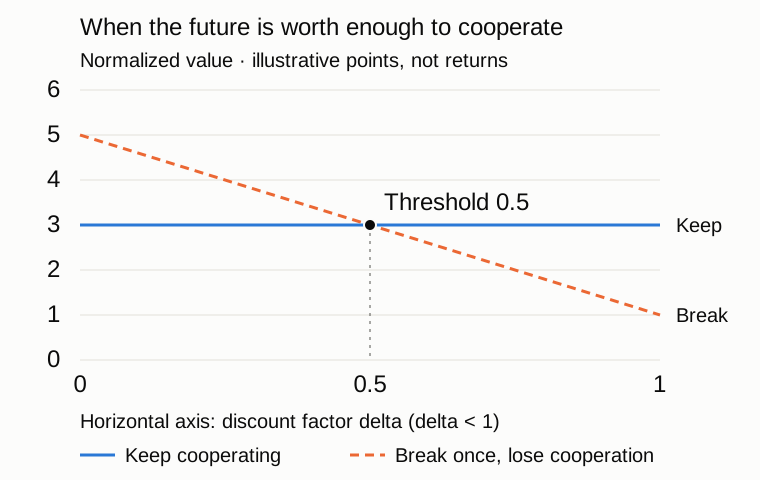
| Cooperate: | Exploit once: | |
|---|---|---|
| 0 | 3 | 5 |
| 0.25 | 3 | 4 |
| 0.5 | 3 | 3 |
| 0.75 | 3 | 2 |
With , the total unscaled value is 4 for cooperating and about 5.33 for exploiting. With , the two values are 12 and 8. These numbers are calculated from the model, not measured from any company.
0.5 is not a universal threshold of trust
Let be the payoff for not cooperating alone, for cooperating together, for both not cooperating, and for cooperating alone. The four letters are just labels for the four cells. A strict symmetric prisoner’s dilemma has the order .[1]
Repeating the calculation for the same rule, the condition is:
In the example, . If the gain from exploiting rises from 5 to 9 with the other payoffs unchanged, the threshold rises to . The more tempting the short-term chance, the more weight the future needs to keep cooperation going.
This is a condition for one rule in a model with accurate observation, stable payoffs and no known final round. It does not prove that people will cooperate whenever is large. Mutual non-cooperation can still be sustained, and many other outcomes can appear too.
Does meeting repeatedly guarantee cooperation?
Not quite. If both sides know for certain they will play exactly ten rounds, round ten has no future left to bind anyone. In the standard model, with known payoffs and commonly known assumptions about rationality, both refuse to cooperate in the last round. Knowing that, they have no reason to cooperate in round nine, and the reasoning runs all the way back to round one.[1]
This is backward induction, like planning a trip by counting back from the train’s departure time to when you must leave home. But applied to people, the conclusion rests on strong assumptions: everyone understands the game, trusts that the other understands it, and keeps knowing this at every level of reasoning.
In real life, people may be unsure of a partner’s character, care about fairness or have a reputation in other relationships. A theoretical result does not license you to call someone who cooperates in the last round “irrational”. The model may have left out something they count as a benefit.
Another well-known rule is tit for tat: cooperate in the first round, then copy your partner’s action from the round before. It is like continuing to give a regular customer credit if they paid on time last time. It is easy to understand, but one mistake can set off a chain of retaliation.
Robert Axelrod’s simulation tournaments made this rule widely known. The Stanford entry also covers later results and how much depends on the environment of opponents.[1] None of this justifies saying that one rule wins every game, or turning it directly into a stock trading strategy.
Investors should watch incentives, not just promises
A supplier that wants to keep a customer for many years has a reason to protect quality. But if it is about to leave the market, is short of cash or can no longer provide the service, the value of future orders may change. You should not simply count how many years two sides have worked together and infer that cooperation will certainly continue.
Likewise, when reading the report of a retail chain, separate revenue that creates value from revenue bought with subsidies. If an advantage lasts only until rivals respond, growth may come with pressure on profit. Check cash flow, the cost of winning customers and how well they are retained after the program, rather than just counting purchases.
You cannot infer the points from a stock price chart. Prices reflect many pieces of information and expectations, while a game table needs to know the results if actions had been different, including things that never happened. That is why this article uses assumed points instead of building a table that looks like empirical data.
Good business results do not prove that a cooperative relationship has become durable either. One favorable period can include some luck, as the article on regression to the mean (article in Vietnamese) explains. And looking only at partners that still exist can miss relationships that broke down, which is one case of survivorship bias (article in Vietnamese).
Plot the price of one exploitation yourself
The Python below uses only the standard library and creates exactly Figure 1. Run it from the root of eyeblogs/. This is a deterministic calculation, with no random numbers and no seed needed.
The two lines use values already multiplied by . This changes the shared scale at each point, not the model. The table above keeps the specific values so you can read the result without telling colors apart.
from pathlib import Path
T, R, P, S = 5, 3, 1, 0assert T > R > P > Sthreshold = (T - R) / (T - P)x = lambda delta: 80 + 580 * deltay = lambda value: 360 - 45 * valuesvg = [ '<svg xmlns="http://www.w3.org/2000/svg" width="760" height="480" viewBox="0 0 760 480">', '<rect width="760" height="480" fill="#fcfcfb"/>', '<g font-family="Arial, sans-serif" font-size="24" fill="#0b0b0b">', '<text x="80" y="35">When the future is worth enough to cooperate</text>', '<text x="80" y="67" font-size="20">Normalized value · illustrative points, not returns</text>',]for value in range(7): svg += [f'<path d="M80 {y(value)} H660" stroke="#e1e0d9"/>', f'<text x="60" y="{y(value)+7}" text-anchor="end">{value}</text>']for delta, label in [(0, "0"), (0.5, "0.5"), (1, "1")]: svg.append(f'<text x="{x(delta)}" y="392" text-anchor="middle">{label}</text>')svg += [ f'<path d="M80 {y(R)} H660" stroke="#2a78d6" stroke-width="3"/>', f'<path d="M80 {y(T)} L660 {y(P)}" stroke="#eb6834" stroke-width="3" stroke-dasharray="9 6"/>', f'<path d="M{x(threshold)} {y(R)} V360" stroke="#52514e" stroke-dasharray="3 5"/>', f'<circle cx="{x(threshold)}" cy="{y(R)}" r="6" fill="#0b0b0b" stroke="#fcfcfb" stroke-width="2"/>', f'<text x="{x(threshold)+14}" y="{y(R)-15}">Threshold 0.5</text>', '<text x="676" y="232" font-size="20">Keep</text>', '<text x="676" y="322" font-size="20">Break</text>', '<text x="80" y="428" font-size="20">Horizontal axis: discount factor delta (delta < 1)</text>', '<path d="M80 455 H115" stroke="#2a78d6" stroke-width="3"/>', '<text x="125" y="462" font-size="20">Keep cooperating</text>', '<path d="M350 455 H385" stroke="#eb6834" stroke-width="3" stroke-dasharray="9 6"/>', '<text x="395" y="462" font-size="20">Break once, lose cooperation</text></g></svg>',]out = Path("images/song-de-tu-nhan/gia-tri-tuong-lai-en.svg")out.parent.mkdir(parents=True, exist_ok=True)out.write_text("\n".join(svg), encoding="utf-8")print(f"Threshold delta = {threshold:.2f}; figure: {out}")The result is Threshold delta = 0.50. You can change the payoffs and compute a new threshold, but you also need to update the labels, axis limits and captions in the figure to match the new numbers. The point at 1 on the axis is the limit of the normalized line as approaches 1, not an infinite sum calculated at .
Back to the two coffee shops
One shop sees a chance to pull in more customers with a promotion. The other sees the same chance. Read separately, both plans seem reasonable. Set side by side, they show that profit can be lost once both react.
The prisoner’s dilemma does not tell us to always cooperate, nor to always grab first. It makes us look at all four outcomes, separate the people in the table from those outside it, and ask what changes the incentives. In investing, seeing clearly how companies respond to each other is often more useful than a promise of growth standing alone.
Free geometry illustrations for students and teachers: EyeViz.
Tài liệu tham khảo
- [1]Prisoner’s Dilemma. Stanford Encyclopedia of Philosophy.
- [2]The Sveriges Riksbank Prize in Economic Sciences in Memory of Alfred Nobel 1994: Press release. NobelPrize.org, Royal Swedish Academy of Sciences, 1994.